The Orchestra of Spring
“The orderly manner in which the universe is run shows that it is guided by some form of intelligence that permeates all created things.”
Paramahansa Yogananda
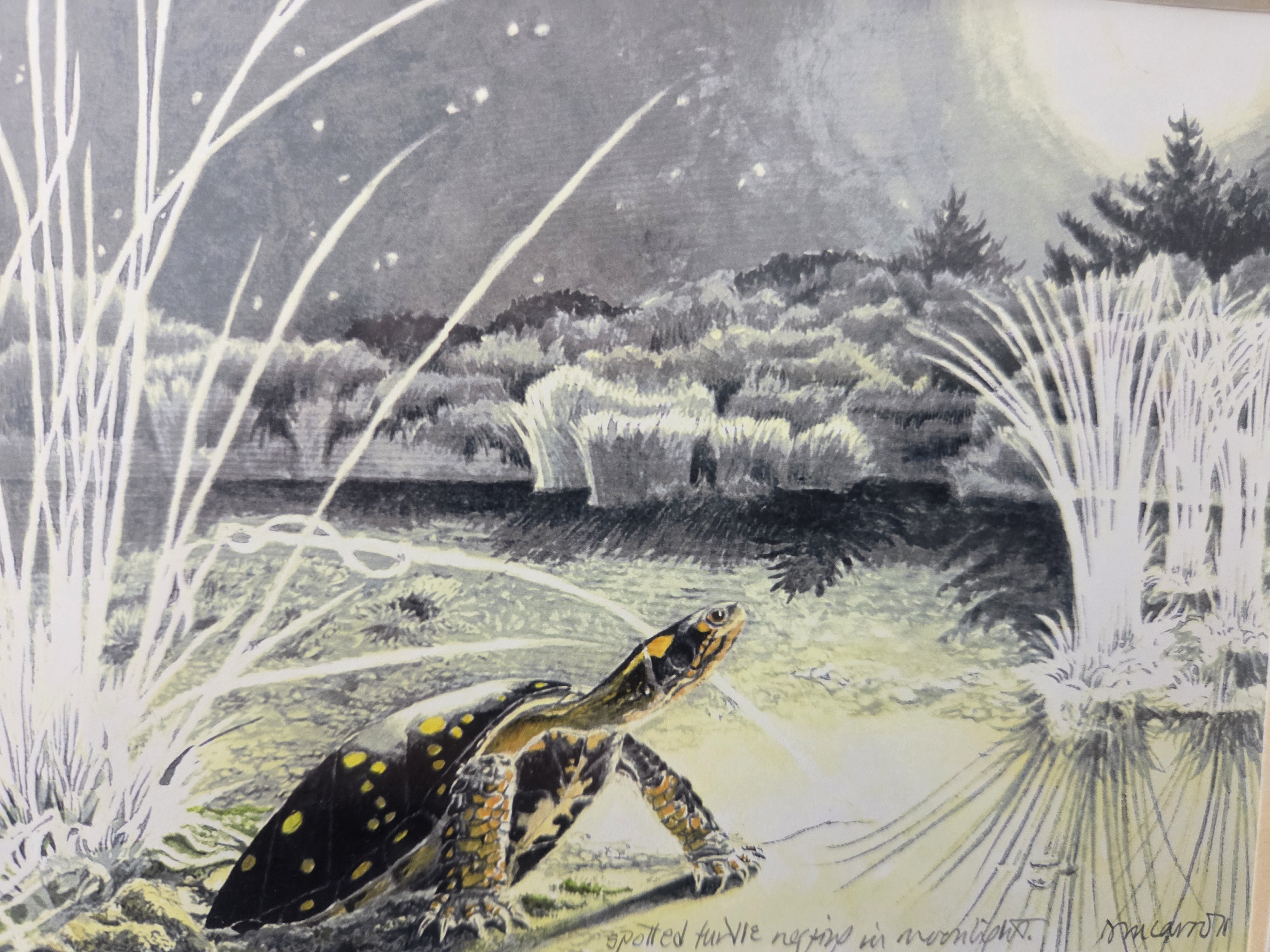
When nature awakens in late March or early April, sap starts flowing in the trees and ice changes to water marking the end of hibernation. This is the grand opening of the wetlands and the pilgrimage to the vernal pools as David M. Carroll writes in his “Swampwalker’s Journal: a Wetlands Year.” A vernal pool is a body of water which fills up in autumn and winter and is swollen in the spring but often dries up completely by the end of the summer. Carroll describes vernal pools so beautifully: “It is at snowmelt and ice-out, the last sleets, first rains, and the earliest warming breaths of spring that they beckon wood frogs, salamanders, and spring peepers from surrounding upland woods, where they have passed the winter in rotted-out trees roots [a reason not to ‘clean up’ the woods], under layers of bark and litter, in small mammal tunnels and other hibernacula in the earth.” The melting snow heralds the march of the amphibians. “Vernal pool habitats hold a galaxy of small things that come to life the instant ice and snow turn back into water.”
Carroll walks the swamps, as the title of his book suggests, in search of mating salamanders and spotted turtles, bogs, fens and all wetland flora and fauna. He tells us that there must be a certain collusion of events– several warm days in a row followed by a darkest of nights with temperatures ideally in the mid-50s with rain preferably two nights in a row. And then the magical migration begins. The salamanders begin their “annual pilgrimage” to the vernal pond to mate.
My husband and I were lucky enough to have a vernal pond on the property next door to us and when Spring sprang out of the depths of winter, the sound at night from that pond made us feel as if we are camping out next to a vast wetland. The music of the spring peepers played through the night throughout the house, often starting overeagerly in the late afternoon. This manic symphony thrilled us every year. It was the first sign of Spring for us. The quality of joyousness and the affirmation of life gladdened our souls. Going to sleep with that sound made us remember what we so often forget, to give thanks to our Creator for his magnificent creatures.
This story, however, does not have a happy ending. In his epilogue to the “Swampwalker’s Journal,” David Carroll explains why it took him more than 7 years to complete this book. He writes that he became involved in saving some of the wetlands in his book and says sadly nearly all of his interventions have or will become “losing battles.” He describes the plight of the wetlands, bogs and fens as a “landscape of loss.” And he scorns our human selfishness as he writes how it “reveals explicitly the extent to which we think of ourselves as owning all living things, along with the very earth, air, and water in which they live, as if we possessed some divinely mandated dominion over all creation.” He warns: “As we will learn in time none of this belongs to us.”










 MOONSIDE
Thank you, Ellen, for sharing the beauty and joys of nature in this very precious piece. Sadly, many ecological concerns are in vain, for human greed is big enough to put an end to something as great as life and the planet. Still, the last sentence says all we need to know about our small passage here. With appreciation, sending you light and blessings, my friend! 🙏✨💖🌻🍀
LikeLiked by 1 person
March 27, 2026 at 8:27 AM
Thank you so much, Susana, for recapping the post so nicely. Love and blessings to you, 🌸💐🪷🏵
LikeLiked by 1 person
March 27, 2026 at 10:53 AM
Powerful quote by David Carroll! We had a wetland near us until the city decided to connect two roads by going through the middle of it. 😦
LikeLiked by 1 person
March 27, 2026 at 11:07 AM
Quadruple ☹️s!
LikeLiked by 1 person
March 27, 2026 at 11:12 AM