In the Hush of it All…
As Christmas recedes into yesteryear, and as turtles and other creatures sleep in frozen slumber, and the New Year dawns after the birth of winter, let us weather the sorrows and “Fully enjoy the wonder and beauty of each instant.”
Paramahansa Yogananda
HAPPY NEW YEAR!

When Spiders Rule

A chill wind blows the yellowing leaves off the trees. They drift down to the ground like giant snowflakes. The air is pregnant with the feel of the coming holidays. Fall has truly come with the sudden drop in temperatures. November appears as a mirror image of March. November is the vibrant color of decay while March is the decaying color of about-to-burst-forth Spring.

The birds are at the bird feeder all the time now. They are not stopped by our presence when we come to fill the feeder or blow leaves under it. Nothing stops them. They swoop around the feeder and the surrounding trees like Kamikaze pilots, darting here and there recklessly. The squirrels are in a frenzy as well, stock piling and burying acorns and walnuts which they will retrieve without fail in a month or so in a snow-covered land.

The trees are most beautiful for me at this time of year, when many of them are bare and a scattering of leaves remain on dark brown branches. The leaves that remain on the trees blow on the limbs with dainty grace in their precarious positions. Yet these are the survivors. The other leaves have fallen and gone the way all living things eventually go. Most trees have lost all their leaves and they stand in stark contrast against the blue sky, the stormy sky, even the night sky. They are perhaps most beautiful at night, like arms reaching up to the darkness trying to grab at the stars twinkling between the branches. Moonlight dances on their limbs.
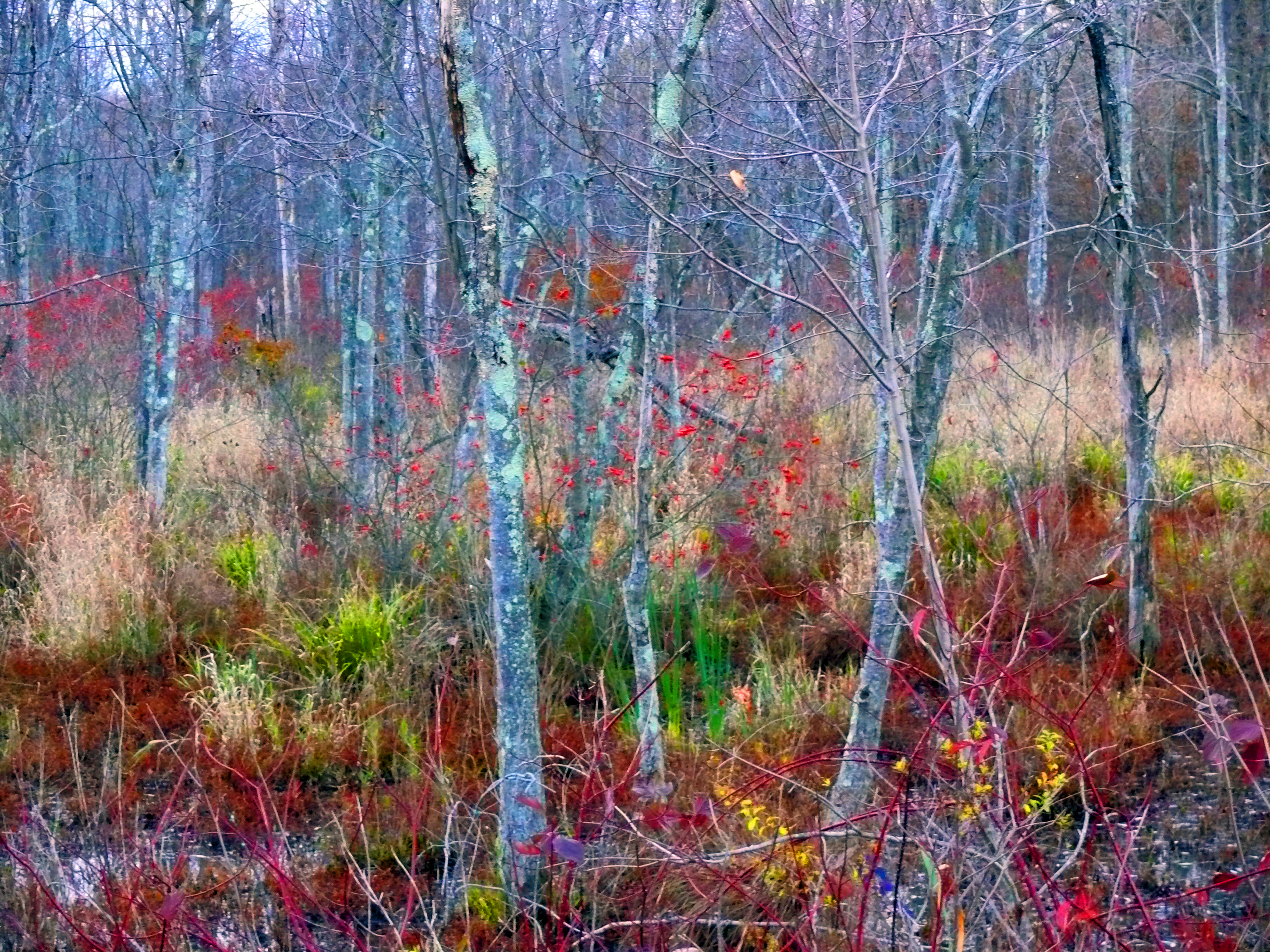
November is the last glimmer of color and in some places the color seems to be predominantly yellow. A carpet of yellow lines the woods now. And now one can see inside the woods, so dark and impenetrable in summer. Some forests have carpets of oak leaves– dark brown tan in color. Or there are forest paths with variegated colors– vibrant crimsons against yellows and faded greens and tawny tans. The unmown lawns are now taken over by the spiders and, at moments, one can see a world of webs covering fields that only appear in a certain slant of sunlight. It is the silent take over of the spiders before the snows come.

The yellow, the brown, the crimson leaves are complemented by the ubiquitous yellow, brown and crimson mums that appear on the roadside near mail boxes, on porches or along driveways. These tough little flowers withstand frosty chills and stand tall throughout most of November. Hearty souls and so giving in their colorful, velvety splendor.

Soon the season of lights will begin. Autumn, as a season, seems the fastest to come and go. I hold each moment in my hands as a treasure, but the moments all sift through my fingers like grains of sand. Then Christmas comes and fades in a flash, and we are into the Nor’Easter blizzards of January. Another year is gone. The years do go faster as you grow older. We go about living our lives, trying, against our natures, to treasure the good moments. Now in November, at Thanksgiving, it is our time to say thank you. Inspired by the Native Americans let us thank the earth. Let us say thank you to the trees for their constantly changing beauty, to the stars for their piercing presence in the night sky, to the leaves for their beauteous colors, to the sun for its life-giving power, to the Spring for its awakening hope, to the Summer for its warm, thriving growth, to the Fall for its bounty, to the Winter for a time of renewal, to the snow flakes for their hushed, white silence that transforms our world, to the animals for their pure souls, to our families and friends for their love, and, lastly but mostly, to the Higher Power of our belief.
Happy Thanksgiving and may you each be blessed with the all embracing, pervasive Love in nature.
Spring’s Siren Song

It is late afternoon and it is Spring by the calendar although still quite cool. And I have just spent the late afternoon listening to music. Some have likened it to the sound to bells. Others to bird song. And still others with unimaginable disdain, to “some kind of nature noise.” For me it is one of the happiest of sounds. The act of creation transformed into sound decibels for all to hear. A sound that comes from the earth and resounds to the heavens, unwittingly praising the Almighty. I hate to leave, and wish I lived even closer to the pond, so that the sound would surround me totally, filling my ears every evening with the sound of perhaps the single-most highlight of spring for me. The siren song of the Spring Peepers.
How have they cast their spell over so many? I cannot say except that their song is uplifting and filled with hope despite the natural perils they face daily. For, as true of all of us, they may die at any moment– say as a meal for a nearby perching crow or underneath murky waters eaten by a snapping turtle. They call for a mate without ceasing, without fear, single-mindedly, without a thought for their own safety. It is nature at its most elemental, in its most singular scope. They all sing out vying to be heard– so many voices. In some spots, I am told, their song is deafening. How nice to be there; I cannot get enough of their sweet music. It moves me to tears– these tiny creatures singing out their heart’s desire.
As I return home to family “situations” and domestic duties, I yearn for the simplicity of their song. Their total fervor. For if they sing then all is right in that small part of the world. Progress has not paved over their pond. Disdainful humans have not drained a “vernal pool.” David Carroll writes about vernal pools in one of his books on turtles called The Swampwalker’s Journal. As the title suggests, Carroll walks such places in search of turtles and other amphibians. He defines a vernal pool as a pool of water that fills up in Fall and Winter, swells in the Spring and often dries up by end of Summer. But a vernal pool is utmost a place of magic, not only a place where turtles lurk but where mating frogs deposit gelatinous eggs which turn into tadpoles first, and there, later become frogs. And after a requisite series of warm days, followed by spring rains, on the first dark night, vernal pools become the site of the “salamander night.” Salamanders leave their hibernacula to go for a night of endless mating and then return to leaf litter in the woods to disappear for the rest of the year. Some people who know nothing of vernal pools and their function deem them a nuisance, a “big puddle” to be filled in or drained. Some people know little of Spring Peepers except that they are “noisy,” “like some sort of insect.” Poor insects being made out to be the pesky lowest of the low. The natural symphony of hormonal, harmonic sounds sometimes falls on deaf ears.
And when, after finishing my evening chores, I try to read, I find the haunting sound of the Spring Peepers deep within my psyche, making me restless and anxious and wishing to be at that pond, surrounded on all sides by their sex song, inebriated by the unbridled joy in the air, immersed in the utter power of nature manifesting in one of her gentler forms. In the song of the Spring Peepers nature celebrates life-to-be rather than taking lives away. For most of all the song of the Spring Peepers is a song of tremendous faith, faith in love and faith that love will propagate and new life will emerge untouched by the oft destructive hand of man.











 MOONSIDE
You must be logged in to post a comment.