Our Prehistoric Visitor Returns
Last year I wrote about our special visitor, Shelley, who has appeared in our driveway around Memorial Day for the past three years to lay her eggs in the exact same spot. Shelley, to introduce her once again, is a large snapping turtle with a muddy, mossy shell and a long jagged tail. In my ignorance the first year she came I tried to save her from getting run over, while all the time unbeknownst to me, she was trying to find the right spot on the side of the road to lay her eggs. Good-natured, she took my meddling in stride and only gently snapped once after the third time I had returned her to the marsh out in back of our house in a snow shovel. Only then did I realize what she was up to. Shelley communicated simply and without malice. Shelley was a class act.
(Click on all photos to enlarge)
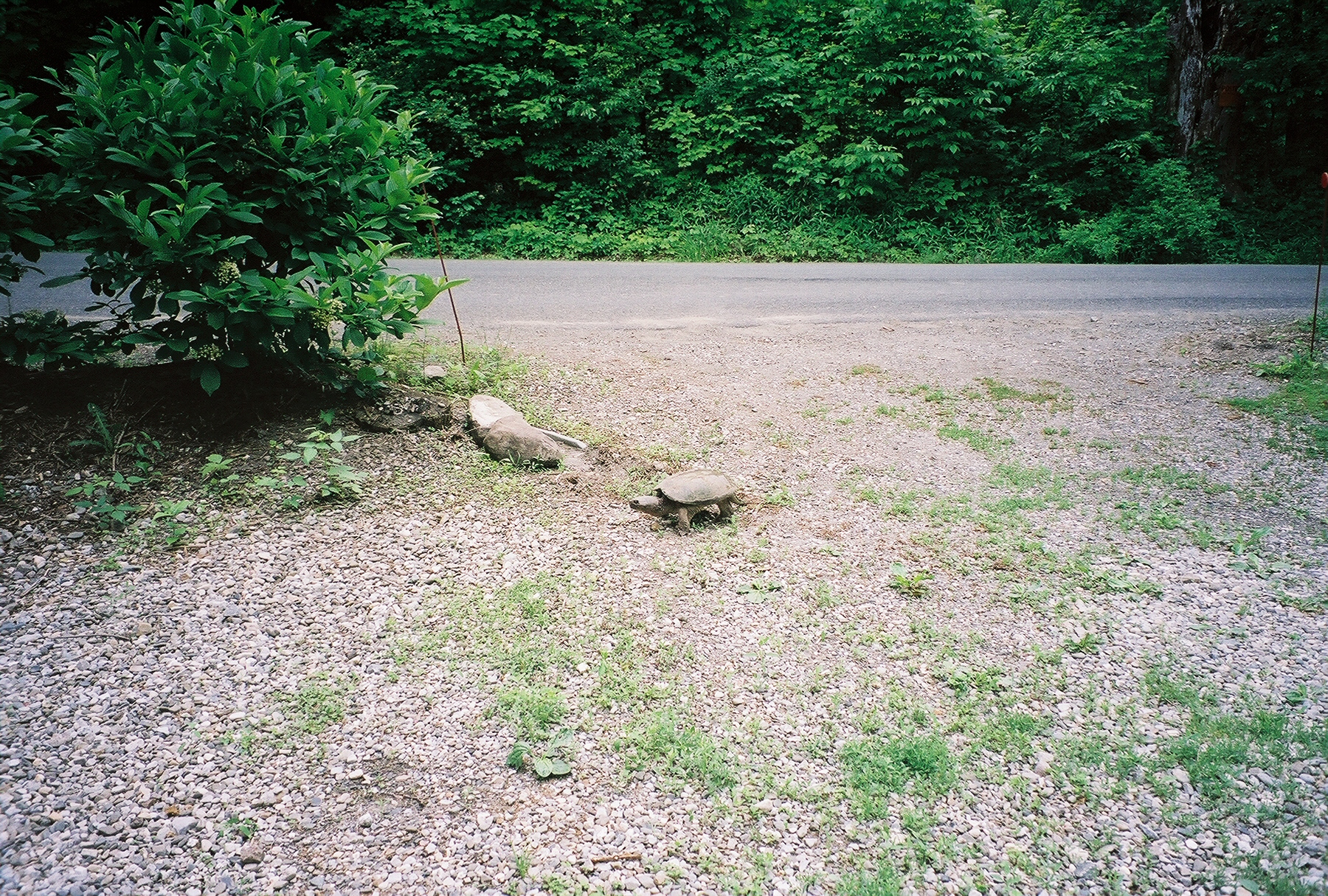
Every year, according to some inner time mechanism, Shelley would come early in the morning to lay her eggs in the swale in the corner of our driveway. A big snapper, she, majestic in her reptilian grandeur. Her shell measured (yes, we measured it) 13 inches, but like all snappers her head juts out of the shell about 4 inches and her spiked, dinosaur-looking tail adds on another 5 inches or so.
This year we checked our driveway early each morning worrying as trucks barreled by dangerously close to where she has laid her eggs in the past. Days went by. No Shelley. Judging by the size of her shell and the speed of her gait, Shelley was not young. Each year we saw her Shelley was walking slower and slower. We wondered if she made it through the winter.
In addition, in the early spring her pond was dug up and drained by the new owner to make it deeper and with each dig of the steam shovel we imagined our snapper being snapped up.
Memorial Day came and went and each day was sunny. Shelley liked overcast days to lay her eggs. The very last day of May was a perfect day for laying eggs, overcast and humid. We checked our driveway. No Shelley. We checked up and down the road. No Shelley. My husband didn’t say anything but disappointment and worry were written on his face. I was feeling worried, too.

We held our breath and waited. And then…
We first noticed her at 6:30 in the morning and watched her as she spent the next 3 hours or so looking for a suitable spot to lay her eggs, digging a hole for them, and then depositing them in the hole. She picked the same spot she picks every year after much mulling around and searching.
It was a delight to see those mighty claws dig a deep hole and then the back feet dig deeper. She rested for awhile and we took pictures which she did not seem to mind. Then we left to give her privacy and the back of her rocked from side to side as she deposited the eggs.
Normally she takes a hair-raising walk crisscrossing a somewhat busy road and I accompany her to make sure no car hits her. But this year she surprised us yet again and took the safer route across our back yard, after a few false starts (stopping at our front door).


Though she could have taken an easier route in our yard, she followed a stream in back of our house following a logic that has worked for 200 million years. Maneuvering over large rocks and crawling between crevices that looked impossibly narrow, we were not sure she could make it home and were wondering how we would rescue her.
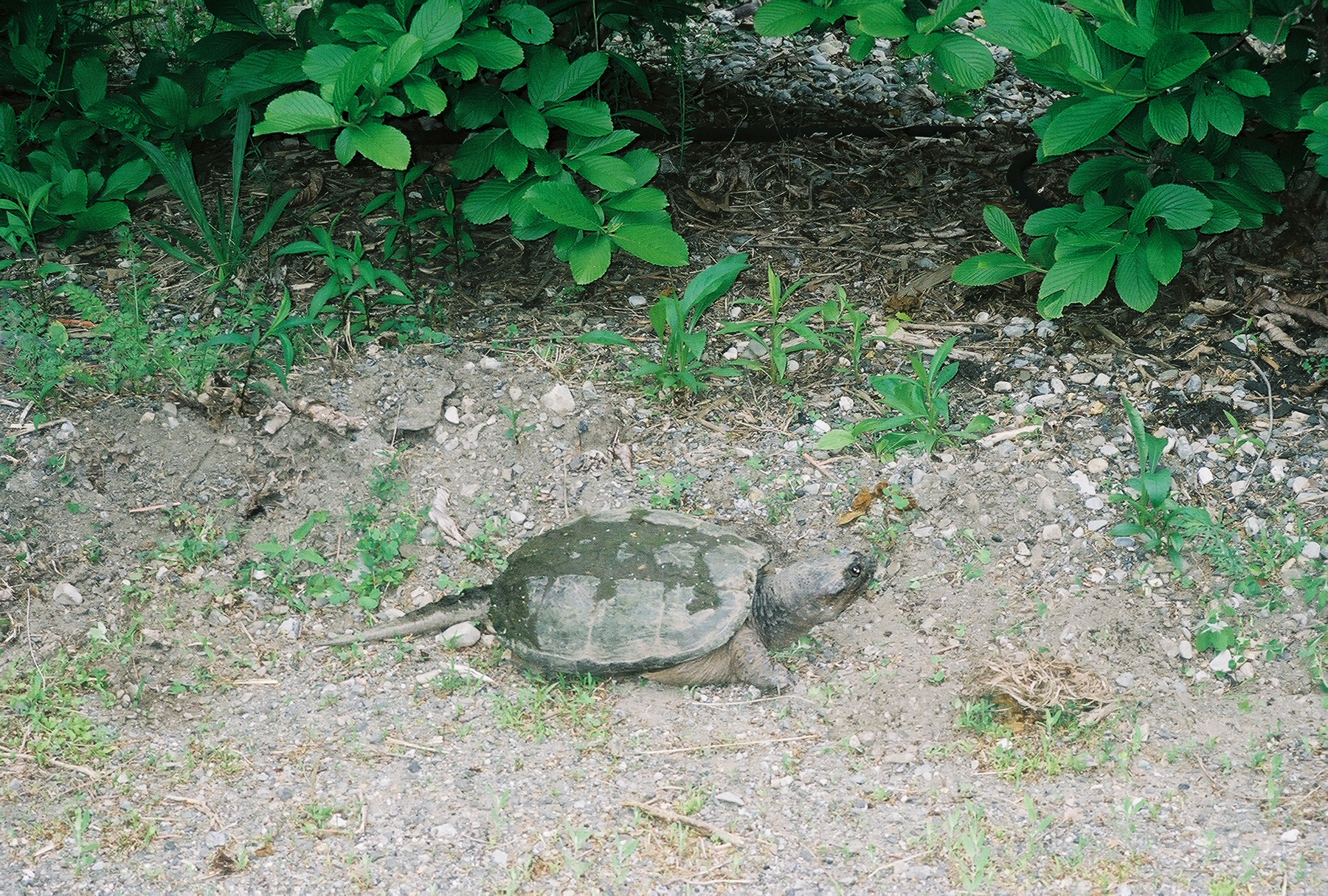

We were the fools. She arrived triumphantly and magnificently in her exhausted state in the marsh on our side of the pond and quickly submerged herself under the mud until she was no longer visible, a living submarine.

After her departure we felt sad. We can only assume this brave lady made it home to her now-deeper pond having survived despite the hand of man and the worry of her next door neighbors. The brilliant naturalist and “turtle man”, David M. Carroll, explains the tinge of sadness we felt after seeing Shelley lay her eggs when he writes in his Self-Portrait with Turtles: a Memoir: “The furtive turtles were utterly silent in their nesting, but the sandy fields and road edges somehow seemed to go quiet with their departure.” Shelley’s departure meant a break in our one-sided bond with her and David Carroll sheds light so poetically on our experience of loss when he writes of his relentless study of turtles: “Through these children of the sun’s dialogue with the earth I could continue to pass out of human time and place and enter the soul of the seasons.” That was Shelley’s gift to us.
Welcome to samples of my work in various art forms showcasing “Eye-locks and Other Fearsome Things.” “Eye-locks” is a Bipolar/Asperger’s memoir in narrative form that describes the triumph of love over mental illness.











 MOONSIDE
You must be logged in to post a comment.