In the Hush of it All…
As Christmas recedes into yesteryear, and as turtles and other creatures sleep in frozen slumber, and the New Year dawns after the birth of winter, let us weather the sorrows and “Fully enjoy the wonder and beauty of each instant.”
Paramahansa Yogananda
HAPPY NEW YEAR!

The Oneness of It All
In this month of darkness, in this the darkest month, the light of the human spirit shines forth in a fullness shown by so many, in so many ways. As the days grow shorter, houses and trees are decorated, and snow falls. In the hushed silence of the nights, lights shine in windows, and the beauty is shared by all. For this season of giving brings the festivals of lights: Diwali (now past), Hanukkah, Christmas, Kwanzaa. Each tradition incorporates light in its ceremonies and decorations. But all is not well. Millions know no peace in any season.
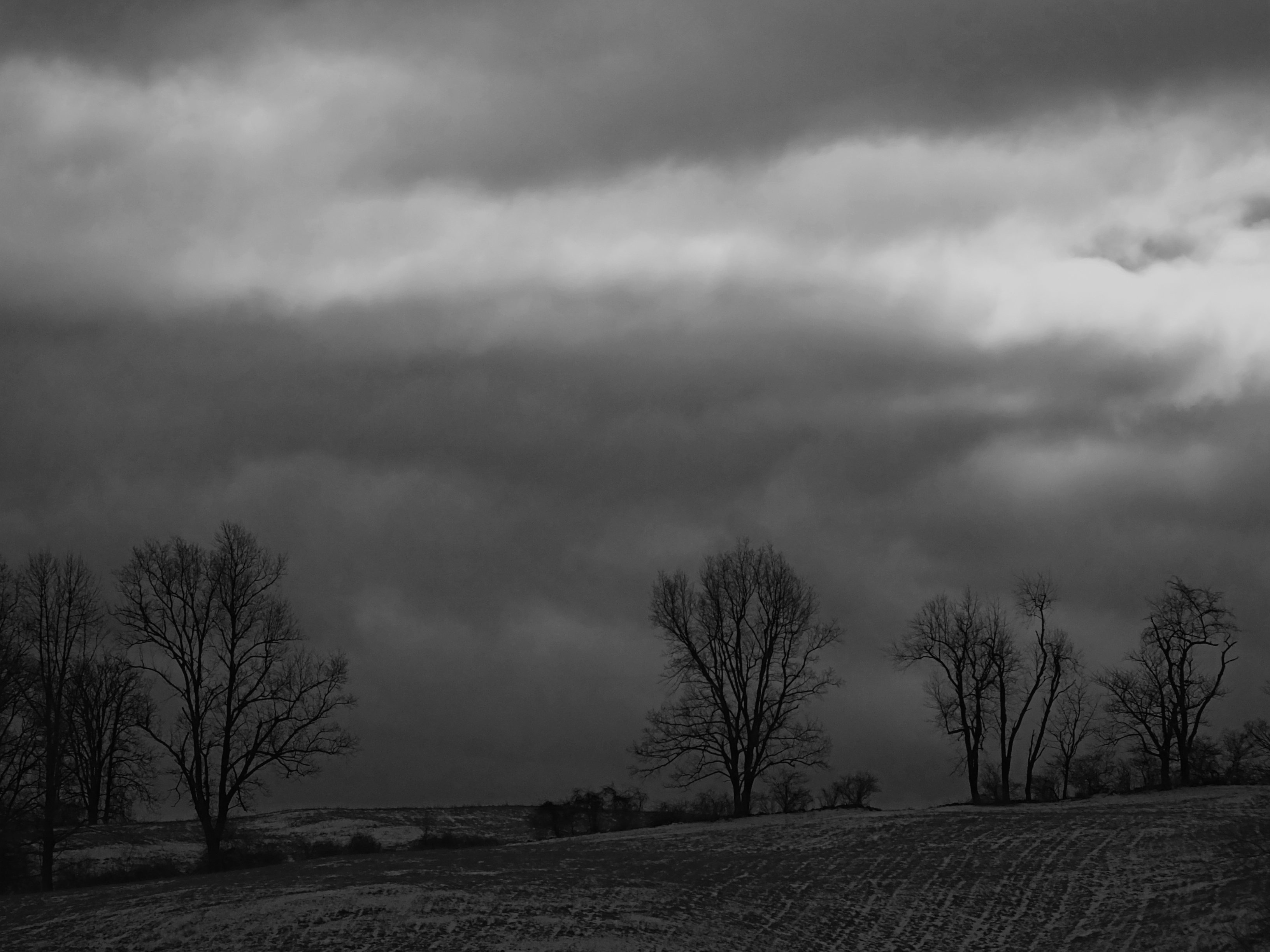
Yet even those living in the worst conditions show the light of the human spirit and celebrate the season of light in personal ways. For the human spirit is indomitable.
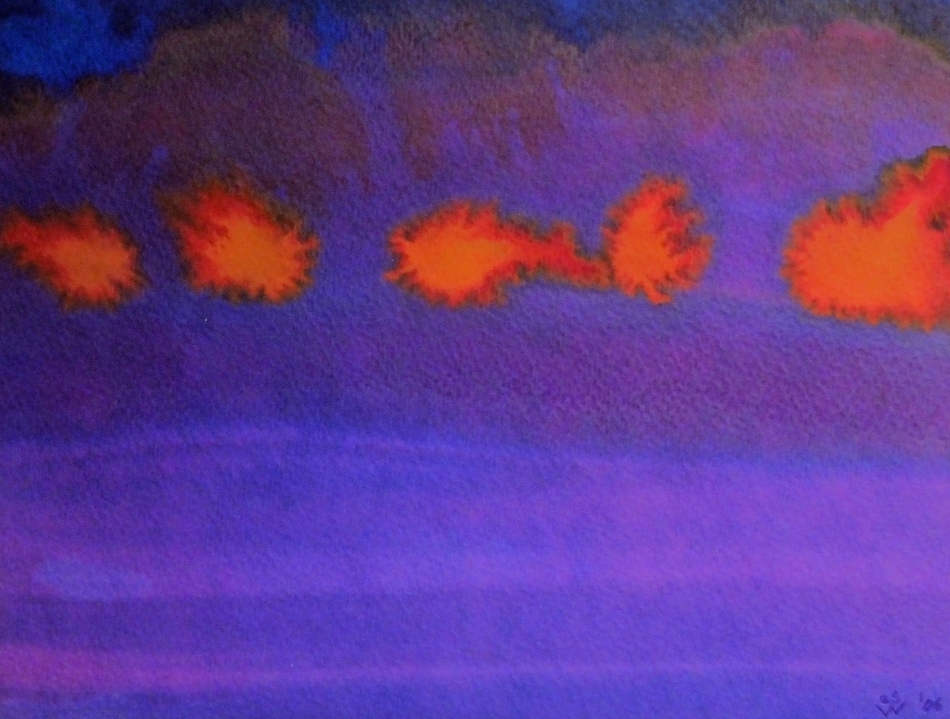
In December’s darkness we light lights. For we are beings of light. A light glows within each one of us. And, at the most basic level, we are beings of light because we are made from stardust. Perhaps that is why the stars hold such majesty for us– we are made from star material.

Einstein said: “A human being is part of the whole, called by us the ‘Universe”– a part limited in time and space. He experiences himself, his thoughts, and feelings, as something separated from the rest– a kind of optical delusion of his consciousness. This delusion is a kind of prison for us, restricting us to our personal desires and to affection for a few persons nearest us. Our task must be to free ourselves from this prison by widening our circles of compassion to embrace all living creatures and the whole of nature in its beauty.”
Repetition of Forms
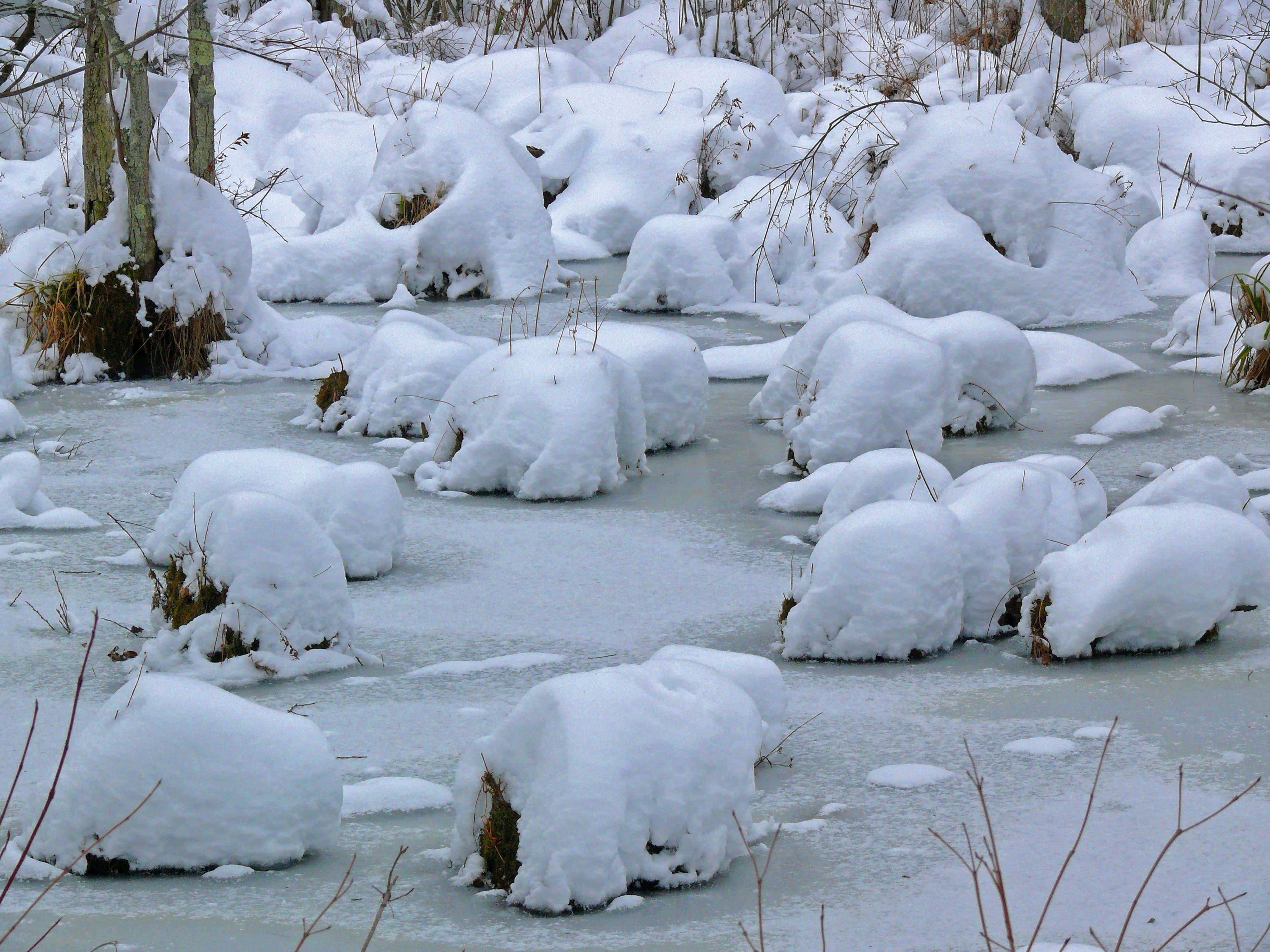
The Marsh in Winter (Millbrook, NY)
(Click to enlarge)
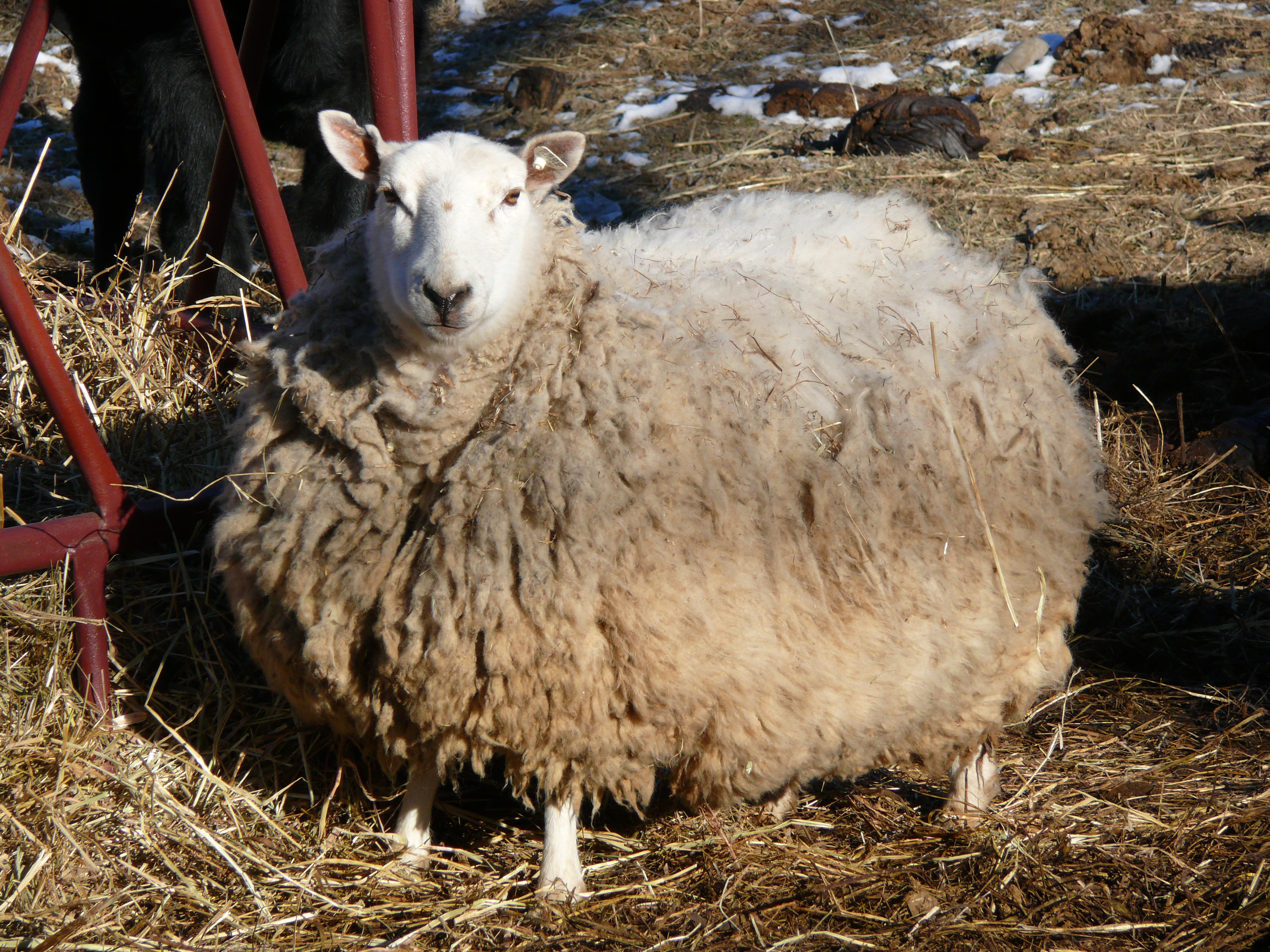
Sheep in Winter (Standfordville, NY)
(Click to enlarge)
“Nature is very beautiful; but still, in one sense, it is very silent: it tells us of the beauty of everything without revealing the Beauty that is behind everything.”
Panamahansa Yogananda
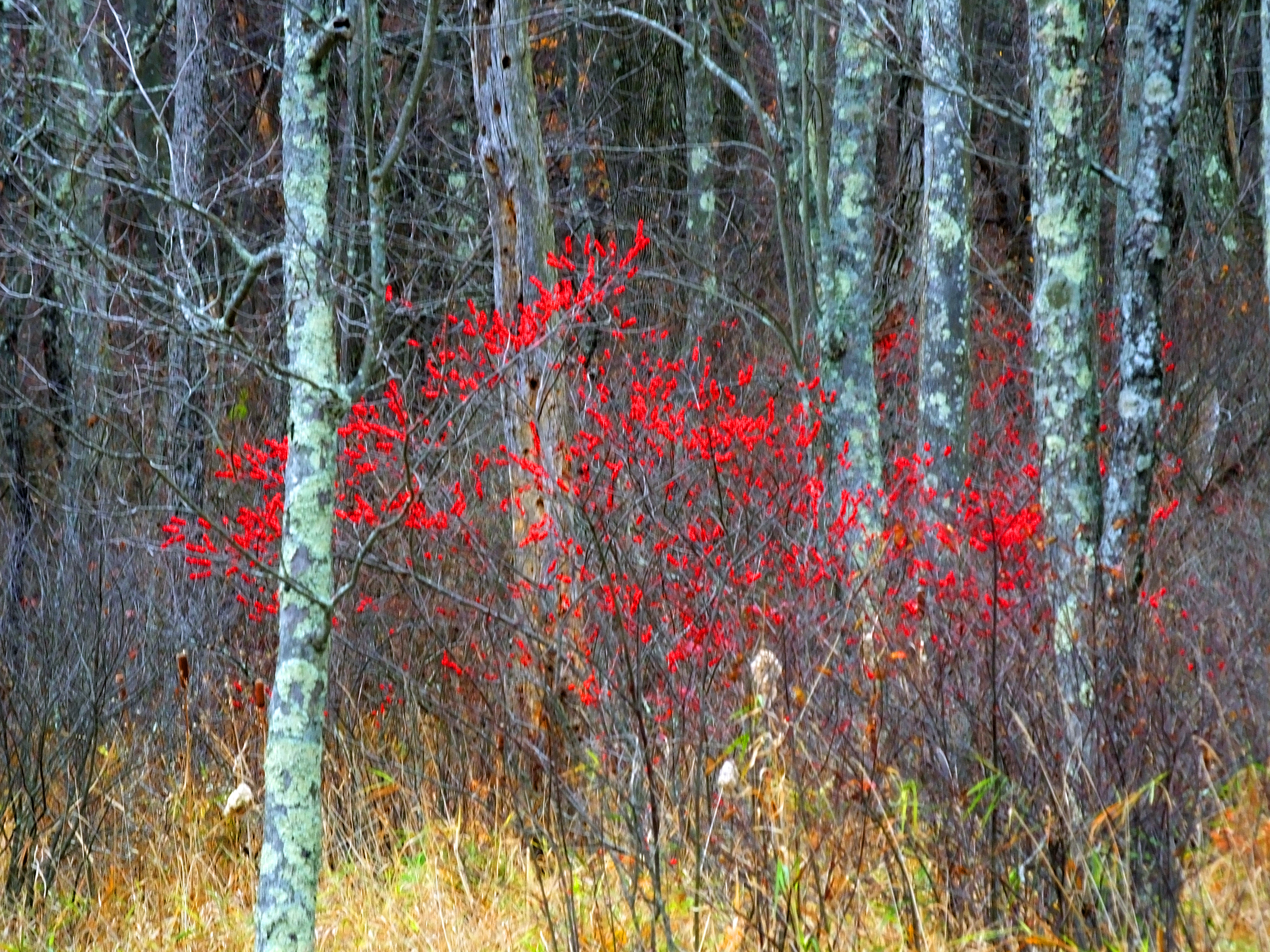
💖💖💖”Just as your consciousness pervades your whole body, the consciousness of Christ is equally present throughout the cosmos– in every tree and plant, in every bird and animal, in all human beings.”💖💖💖💖💖💖💖 Paramahansa Yogananda
(Click to enlarge)

(Click to enlarge)
(Click to enlarge)
Sentient Trees in Almost-Winter

“The Feather Trees”
(Click to enlarge)

“The Heart of Darkness“
(Click to enlarge)
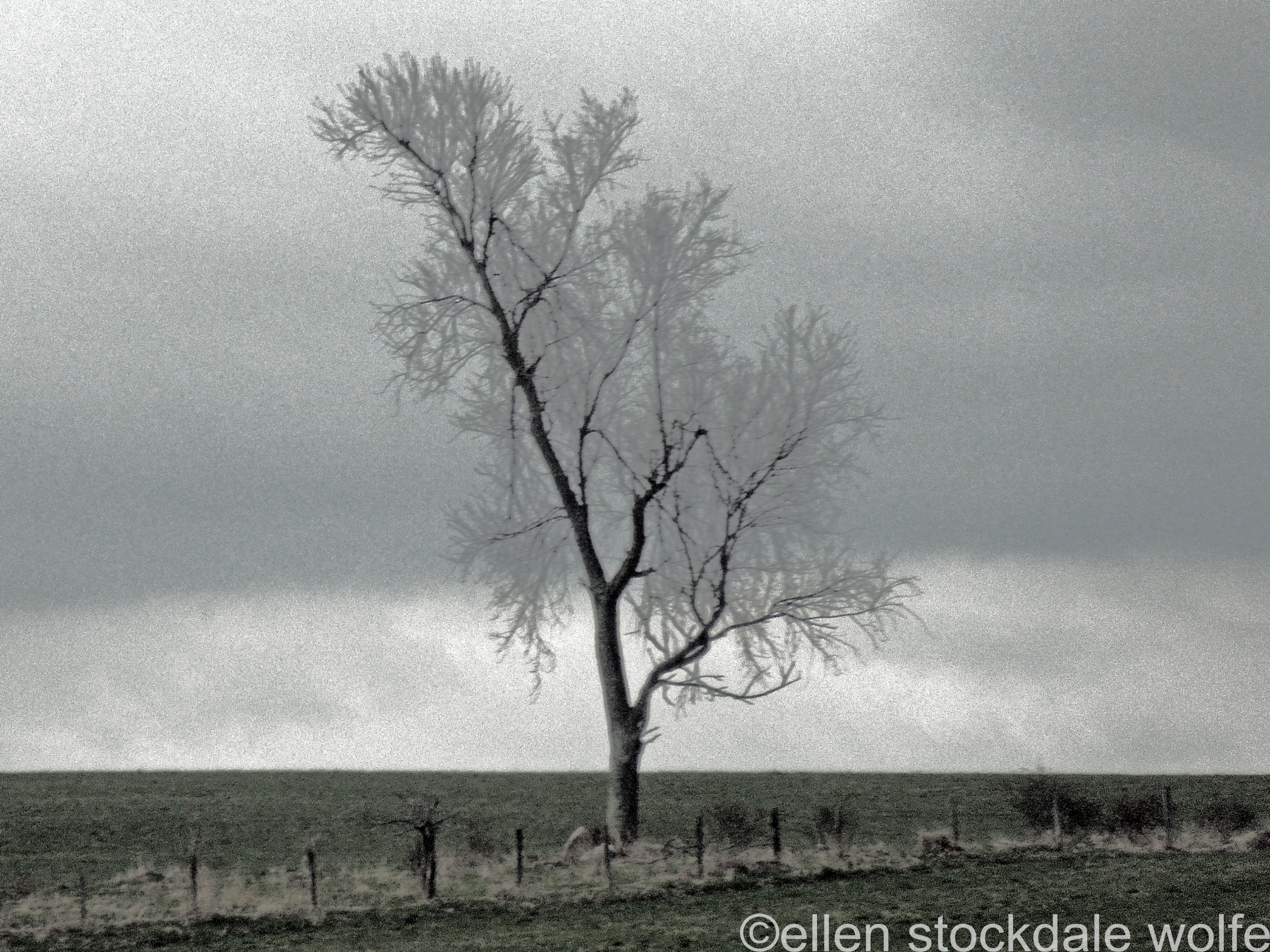
“The Cold and Lonely Tree“
(Click to enlarge)
The Edge of Winter

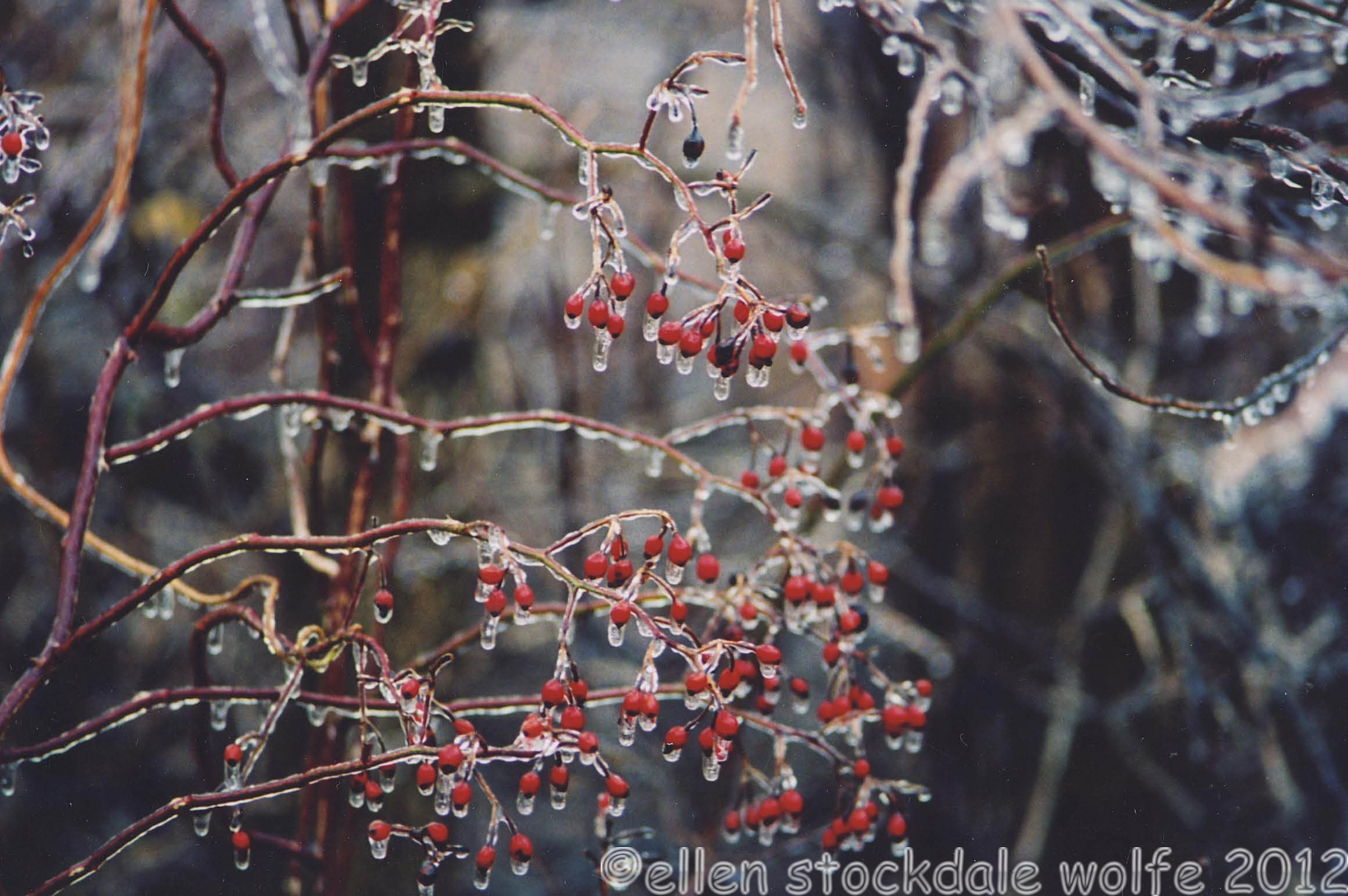
It is an overcast day. Brightly colored birds stand out like jewels in the greyness. The winter birds– jays and cardinals, juncos, black-capped chickadees, white-breasted nuthatches and downy woodpeckers flock to the bird feeder and it has to be filled up almost every day. The red berries on the bushes are nearly all gone and the feeder is becoming a matter of survival. On our walks we see empty nests held in the bare arms of winter trees. An empty robin’s nest is filled with snow– the hatchlings and the mother long gone to fairer climes. The trees are stripped down to their souls. With ice storms they become tinkling chandeliers. In the rain the few remaining dead leaves drip icy tear drops.
Occasionally a dove visits the feeder. The chipmunk, who gathered scattered seeds under the feeder all fall, is not to be seen. He must be in torpor in his den. According to Bernd Heinrich in: The Winter World: the Ingenuity of Animal Survival, the eastern chipmunk builds a twelve foot storage system with a nest chamber some three feet down and a tunnel system which includes a food storage chamber. Heinrich says chipmunks go in and out of torpor. He reasons that they would not gather food if they were to be in torpor all winter long. We will probably not see our chipmunk for the rest of the winter for, in his stuporous state, he would be easy prey. However he can be roused to eat and venture outdoors if need be, especially in March when there still may be snow on the ground but mating season begins.
The grey squirrels are busy clearing snow from branches as they run along tree limbs. On the ground they dig through the snow for the walnuts we watched them bury in the ground with their noses this fall. They do not need to hibernate for they have food stores which they built up in the autumn and leafy, well-insulated nests. The red squirrels survive winter by putting on a thick, insulating fur.
The back yard is a maze of tunnels. We think they are deer mouse tunnels as many have tunneled their way into our house. But they must get by the feral cat who sometimes waits out a snow storm under our deck. In the woods, the occasional deer waits out the same storm under a squat fir tree. The tracks in the snow tell the story of how they weathered a Nor’Easter.
Beneath the tracks in the snow, in the frozen leaf litter, the insect world is dormant. Some hibernate. Others fill their bodies with antifreeze, glycerol, to stay alive. Heinrich talks about woolly bears hibernating but they are also capable of freezing solid and surviving, coming to life again as they thaw in the spring. The pupae, however, don’t survive being frozen.
In Winter: an Ecological Handbook, authors, James C. Halfpenny, Elizabeth Besiot and Roy Douglas Ozonne, tell us that the reptiles and amphibians pick out a “microclimate for hibernation that does not freeze” for their winter, such as the “bottoms of ponds, streams, or deep in the ground.”
Our stream flows out back in the marsh under ice and snow and one can see the elongated bubbles of running water. In the pond next door the turtles lay beneath the ice in their hibernacula. At the end of the book, The Year of the Turtle, David M. Carroll, the naturalist, author and artist, has his watercolor of a spotted turtle hibernating. This picture is hypnotic and in its spell, I think of all the animals hibernating beneath our feet in lugubrious gloom. It reminds me of the penguins in the film, The March of the Penguins, in the dead of an Antarctic winter, huddled together for warmth in the harsh, strong winds and snow, taking turns being on the outside of the huddle. Winter can be magnificent in its transformations yet tragic in its harshness: hibernating animals who freeze to death and deer starving to death in the snow among the victims of its violence.
Carroll’s drawing shows the turtle all alone, withdrawn into its shell under less than two feet of water lodged firmly in the mud under ice under snow in a sunny winter’s day, a far better clime than the penguin’s– and yet it evokes a certain sadness for this little creature all alone beneath the snow, in a torpid state. The turtle is missing out on a sunny day, sleeping a deep sleep in a “half year of stillness.”
Carroll’s writing is sheer poetry as he describes the turtle’s hibernation: “Mounting layers of snow silently cover the ice. Night after night in the harshest depth of winter, as Orion and the Pleiades burn distant and brilliant in the black sky and strong winds howl off the mountain to the northwest, the turtles rest beneath the ice. With the life in them nearly suspended, reduced to its most tenuous hold, all but extinct in the vast, inhospitable regime that reaches above them to the limits of the universe, they lie within their shells, waiting for the earth to make its required turnings and return them to the sun that will awaken them to another season.”
I think of the turtles below, along with all the other beautiful creatures. I wish them a kind sleep from which they will safely stir with the life force surging through their veins as the sun brings them to the fullness of life again. The death of some, and the half life of so many, proffers the poignancy of winter.
Synchronicity

The Oxford dictionary describes “synchronicity” as “the simultaneous occurrence of events which appear significantly related but have no discernible causal connection.”
Wikipedia has a longer definition: “Synchronicity (German: Synchronizität) is a concept first introduced by analytical psychologist Carl G. Jung “to describe circumstances that appear meaningfully related yet lack a causal connection.”[1] In contemporary research, synchronicity experiences refer to one’s subjective experience whereby coincidences between events in one’s mind and the outside world may be causally unrelated to each other yet have some other unknown connection.[2] Jung held that this was a healthy, even necessary, function of the human mind that can become harmful within psychosis.[3]“
As a Bipolar 1 woman who was not diagnosed, let alone medicated, until I was 28 years old, my life was full of synchronicity. I was working as a clerk in Columbia University libraries, cataloging art books. My family did not “believe” in psychiatry nor in mental illness. I kept everything secret from them until I could no longer, when I had my breakdown at age 28. At that point I went for emergency care to the Columbia Counseling Service and was told to stay with my family for a week or go to hospital. I was lucky enough to be able to go to my parents for a week . I had begun therapy with the psychiatrist I would wind up staying with until age 74. But at the time I was all alone. I had a best friend from grammar school who was living in France at this time. She and I corresponded every week. We remained close until she died at age 39. I had a few friends at work, but I lived alone and was isolated. And I became psychotic at times. Synchronicity ruled my life. Parts of a song on the radio, or a program on the TV, a man singing in the street… they all had special messages for me. I thought of people in the street as “teachers” for me to learn from and the people who worked with me, as “mystics,” who understood me, and who were trying to train me.
It was exhilarating when the teachers were happy with my progress but terribly depressing when I did wrong. There were “signs” for me to interpret all over the place. And at work, I regarded every book I catalogued as something that held secrets to help me get mentally well or learn truths about life. I would do my job faithfully, most of the time, but while doing it, I was on the constant look-out for special messages meant for me. I did what I called “readings”. I would find some lesson in each book. One book I was working on held a special secret about the womb and the egg and the sperm uniting and becoming a zygote. I pictured the uniting of the egg and the sperm as fireworks. (Thirty years later, saner and married and actively creating art, and, writing a newspaper column upstate on the side, I created an abstract photograph called “Conception”.) But in the library, I did what I called “time travels.” I didn’t talk to people much during this period. I listened to co-workers and street people, read extensively and deciphered messages. People would come up to me at work to actually talk to me sometimes, to be nice, I guess, and I would leave the world of the womb, and zygotes or some such thing, and talk to them normally as if I were in their world. I was not!!
In other words, to put it in professional terms, I was WACKO!
That is all behind me now and fortunately, though I have had some hard times, but they have occurred within the realm of a marriage, to be 35 years long this May. It has offered me the only stability and deep love in my life. Gone is the world of readings and messages. Gone is the synchronicity. Sometimes I miss it but not the craziness that went with it. Now I have more meaningful, everyday experiences of sanity. There are still some epiphanies, but not like the old days.
Before I close I must add, there was at least one incident that was truly synchronicity… that was not delusional… that felt distinctly like a message from God, the Universe. I was working at my desk and suddenly my scalp felt prickles all over it. I grew alarmed and so decided to go to the reference room for one of my “readings.” Clearly this warranted research. I went to the Reference Room of the library and found a one volume encyclopedia which I pulled off the shelf. In order for the reading to give answers impartially, I had to open it at random and then put my finger on the page. So that’s what I did whilst my scalp prickled. My finger pointed to a picture. It was a print of Christ with a crown of thorns. I was stunned. I felt like it was a message from God. And to this day I think it was. It was a message of hope and love.
Yesterday I wrote to a fellow blogger, Anneta Pinto-Young, at Devotionalinspirations.com, who is a Social Worker and a Christian Minister and recounted this story briefly in response to her post on coincidences in her series on “Hearing God Speak.” She told me something very wise. She said that religion and science have always clashed over these type of things. Sure, I was delusional for much of the time, but I did have occasional experiences like this one. And, she said, that was God sending me a message of his love and encouragement. I felt that then and I feel it today.
Maybe I don’t need the secret messages any more. God’s word comes through friends now and most definitely through my long-suffering husband.
What can I say but look out for synchronicities and see what message there is for you.
Just Renters
The house that we think of as “our” house does not belong to us. Not because we are still paying the mortgage on it. This becomes evident one morning while sitting in a moment of calm before the day has begun, watching the bird feeder which my husband lovingly is filling. He has dumped out the seeds too big to fit through the wire mesh of the feeder. About 10 little birds, sparrows and juncos and sometimes a dashing male cardinal, are feeding on the seeds on the snow-covered ground. They are not scared off by the lone squirrel who comes to eat the peanuts from the mix. Larger birds flock to the now-full feeder. The largest birds, too big to land on the feeder, sometime take over the small bird territory, eating seeds on the ground.
The snow is falling as we prepare to go to work, cleaning up the kitchen and locking up the house. The birds fly around in my mind. So vulnerable they seem yet so brave, so tiny yet enormous in their freedom to take to the air. I want to hold them in my hand and stroke their soft, downy feathers, give them love. But truth is, this is purely a selfish wish on my part for they don’t need my love. They don’t really even need the bird seed my husband religiously puts in the feeder. There are bushes out back with berries which they love. It is I who need them, to make me feel happy, to make me feel loving, to make me feel alive and connected to something larger than myself.
As we pull out of the driveway I take another lingering look at the birds in the brightening light. And then it hits me. They get to stay there all day as we drive off through the snow to our respective jobs in the cement jungle of a nearby city. We drive past horses, grazing in a neighboring meadow. Same deal. Often I make an effort to remember the birds and the squirrels and the horses to bring calm to a fraught work day. Yet I usually get so caught up in my frenetic, little life that I forget to think of them. Or if I manage to conjure them up, the image of them in my mind is thin, pale and lacking in substance.
I imagine the animals laughing at us as we have to drive off to go to work. Our house belongs to them. Sometimes they even invade our living quarters. When we first bought the house, it had 50 or so little brown bats in the attic who would occasionally fly around the bedroom at night. One year we had a pair of squirrels. We even had the company of a milk snake one afternoon. And every fall as the weather turns frigid, the field mice run in.
A little more thought on the subject reveals to me that in actuality we own nothing. Not our house, our spouse, our children nor our pets, not even the body we inhabit. All of these things are on loan to us, rented to us if you will, by the Maker of the sun and the moon and the stars. Such a wealth of beauteous bounty is there for us, ours to enjoy for the mere act of attention. The trees, the summer breeze, the blanket of snow in winter, the flowers of summer, the butterflies, the deer who eat our lilies, the possum, the ever-changing species of birds, the occasional coyote and the thousands, if not millions of insects underfoot in a terrestrial universe, to say nothing of the universe above our heads and the trillions or gazillions of stars, the planets, the sun, the moon. And yet we are so caught up in the dramas of our mundane lives that we fail to duly honor the ever-present gifts except in periodic snatches, when we turn our attention outside ourselves to the piece of earth we rent. We may pay a sum to rent a piece of the earth but that piece contains a seemingly infinite multitude of gifts given for the taking. Or rather, I should say, for the renting.

The Trees of Winter

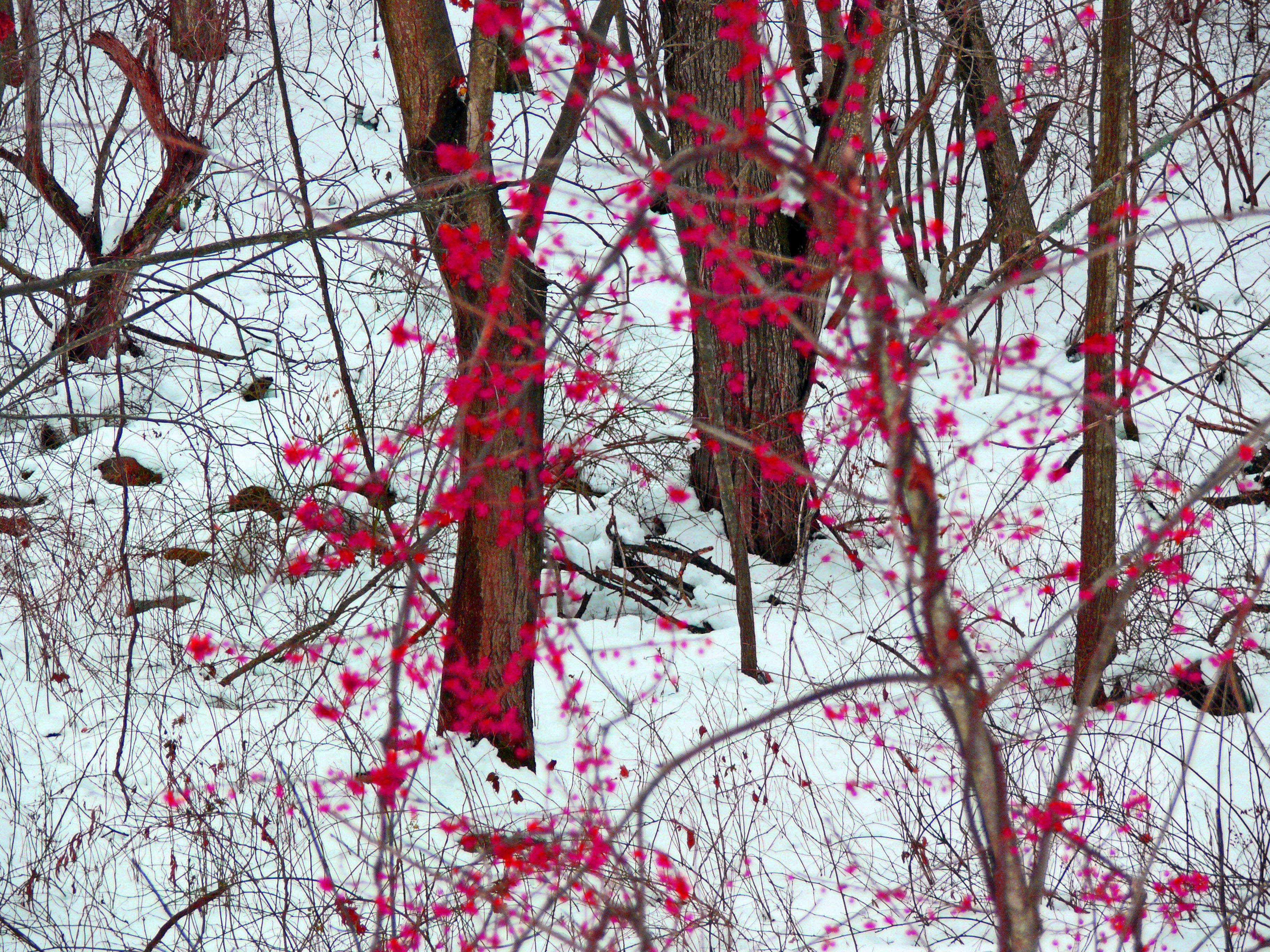
Every year what budded in autumn, blossoms full blown in winter– my love affair with trees. Trees that were drop-dead gorgeous in their fall colors are now bare, with the exception of evergreens and a few stray deciduous trees that refuse to relinquish their leaves. Now the trees are stripped down to their souls and their souls sing a siren song to the universe.
The tops of trees lift my spirit; brushlike they paint the sky the baby pinks and blues of mornings, and the majestic magentas and violets of day’s end. Each tree has its signature shape against the sky, like a fingerprint or a snowflake, similar yet each unique. Some treetops in their bare state are shaped like a fancy coiffure; others look like wrought iron filigree. On distant mountains, against the snowy ground, some look like stubble on an old man’s unshaven face.
It is the colorful winter sky showing through, and showing off, the bare branches that woo me. The bare curvaceous branches are stark, dark lines against the bright of day and the inky sky of night. These resplendent creatures are living lines that explode. Branches tangle like the lines in a Jackson Pollock painting. Others curve in the sensuous lines of a Brancusi sculpture. Buxom tree trunks stand strong surrounded by their dead blossoms and their burgeoning offspring like a Renaissance Madonna. In truth these trees are not like art at all. Rather art imitates them– their beauty provides the timeless inspiration for artists, writers and poets of all ages and styles.
Trees not only inspire, they themselves are paragons of diversity. One look out of a car window while driving on the Taconic and one can see squat pines alongside towering majestic firs, birches interspersed with maple and oak. And together the different brown and tan barks interspersed with evergreens create not only a mosaic of contrasting colors, but display an example to inspire humans to live together in peaceful unity.
These beneficent beings carry the heavy, dark grey clouds of winter. When it snows the tree trunks become canvases for the abstract patterns of windblown-snow, while the serpentine branches are outlined in white. In ice storms their branches become chandeliers, each enveloped in glassine ice, tinkling in the wind. While in the melancholy of a winter rain, the branches become oiled skins of snakes weeping to the ground below. And finally, in the night sky, the branches hold the stars in their arms, those with leaves holding them in their hands, as they nurse the moon.
All trees, no matter what their species, age or height, stand tall in proud humility, their arms reaching up to the Heavens to our Creator in prayer– soft-spoken beings of peace and tranquility towering over us, while the little creatures race around distractedly below.











 MOONSIDE
You must be logged in to post a comment.