Latest

In the Heart of a Dying Star, Life
The work of Professor Brian Cox who appears in the video:
Brian Edward Cox, OBE is a British particle physicist, a Royal Society University Research Fellow, PPARC Advanced Fellow and Professor at the University of Manchester. Wikipedia
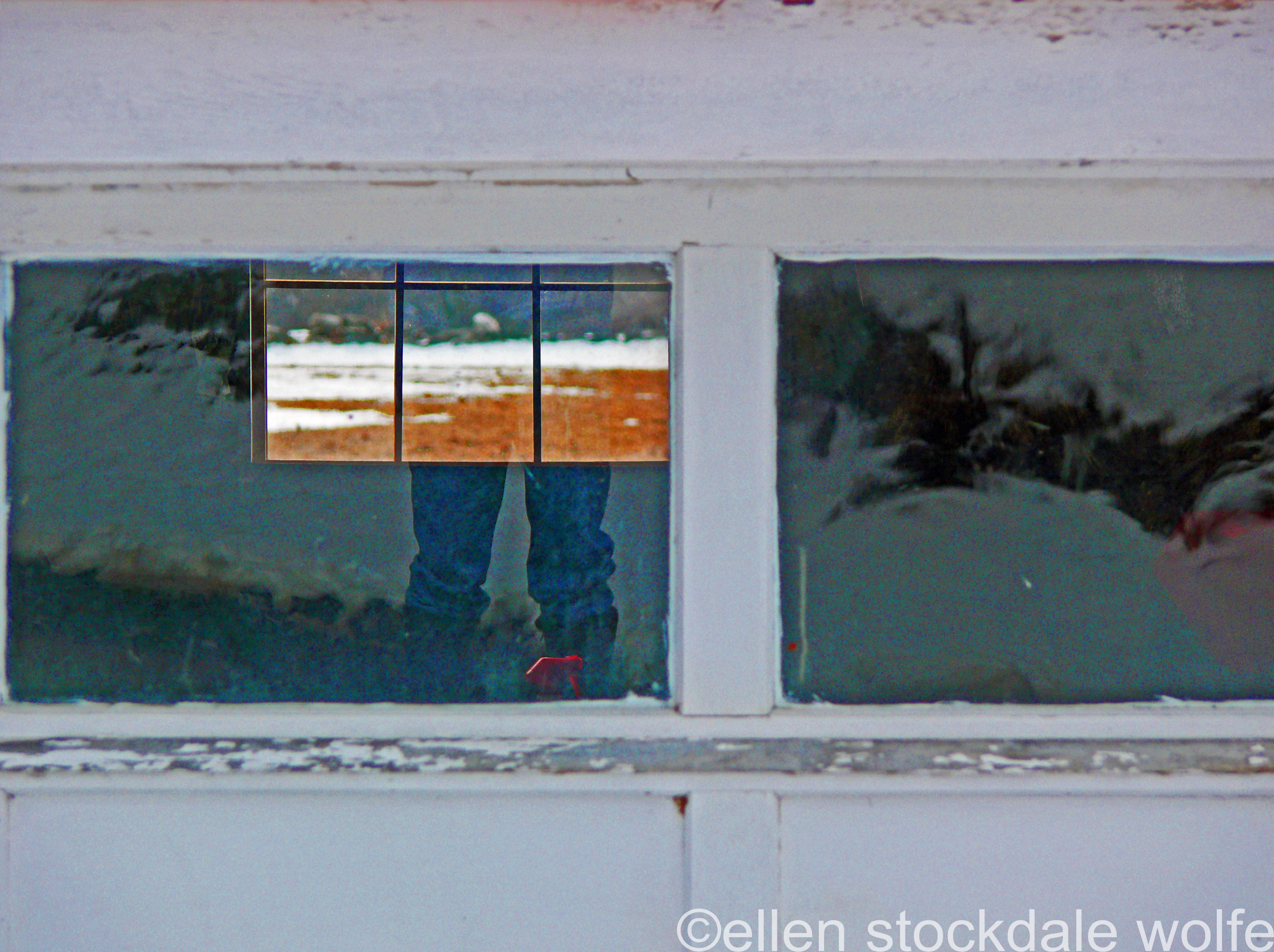
Old Barn with Window View

Could not resist the lovely curve of the roof of this little red barn– some might call old age sag.
Vestigial Remnants of Hibernation?
It is frigid outside and has been for a long time. It is very cold in many parts of the country. The holidays have come and gone. The hoopla of the inauguration is over. Now begins the nitty-gritty of hard winter work. I find myself listless and not wanting to go outside or exercise or paint or take pictures or do much of anything I usually love to do. I have a cold but that does not excuse this lassitude. When I go to my favorite deli, I find that Terry, the sandwich lady, is in the same mood. “I was ready to go home the moment I came in,” she says. My husband was dour and I was sour. What is the meaning of this discontent? Could it be some vestigial remnant of human hibernation? While man has never hibernated, science finds his metabolism slows down in winter and he becomes less active. Binging on food and drink over the holidays may not be the sole reason for weight gain in winter. Perhaps we should be sleeping off the extra pounds.
I who love winter and live for fall each summer, find myself longing to hear the music of the spring peepers. It is months away– well about a month and a half away. They signal for me the first harbingers of new life. Terry, who also loves winter, tells me today she is sick of winter as she makes our sandwiches. Perhaps it is this string of Arctic air and grey days and icy road conditions and snow every few days. Perhaps, and more likely, it is the human condition to always be dissatisfied.
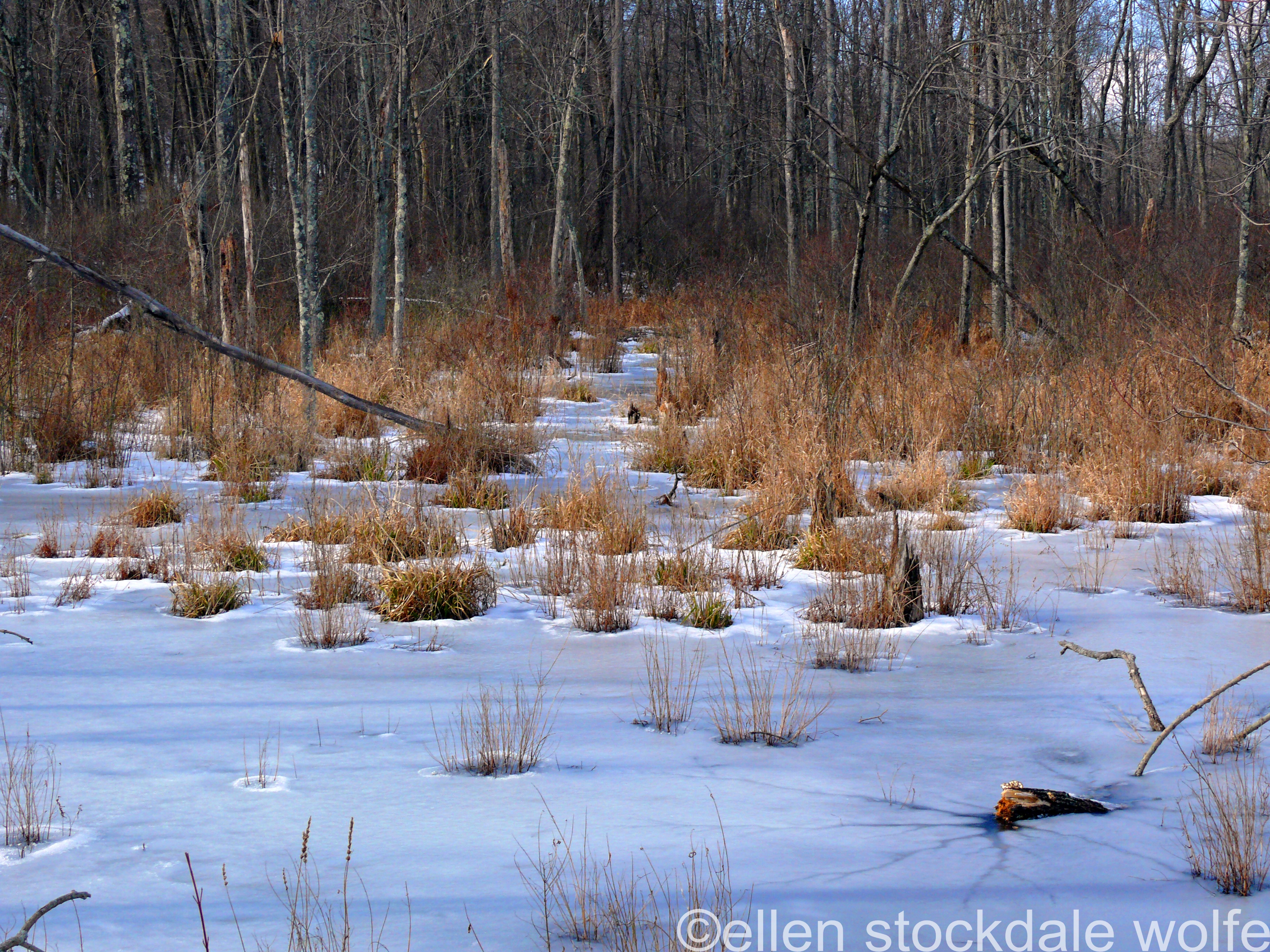 Hibernaculum for turtles and other animals
I miss the squirrels. It has been so cold and snowy they seem to be laying low in their nests. Judging from the tracks in the snow the animals most on the move are the deer. And as much as I love the silence of winter, I find myself longing for the sweet dulcet music of birdsong at mating season in spring.
We bought a calendar for the new year with a celestial map of the sky for each month so you can find the constellations in the night sky. We have yet to go out with flashlights and match the map with the canopy of stars. It has been too overcast or too cold or too something. But my dazzled psyche is humbled by the view of the stars through the stripped down trees that we see from bed every night.
Then again maybe it is laziness. Too many sugar highs in December have led to a deep low in February. And after a tease of spring one day in which the temperature reached almost 60 degrees we were let down even further. Not liking being unproductive, I think I can overcome this. But maybe I should just go with the flow and accept a period of inactivity, let the land lay fallow, so that an increase in productivity may eventually result.
I know I should focus on what is positive. Winter is the season of silent beauty that I so long for in the summer heat. I delight in the quiet of winter days. The snows bring a hushed stillness good for the soul. It is a time to regroup. Spring will come. Hopefully if man has not destroyed all the vernal pools, the spring peepers will return. And if pesticides have not destroyed all the birds, sweet mating songs will be sung. And if the weather turns more clement, our spirits will soar once again, and we will be busy bees making honey while the sun shines.


Aspie Empathy
There is a saying in Tibetan, ‘Tragedy should be utilized as a source of strength.’
No matter what sort of difficulties, how painful experience is, if we lose our hope, that’s our real disaster.
By Dalai Lama XIV
Pema Chodron says Pain has its virtues.
Asperger’s Syndrome (AS), an Autistic Spectrum Disorder on the mild end of the spectrum, is often characterized by a supposed lack of empathy. What it really means, and many professionals still do not know this, is that there is a different kind of empathy. An empathy in which we, Aspies, are so overrun with feelings that our system crashes– to use a computer analogy.
For example, my aunt is on death’s door and my cousin calls to give me the news. Suddenly she starts crying hysterically and shouting that her mother can’t die and leave her, that she needs her mother, and conveying a powerful sadness. I start crying, too, and try to say some words of comfort or of wisdom acquired from losing my own parents. All pales and I am reduced to stuttering. Why does this happen? I am overcome with her feelings and feel them myself. And the computer freezes up. System crash– whereas, a Neurotypical (NT) would know what to say and be sympathetic and empathetic and help my cousin. I make vague attempts that wind up as feeble words. Does that mean I am an unfeeling person? No. Ineffectual, yes. And maybe seen as heartless despite my attempt to convey love and sympathy for what my cousin is going through.
Another example shows me as a monstrous teen. I am 15 and my mother gets a phone call and starts crying hysterically. I immediately know it means that Grandpa is dead. I adored my grandfather and had a very special relationship with him. In some ways which I will not go into here, too special in a not-good way, especially for so young a child. I know there is no room for my grief. It is only my mother’s that counts. There is no one to go to with the devastation I feel inside. So how do I express it? Do I cry? No. I say to my father, “I guess we won’t be having hamburgers for dinner.” A totally callous remark. And my father chastises me for being “unfeeling”—for my lack of empathy, when all the time I am in great pain inside. This on the surface is what Asperger’s lack of empathy looks and sounds like. Underneath the surface there is a chaos of feelings rampaging within. Now an NT might actually feel less deeply, but would act and say something appropriate and certainly wouldn’t make a remark like the hamburger one. It is not that I wanted hamburgers– I hated them. To this day, I don’t know why that remark slipped out.
Things like that still happen. I did not get officially diagnosed with AS until age 61, though I knew I was autistic decades before, having worked with autistic children on the serious end of the spectrum. Aspies feel emotion and shut down, just like an overloaded computer. It does not mean that they have no feelings nor empathy. It is a different kind of feeling and empathy. And I have noticed a tremendous reservoir of feeling for animals that can be expressed more easily, for animals are so less threatening and more straightforward than human beings. If I were more intelligent, I would become a vet. Now, whenever I can the chance with an animal, I give Reiki, which many animals respond to quite naturally. It is definitely easier to give Reiki to an animal rather than to a human being. My husband is the one exception. He is a special case, lumped in with non-humans simply because I am so comfortable with him, a high-functioning Aspie himself.
I learned to try to pass for normal– in some ways, quite successfully. I became an expert observer of people though I could not, and still cannot, interpret what I observe. But I owe my success to my mother having a mood disorder which got passed down to me as Bipolar Disorder– and to my father being an alcoholic. Why? Because in order to survive, to minimize fear and pain, I had to become a keen observer of my mother’s moods before she lashed out at me. I would scour her face for every nuance of mood although I still seldom knew what was to come. This extreme vigilance served to protect myself. Similarly with my father. I would study him, scrutinize his behavior when he came in the door on the rare nights he came home when he said he would, and did not stay out drinking. Just because he came home early did not mean he was not drunk. A facial expression, a different gait wherein he tried to walk normally, the way he said hello, would give it away. I became expert at detecting drinking, often knowing long before my mother did that he was drunk and would tell her. She wouldn’t always believe me. I was terrified of my father when he was inebriated. Once, as a very little girl, I heard him sick in the middle of the night and my mother was with him in the bathroom, semi-hysterical, yelling at him for my father was obviously out of control. I felt sick myself, tried to drown out the sounds with a pillow, and was scared to death I would have to run to the bathroom and be ill also. This turned into a life-long phobia and obsession. I loved my father but when he was drunk I didn’t want him anywhere near me. And sometimes, especially when drinking gin, he could be mean. Were his true feelings coming out—“In Vino Veritas” or were they just drunken ramblings of a disturbed mind? For he did have a disturbed mind, an outcome of a tragic childhood and he used alcohol to self-medicate his demons. His father was an alcoholic, too.
Pain has its virtues. I learned to study people and became so astute that it hid my Asperger’s symptoms for years. Female Aspies seem to be better at hiding their disability than males. I learned to study people but I still cannot decipher what expressions mean. I can see something happening on the face but am often still not be able to tell what it means. This just increases what is already acute social anxiety and is hard to translate into socially appropriate responses.
“Tragedy should be utilized as a source of strength.” Certainly my childhood was not a tragedy by any means. But parts of it were tough and those parts made me strong.
Next time you see an Aspie act without empathy, especially a child, you might check in with them to see just what they are feeling. I would wager that they are feeling a great deal and simply cannot process or express their feelings.
When the Snows Come
Sitting in our living room, with all the little, dairy barn windows alive with falling flakes of snow, it is as if my husband and I were on a ship, floating on a sea of white. The living room in our converted dairy barn has the feeling of a ship cabin, and I think it most beautiful when the snow is falling.
The glass doors in the kitchen give us perfect view of the bird feeder, our television in all seasons. In winter we watch male cardinals, bright red in the stark white, feed and contend with the beautiful, bullying blue jays. And the more modest, gentle, tiny juncos and sparrows touch our hearts with their humility.
One winter, when the snow had covered the ground for a month or so and turned to solid ice, we watched, horrified, as squirrels clawed at the feeder and fought with one another for a chance to feed, making shrill cries of territoriality. The ground was too frozen for them to retrieve the nuts they had buried in the fall. They were fighting off starvation.
Waking up in the morning there is no need for a weather report as we see the snow piled high on the surrounding trees and see the sky through what used to be the hayloft door, now a cathedral window. The thermometer tells us how cold it is though we can feel the chill in the air. We gauge the depth of the snowfall by watching the squirrels running along the limbs of the trees, cleaning off the heavy snow. They seem friskiest just after a snowfall.
And if we are lucky, and the snow is deep enough, we get out our snow-shoes and climb up the hill out back to what we were told was once a Christian Indian burial ground. There are no markers left but the spot has the air of the sacred and it affords mountain views in winter. High on the hill overlooking the valley, it seems a perfect place for a burial ground. The snowfall makes it easier to walk the hill. In the summer the path is too full of saplings and underbrush to walk the “meadow.”
On our half of the meadow there is a squat fir tree which provides a great shelter for deer in a storm and the deer love the meadow. There are a few blown over trees. And as we snow-shoe we see all kinds of animal tracks which we attempt to identify.
Like many barns, ours was built near the road so there is some traffic noise. But in the meadow we are far removed from the road. When it snows, it is so beautiful in the quiet, looking at the animal tracks, and feeling the spirits in the graveyard. A secret, little piece of Paradise. And to stand there in the virgin white silence, and see the abstract patterns of the snow on the surrounding hundreds of trees, is a taste of the Divine.
Ice-formations
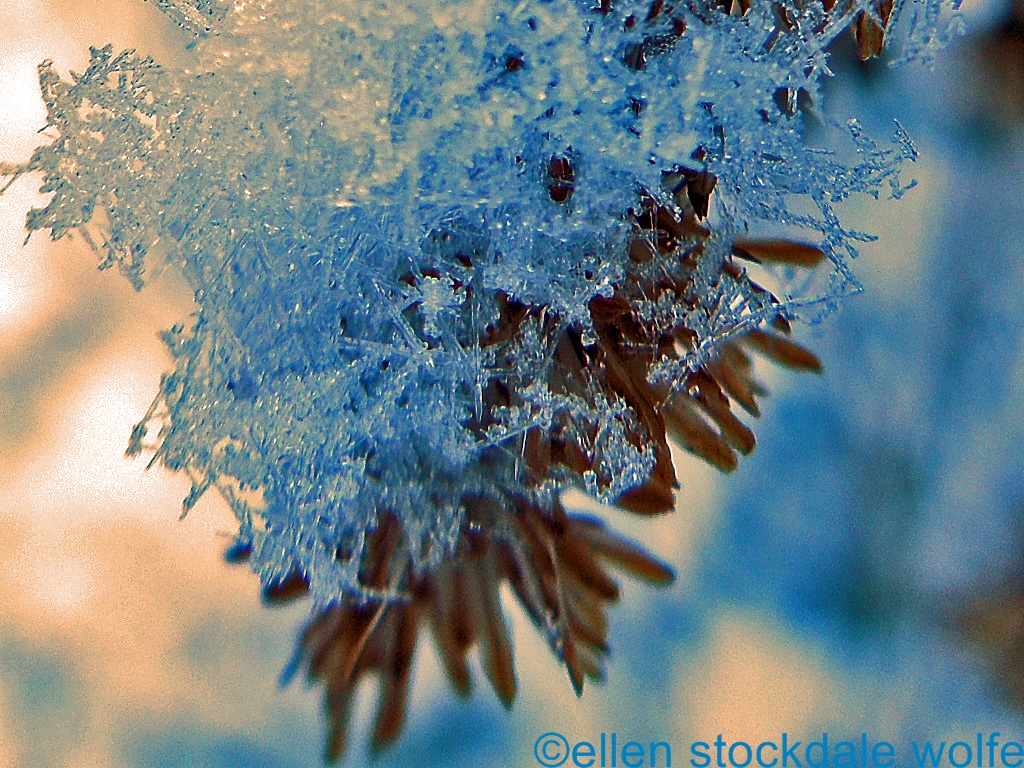
“Thou art everywhere;
Where’er Thou art, perfection’s there” ~ Paramahansa Yogananda










 MOONSIDE
You must be logged in to post a comment.