“It is so interesting to see the marvelous evolution of complex matter from the singular consciousness of Spirit. How intricate it is, and yet so simple” ~ Paramahansa Yogananda
“It is so interesting to see the marvelous evolution of complex matter from the singular consciousness of Spirit. How intricate it is, and yet so simple” ~ Paramahansa Yogananda
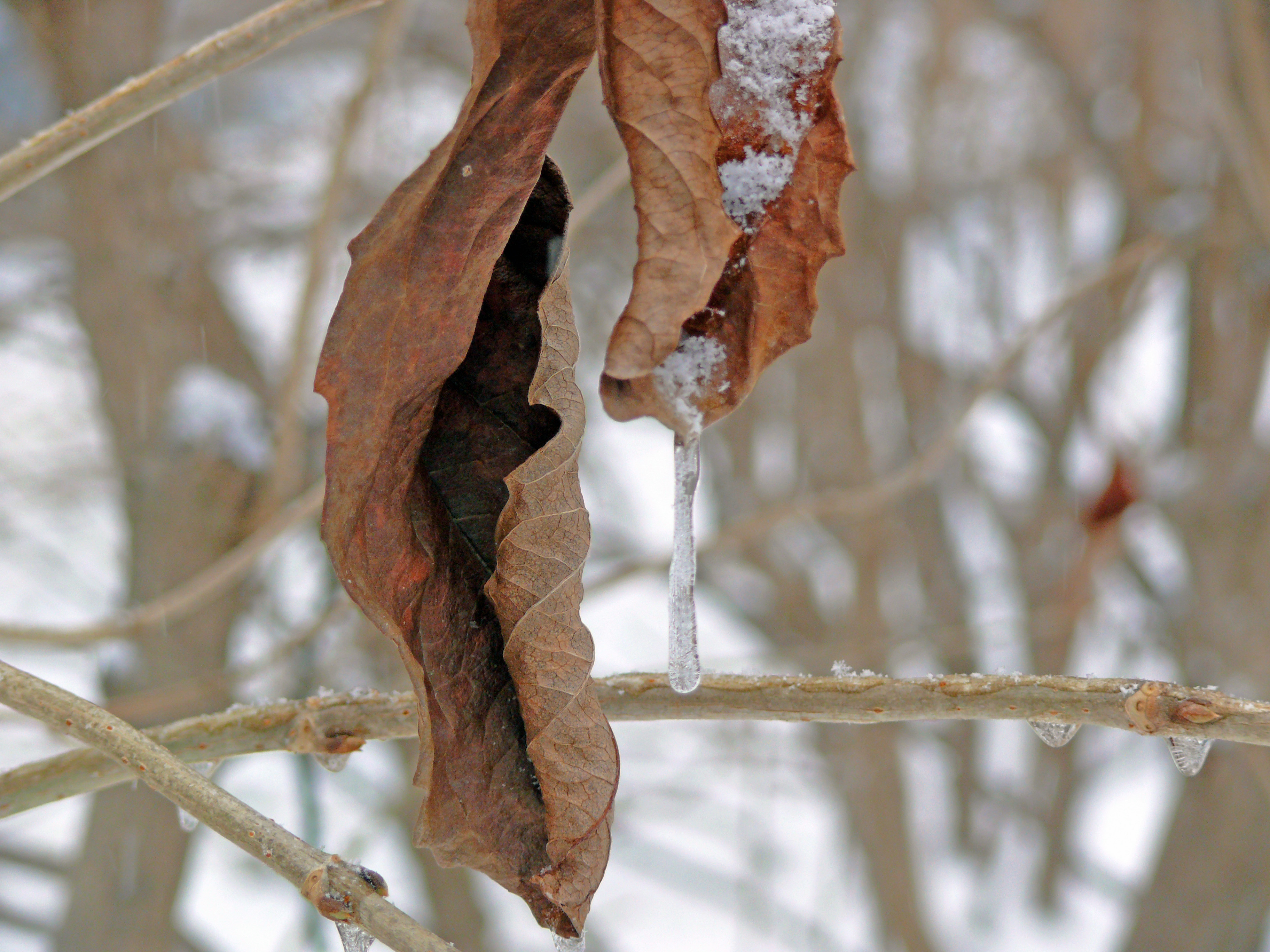
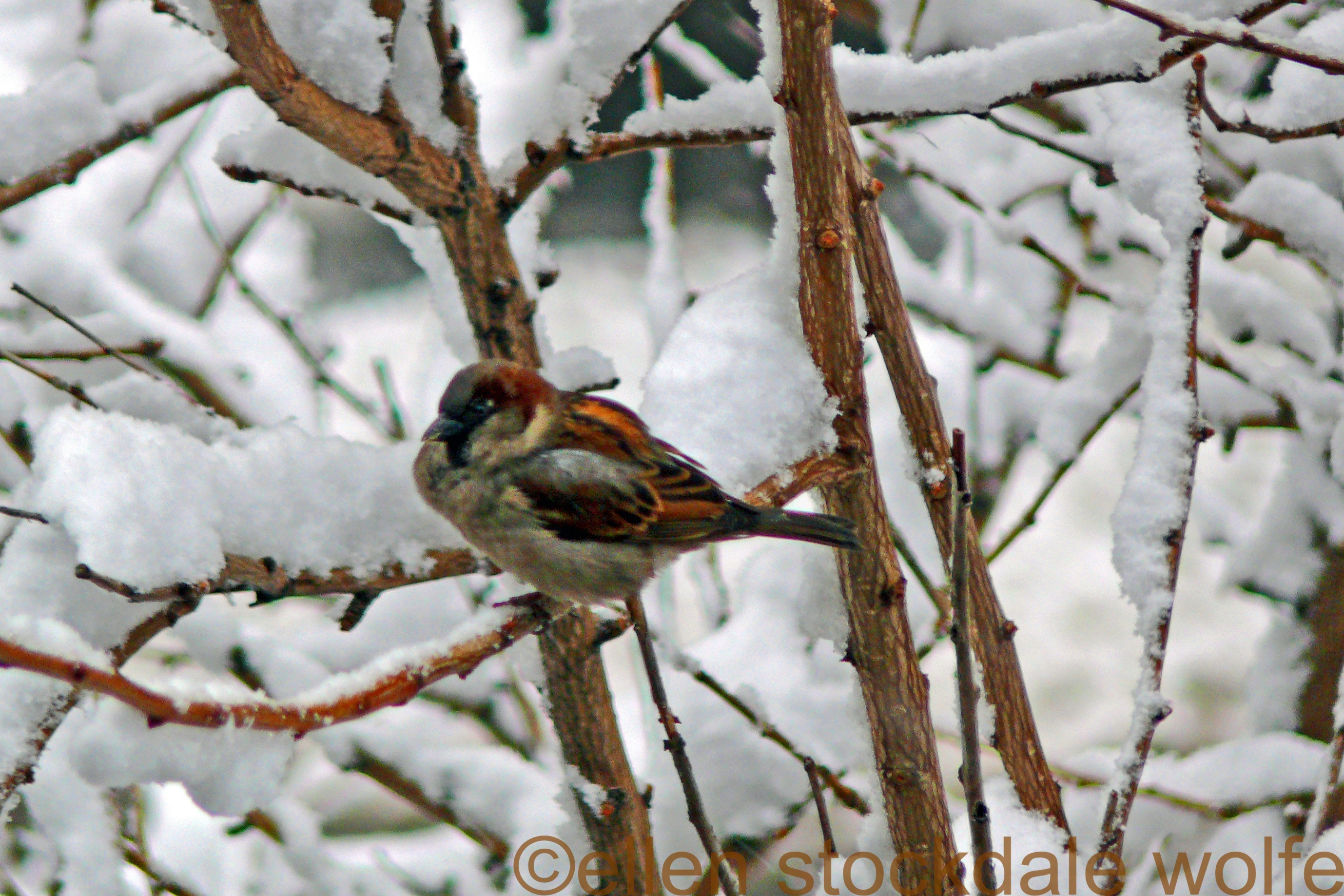 It is an overcast day. Brightly colored birds stand out like jewels in the greyness. The sparrows blend into the wooded grey/brown of snow-covered shrubs. The ever-present sparrows and the winter birds– jays and cardinals, juncos, black-capped chickadees, white-breasted nuthatches and downy woodpeckers– flock to the bird feeder which now has to be filled up almost every day. The red berries on the bushes are nearly all gone and the feeder is becoming a matter of survival. On our walks we see empty nests held in the bare arms of winter trees. An empty robin’s nest is filled with snow– the hatchlings and the mother long gone to fairer climes. The trees are stripped down to their souls. With ice storms they become tinkling chandeliers. In the rain the few remaining dead leaves drip drops of icy tears.
Occasionally a dove visits the feeder. The chipmunk, who gathered scattered seeds under the feeder all fall, is not to be seen. He must be in torpor in his den. According to Bernd Heinrich in: The Winter World: the Ingenuity of Animal Survival, the eastern chipmunk builds a twelve-foot storage system with a nest chamber some three feet down and a network of tunnels which includes a food storage chamber. Heinrich says chipmunks go in and out of torpor. He reasons that they would not gather food if they were to be in torpor all winter long. We will probably not see our chipmunk for the rest of the winter for, in his stuporous state, he would be easy prey. However he can be roused to eat and venture outdoors if need be, especially in March when there still may be snow on the ground but mating season begins.
The grey squirrels are busy clearing snow from branches as they run along tree limbs. On the ground they dig through the snow for the walnuts we watched them bury in the ground with their noses this fall. They do not need to hibernate for they have food stores which they built up in the autumn– and leafy, well-insulated nests. The red squirrels survive winter by putting on thick, insulating fur.
The back yard is a maze of tunnels. We think they are deer mouse tunnels as many have tunneled their way into our house. But they must get by the feral cat who sometimes waits out a snow storm under our deck. In the woods, the occasional deer waits out the same storm under a squat fir tree. The tracks in the snow tell the story of how they weathered a Nor’Easter.
Beneath the tracks in the snow, in the frozen leaf litter, the insect world is dormant. Some hibernate. Others fill their bodies with antifreeze, glycerol, to stay alive. Heinrich talks about woolly bears hibernating but they are also capable of freezing solid and surviving, coming to life again as they thaw in the spring. The pupae, however, don’t survive being frozen.
In Winter: an Ecological Handbook, authors, James C. Halfpenny, Elizabeth Besiot and Roy Douglas Ozonne, tell us that the reptiles and amphibians pick out a “microclimate for hibernation that does not freeze” for their winter, such as the “bottoms of ponds, streams, or deep in the ground.”
Our stream flows out back in the marsh under ice and snow and one can see the elongated bubbles of running water. In the pond next door the turtles lay beneath the ice in their hibernacula. At the end of the book, The Year of the Turtle, David M. Carroll, the naturalist, author and artist, has his watercolor of a spotted turtle hibernating. This picture is hypnotic and in its spell, I think of all the animals hibernating beneath our feet in lugubrious gloom. It reminds me of the penguins in the film, The March of the Penguins, huddled together for warmth in the harsh, strong winds and snow, taking turns being on the outside of the huddle. Winter can be magnificent in its transformations yet tragic in its harshness. Hibernating animals who freeze to death and deer starving in the snow are among the victims of its violence.
Carroll’s drawing shows the turtle all alone, withdrawn into its shell under less than two feet of water, lodged firmly in the mud under ice and under snow on a sunny winter’s day, a far better clime than the penguin’s– and yet it evokes a certain sadness for this little creature all alone beneath the snow, in a torpid state. The turtle is missing out on the days and nights, sleeping a deep sleep in a “half year of stillness.”
Carroll’s writing is sheer poetry as he describes the turtle’s hibernation: “Mounting layers of snow silently cover the ice. Night after night in the harshest depth of winter, as Orion and the Pleiades burn distant and brilliant in the black sky and strong winds howl off the mountain to the northwest, the turtles rest beneath the ice. With the life in them nearly suspended, reduced to its most tenuous hold, all but extinct in the vast, inhospitable regime that reaches above them to the limits of the universe, they lie within their shells, waiting for the earth to make its required turnings and return them to the sun that will awaken them to another season.”
I think of the turtles below, along with all the other beautiful creatures, and wish them a kind sleep from which they will safely stir as the life force surges through their veins again when the sun brings them to the fullness of life in spring. The death of some, and the half-life of so many, proffers the poignancy of winter.
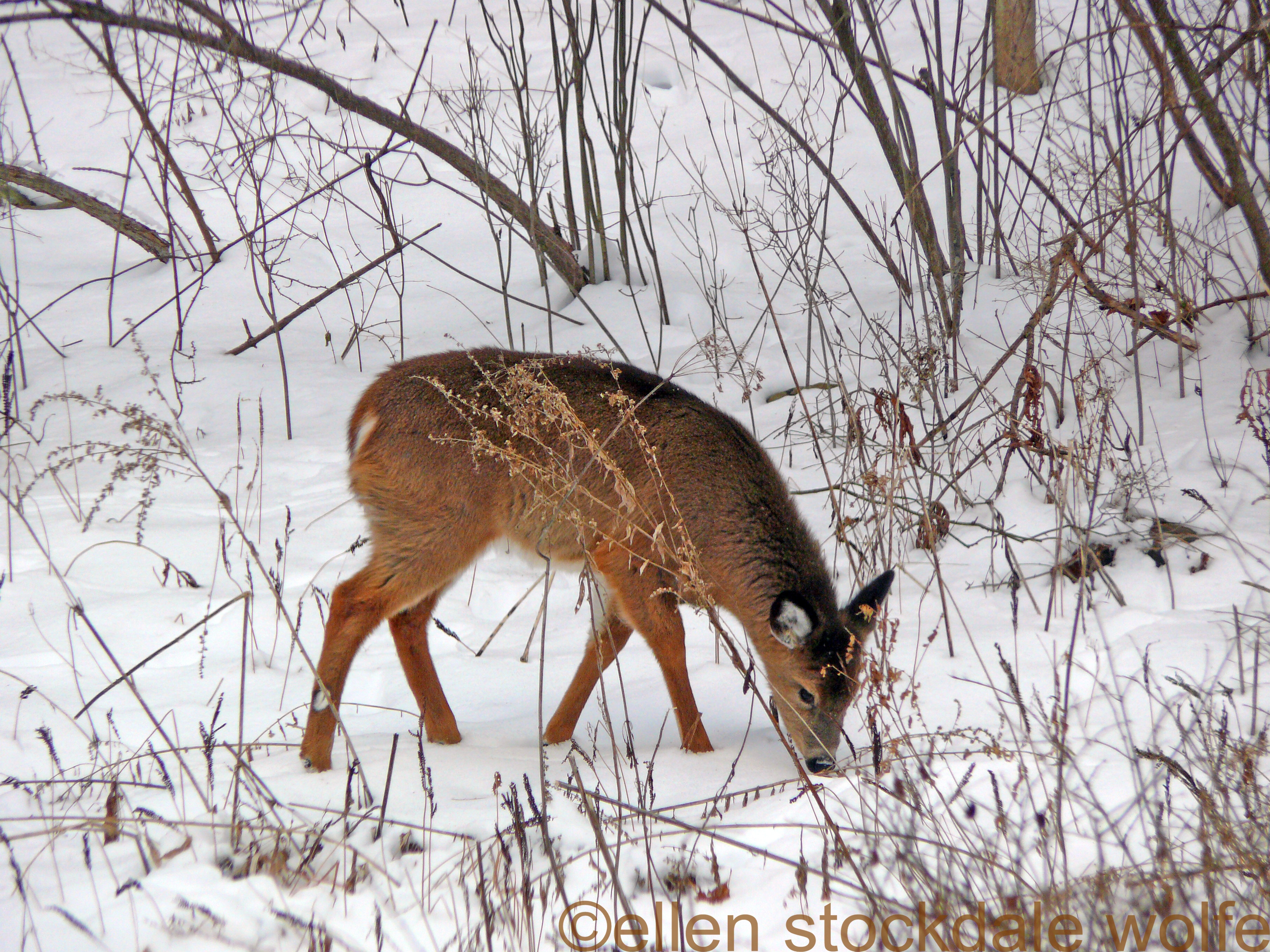
This “tres sensible,” furry doe appeared in our backyard one morning, showing no fear of us as we went about our activities. It pains me that Vassar College has hired hunters to feed deer, luring them to their death for mercenary gain in some non-sensical culling. As if hunting season weren’t bad enough. My heart sank for this fearless doe, unafraid of us. She must learn to be afraid of humans because humans are cold-hearted killers, hiding under the guise of sportsmanship and pest control. What kind of sport is this to entice deer to an area using food as bait and then, when trust is established, shooting them? It makes me ashamed of the human race. Issac Bashevis Singer, who fled the Nazis himself, and whose mother and brother were killed in the Camps, writes most eloquently on the subject in his ode to a mouse:
“What do they know—all these scholars, all these philosophers, all the leaders of the world—about such as you? They have convinced themselves that man, the worst transgressor of all the species, is the crown of creation. All other creatures were created merely to provide him with food, pelts, to be tormented, exterminated. In relation to them, all people are Nazis; for the animals it is an eternal Treblinka.”
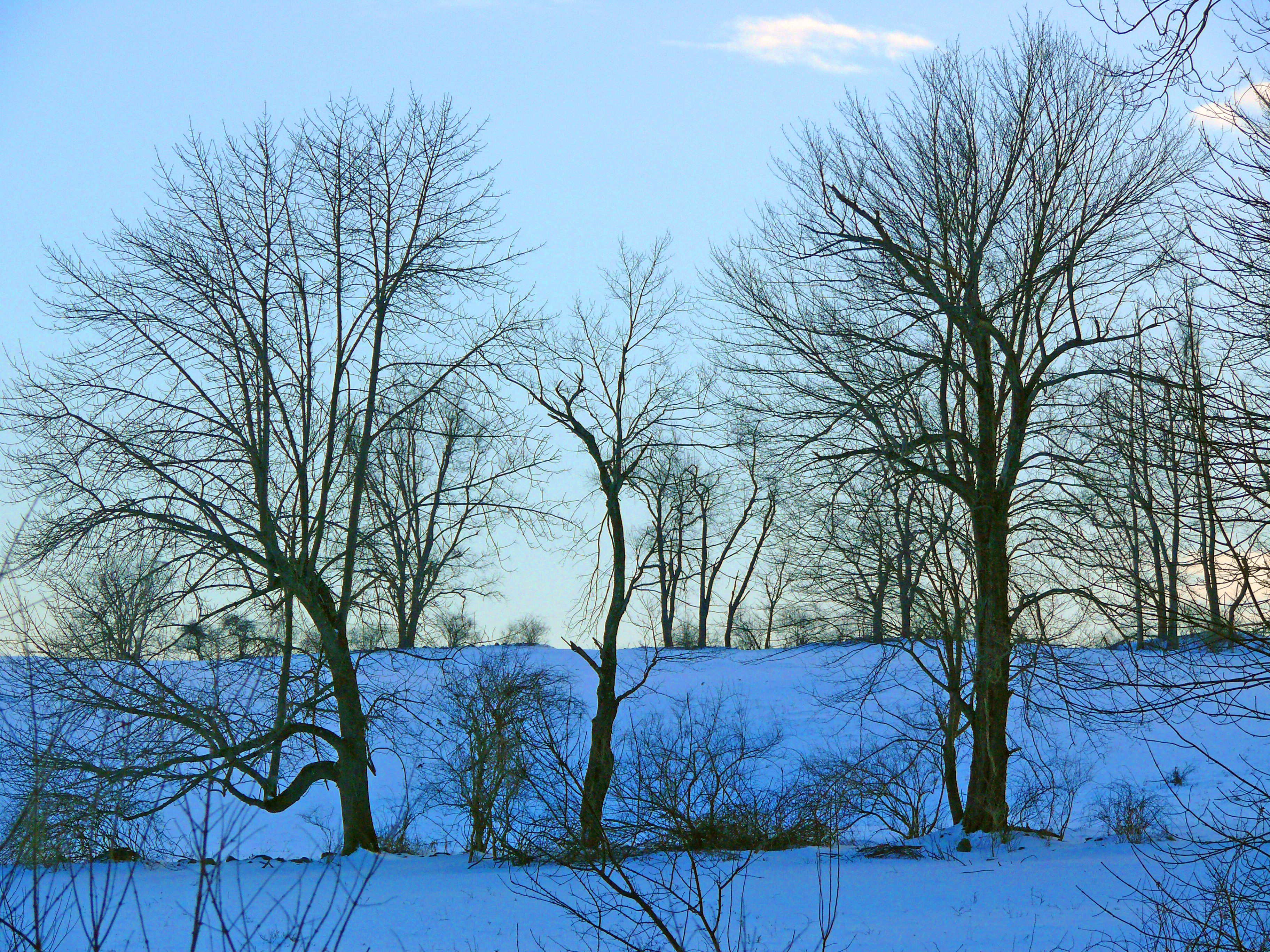 Every year what starts as a budding romance in autumn blossoms into a full-blown love affair in winter– my pitter-patter passion for trees. Trees that were drop-dead-gorgeous in their fall colors are now bare, with the exception of evergreens and a few stray deciduous trees that refuse to relinquish their leaves. Stripped down to their souls and the trees sing a siren song to the universe.
The tops of trees lift my spirit; brush-like they paint the sky with the baby pinks and blues of mornings, and the majestic magentas and violets of day’s end. Each tree has its signature shape against the sky, like a fingerprint or a snowflake– similar yet each unique. In their bare state, some treetops are shaped into fancy coiffures– others into wrought iron filigree. On distant mountains, against the snowy ground, still others assume the image of stubble on an old man’s unshaven face.
It is the colorful winter sky showing through, and showing off, the bare branches that woos me. The bare, curvaceous branches are stark, dark lines against the bright of day and the inky sky of night. These resplendent creatures are living lines that explode. Branches tangle like the lines in a Jackson Pollock painting. Others curve with the sensuous lines of a Brancusi sculpture. Buxom tree trunks stand strong surrounded by their dead blossoms and their burgeoning offspring like a Renaissance Madonna. In truth these trees are not like art at all. Rather art imitates them– their beauty provides the timeless inspiration for artists, writers and poets of all ages and styles.
Trees not only inspire, they are paragons of diversity. One look out of a car window while driving on the Taconic and one can see squat pines beside towering majestic firs, birches interspersed with maple and oak. And together the different brown and tan barks interspersed with evergreens create not only a mosaic of contrasting colors, but display an example to inspire humans to live together in peaceful unity.
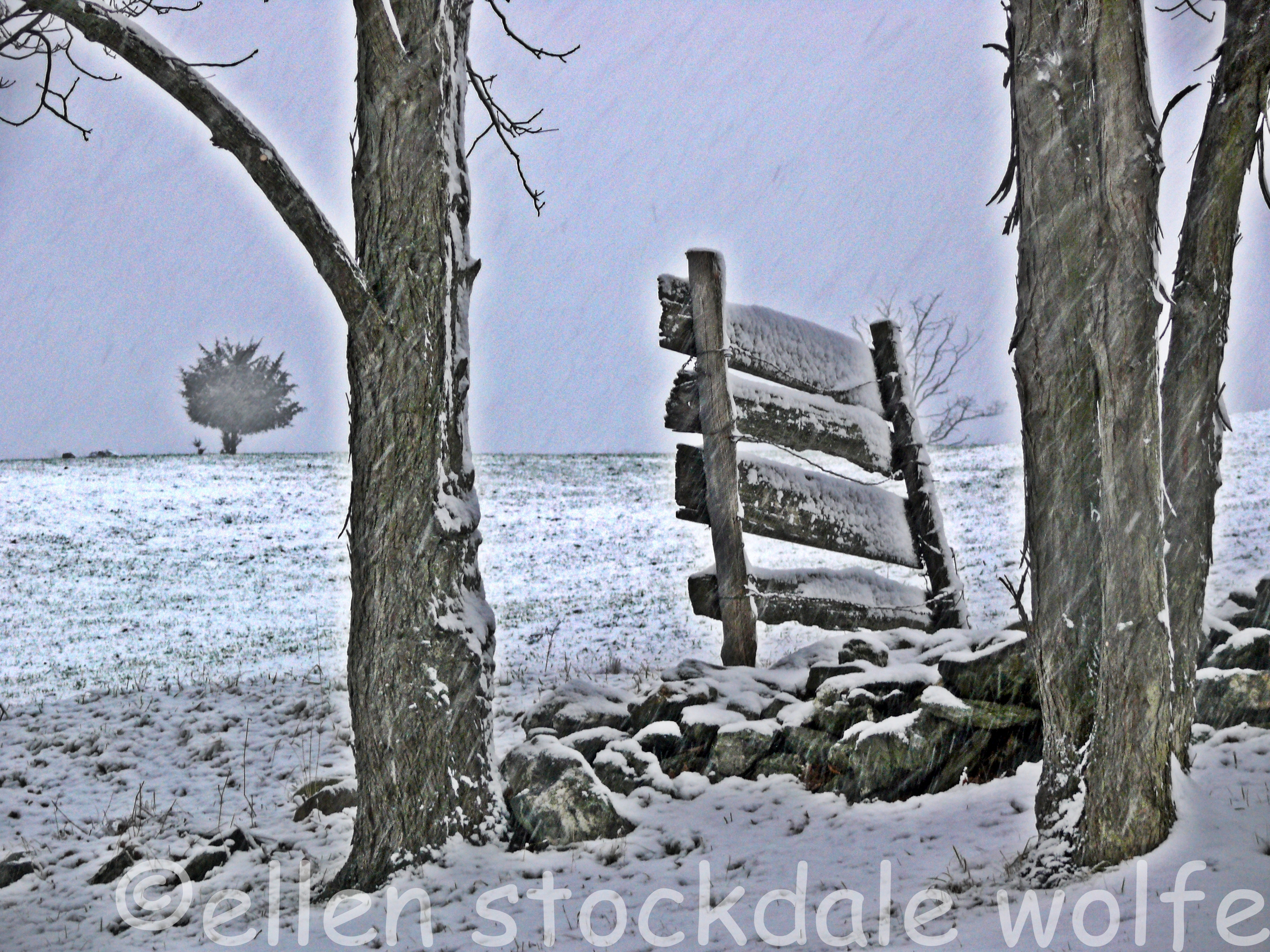
These beneficent beings carry the heavy, dark grey clouds of winter. When it snows the tree trunks become canvases for the abstract patterns of windblown-snow, while the serpentine branches are outlined in white. In ice storms their branches become chandeliers, each with glassine ice crystals tinkling in the wind. In the melancholy of a winter rain, the branches become oiled skins of snakes weeping to the ground below. And finally, in the night sky, the branches hold the stars in their arms, those with leaves, in their hands, as they nurse the moon.
All trees, no matter what their species, age or height, stand tall in proud humility, their arms reaching up to the Heavens to our Creator in prayer– soft-spoken beings of peace and tranquility towering over us, while we, wee, little creatures race around distractedly in a dither below.
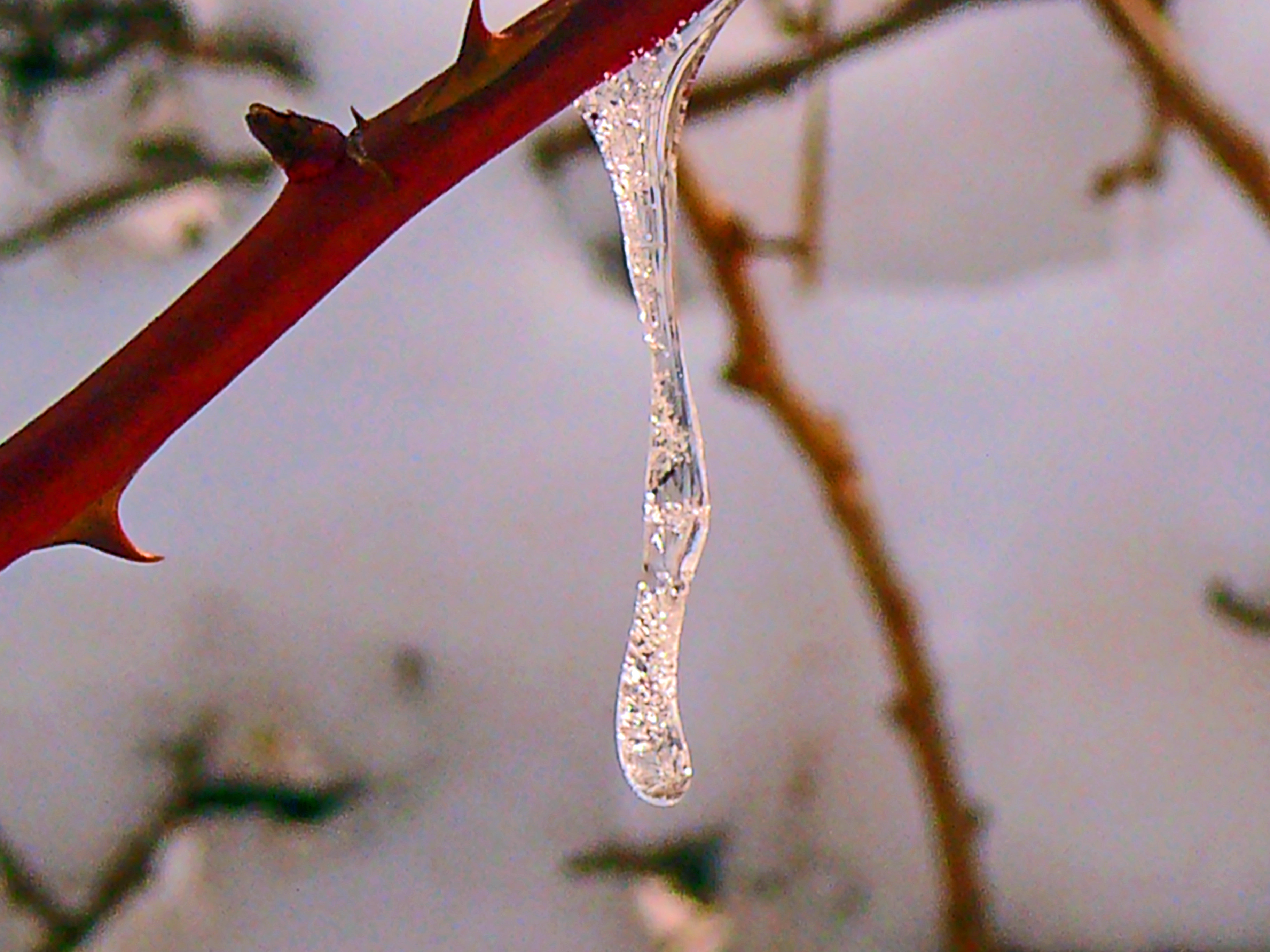 “As the solid substance we call ice appears from water, steam, or hydrogen-oxygen gas, so the solid earth with its oceans and vapors appears out of the universe of Cosmic Energy” ~ Paramahansa Yogananda










Nature's nuances in a nutshell
Kevin Brennan Writes About What It's Like
The World through Shaggie's eyes
Ravindra Kulkarni , Content Writer, Creative Writer and Story Teller
Drawing Norwegian Nature
Life in Kana-text (er... CONtext)
"Reflections, Insights, and inspiration for Every Journey"
poetry & art as sadhana in Shiva’s service
La poesía es la libertad del alma.
love each other like you're the lyric to their music
Experience The Finest Travel, Food and Lifestyle Stories Around The World
I upload photos & videos Golu lodhi village pairakhedi
True wealth is the wealth of the soul
gulfcoastpoet.com
Psychotherapy, Walk and Talk Therapy, Neurodiversity, Mindfulness, Emotional Wellbeing
"Exploring the Spiritual Cosmos in the Digital Universe," "Harmony Beyond Boundaries in the Digital Realm," "Your Gateway to Infinite Wisdom in the Digital Universe," "Connecting Consciousness Across the Virtual Cosmos," "Discover Divinity in the Digital Universe," "Where the Spirit Meets the Digital Frontier," "Empowering Inner Growth Through the Digital Universe," "Digital Universe, Infinite Spiritual Possibilities," "Awakening Souls Across the Digital Horizon," "Navigating Spiritual Journeys in a Boundless Digital Universe."
Photos, stories and more
Poems about the random (and more)
Mid-Life Ponderings
"قوتك تبدأ من هنا"
Peace 🕊️ | Spiritual 🌠 | 📚 Non-fiction | Motivation🔥 | Self-Love💕
Lyrics Of Life
exploring the dreamworld
LIBERTE - RESPECT- FORCE
The Art of Sustainable Glamour
Christian Writings, Testimonies, Prayers and Inspiration, Poetry, Faith, Family, Trust, Religion, Christian, God, Jesus, Jesus Christ, Being Crazy For Christ, Published Author, Chrisitan Books, Growing, Believe, Leo The Lion, David The Darvin Fox, Hope, Dreams, Christian, worship, Fantasy, Adventure,
Foundational Life Truths stories and pictures

 MOONSIDE
You must be logged in to post a comment.