Spring’s Siren Song

It is late afternoon and it is Spring by the calendar although still quite cool. And I have just spent the late afternoon listening to music. Some have likened it to the sound to bells. Others to bird song. And still others with unimaginable disdain, to “some kind of nature noise.” For me it is one of the happiest of sounds. The act of creation transformed into sound decibels for all to hear. A sound that comes from the earth and resounds to the heavens, unwittingly praising the Almighty. I hate to leave, and wish I lived even closer to the pond, so that the sound would surround me totally, filling my ears every evening with the sound of perhaps the single-most highlight of spring for me. The siren song of the Spring Peepers.
How have they cast their spell over so many? I cannot say except that their song is uplifting and filled with hope despite the natural perils they face daily. For, as true of all of us, they may die at any moment– say as a meal for a nearby perching crow or underneath murky waters eaten by a snapping turtle. They call for a mate without ceasing, without fear, single-mindedly, without a thought for their own safety. It is nature at its most elemental, in its most singular scope. They all sing out vying to be heard– so many voices. In some spots, I am told, their song is deafening. How nice to be there; I cannot get enough of their sweet music. It moves me to tears– these tiny creatures singing out their heart’s desire.
As I return home to family “situations” and domestic duties, I yearn for the simplicity of their song. Their total fervor. For if they sing then all is right in that small part of the world. Progress has not paved over their pond. Disdainful humans have not drained a “vernal pool.” David Carroll writes about vernal pools in one of his books on turtles called The Swampwalker’s Journal. As the title suggests, Carroll walks such places in search of turtles and other amphibians. He defines a vernal pool as a pool of water that fills up in Fall and Winter, swells in the Spring and often dries up by end of Summer. But a vernal pool is utmost a place of magic, not only a place where turtles lurk but where mating frogs deposit gelatinous eggs which turn into tadpoles first, and there, later become frogs. And after a requisite series of warm days, followed by spring rains, on the first dark night, vernal pools become the site of the “salamander night.” Salamanders leave their hibernacula to go for a night of endless mating and then return to leaf litter in the woods to disappear for the rest of the year. Some people who know nothing of vernal pools and their function deem them a nuisance, a “big puddle” to be filled in or drained. Some people know little of Spring Peepers except that they are “noisy,” “like some sort of insect.” Poor insects being made out to be the pesky lowest of the low. The natural symphony of hormonal, harmonic sounds sometimes falls on deaf ears.
And when, after finishing my evening chores, I try to read, I find the haunting sound of the Spring Peepers deep within my psyche, making me restless and anxious and wishing to be at that pond, surrounded on all sides by their sex song, inebriated by the unbridled joy in the air, immersed in the utter power of nature manifesting in one of her gentler forms. In the song of the Spring Peepers nature celebrates life-to-be rather than taking lives away. For most of all the song of the Spring Peepers is a song of tremendous faith, faith in love and faith that love will propagate and new life will emerge untouched by the oft destructive hand of man.
Jeepers Peepers

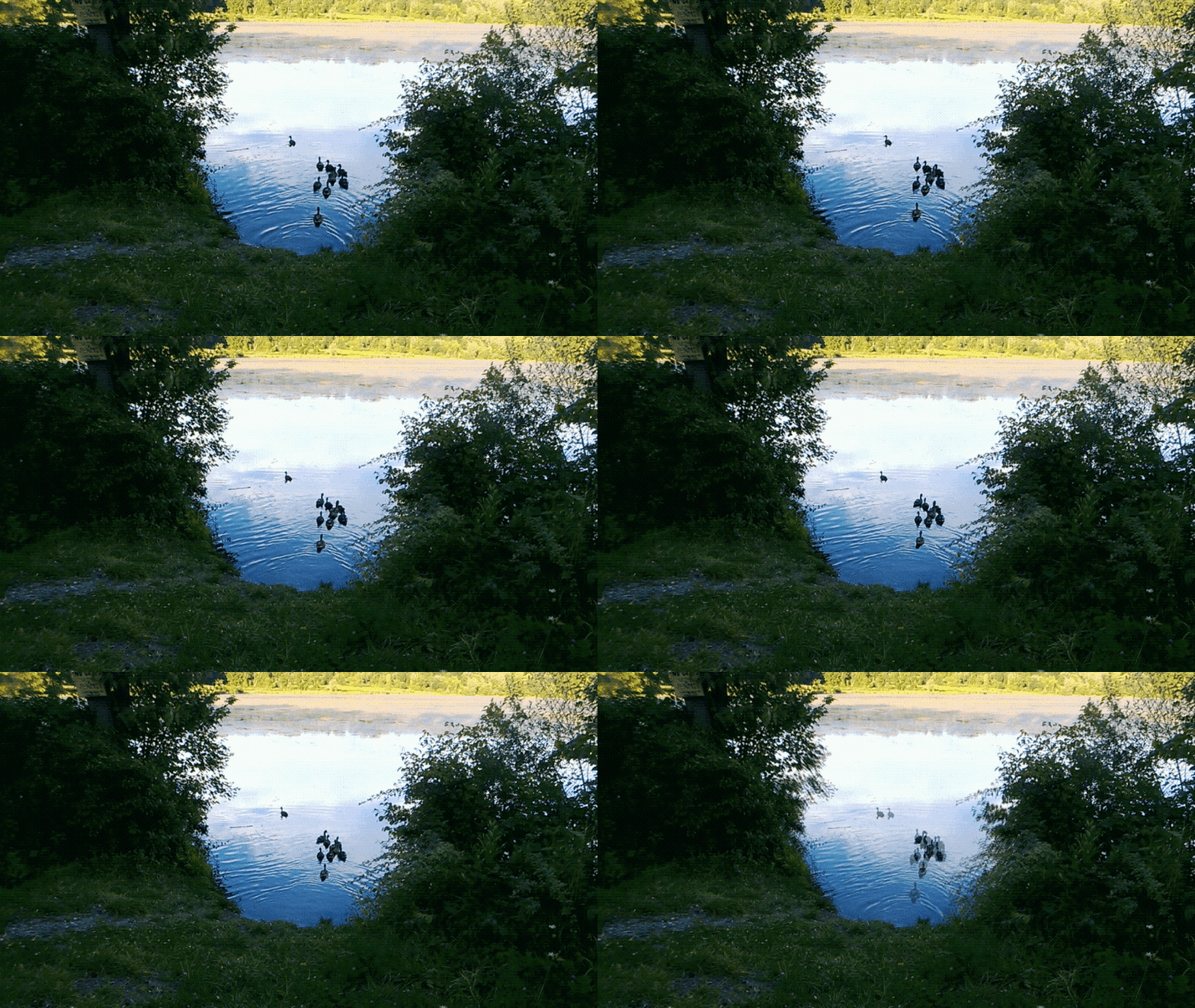
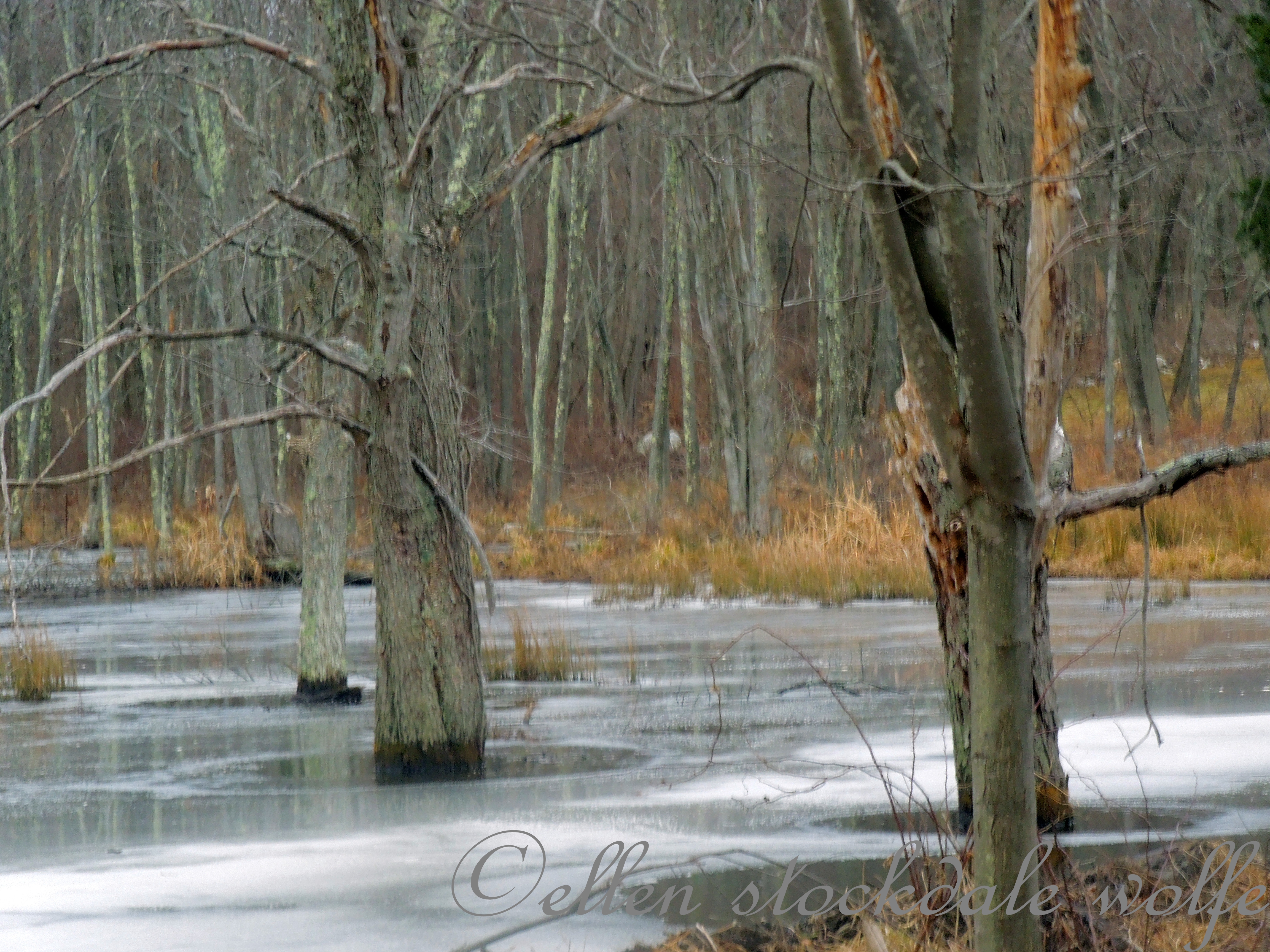
Above: the vernal pool not yet unfrozen and below: the YouTube video to hear the song of the Spring Peepers
It is late afternoon and it is spring according to the calendar although still quite cool. I have just spent the late afternoon listening to “music.” Some have likened it to the sound to bells. Others to bird song. And still others, with unimaginable disdain, to “some kind of nature noise.” For me it is one of the happiest of sounds. The act of creation transformed into sound decibels for all to hear. A sound that comes from the earth and resounds to the heavens, unwittingly praising the Almighty. I hate to leave, and wish I lived even closer to the pond, so that the sound would surround me totally, filling my ears every evening with the sound of perhaps the single-most highlight of spring for me. The siren song of the Spring Peepers.
How have they cast their spell over so many? I cannot say except that their song is uplifting and filled with hope despite the natural perils they face daily. For, as true of all of us, they may die at any moment– say as a meal for a nearby perching crow or underneath murky waters eaten by a snapping turtle. They call for a mate without ceasing, without fear, single-mindedly, without a thought for their own safety. It is nature at its most elemental, in its most singular scope. They all sing out vying to be heard– so many voices. In some spots, I am told, their song is deafening. How nice to be there; I cannot get enough of their sweet music. It moves me to tears– these tiny creatures singing out their heart’s desire.
As I return home to family “situations” and domestic duties, I yearn for the simplicity of their song. Their total fervor. For if they sing then all is right in that small part of the world. Progress has not paved over their pond. Disdainful humans have not drained a “vernal pool.” David Carroll writes about vernal pools in one of his books on turtles called The Swampwalker’s Journal. As the title suggests, Carroll walks through such places in search of turtles and other amphibians. He defines a vernal pool as a pool of water that fills up in Fall and Winter and freezes, swells in the Spring and often dries up by end of Summer. But a vernal pool is utmost a place of magic, not only where turtles lurk, but also where mating frogs deposit gelatinous eggs, which turn first into tadpoles, and then, later, become frogs. Vernal pool habitats hold a galaxy of small things that come to life the instant ice and snow turn back into water. And after a requisite series of warm days, followed by spring rains, on the first dark night, vernal pools become the site of the “salamander night.” Salamanders leave their hibernacula to go for a night of endless mating and then return to leaf litter in the woods to disappear for the rest of the year. Some people, who know nothing of vernal pools and their function, deem them a nuisance, a “big puddle” to be filled in or drained. Some people know little of spring peepers except that they are “noisy,” “like some sort of insect.” (Poor insects being made out to be the pesky lowest of the low.) The natural symphony of hormonal, harmonic sounds sometimes falls on deaf ears.
And when, after finishing my evening chores, I try to read, I find the haunting sound of the spring peepers deep within my psyche, making me restless and anxious and wishing to be at that pond, surrounded on all sides by their sex song, inebriated by the unbridled joy in the air, immersed in the utter power of nature manifesting in one of her gentler forms. In the song of the Spring Peepers nature celebrates life-to-be rather than taking lives away. For most of all the song of the Spring Peepers is a song of tremendous faith, faith in love, and faith that love will propagate and new life will emerge untouched by the often destructive hand of man.
************
To read about and/or give to Michael’s foundation for orphan and street children in Uganda, click on the link below the picture of Michael and Angie:

http://www.gofundme.com/f/sustainability-support-for-the-Makindye-Foundation
Jeepers, Peepers
When nature awakens in late March or early April, sap starts flowing in the trees and ice changes to water marking the end of hibernation. This is the grand opening of the wetlands and the pilgrimage to the vernal pools as David M. Carroll writes in his “Swampwalker’s Journal: a Wetlands Year.” A vernal pool is a body of water which fills up in autumn and winter and is swollen in the spring but often dries up completely by the end of the summer. Carroll describes vernal pools so beautifully: “It is at snowmelt and ice-out, the last sleets, first rains, and the earliest warming breaths of spring that they beckon wood frogs, salamanders, and spring peepers from surrounding upland woods, where they have passed the winter in rotted-out trees roots [a reason not to ‘clean up’ the woods], under layers of bark and litter, in small mammal tunnels and other hibernacula in the earth.” The melting snow heralds the march of the amphibians. “Vernal pool habitats hold a galaxy of small things that come to life the instant ice and snow turn back into water.”
Carroll walks the swamps, as the title of his book suggests, in search of mating salamanders and spotted turtles, bogs, fens and all wetland flora and fauna. He tells us that there must be a certain collusion of events– several warm days in a row followed by a darkest of nights with temperatures ideally in the mid-50s with rain preferably two nights in a row. And then the magical migration begins. The salamanders begin their “annual pilgrimage” to the vernal pond to mate.
My husband and I are lucky enough to have a vernal pond on the property next door to us and when Spring comes the sound at night from that pond makes us feel as if we are camping out next to a vast wetland. The music of the spring peepers plays through the night throughout the house, often starting overeagerly in the late afternoon. This manic symphony thrills us every year. It is the first sign of Spring for us. The quality of joyousness and the affirmation of life gladdens our souls. Going to sleep with that sound makes us remember what we so often forget, to give thanks to our Creator for his magnificent creatures.
Inspired by Carroll, one year we awaited the first dark, rainy warm night after a succession of warm days. In our rain gear, armed with flashlights we set out around 11PM to look for the march of the salamanders. We walked to the nearby pond. Nothing. We walked quite aways down a nearby dirt road that has run off but is not quite a vernal pond. We shone the flashlight this way and that. Nothing. We finally headed home disappointed and dejected and my husband started towards the front door when I yet out a yelp. There in the doorway was a 6 inch spotted salamander in all its glory! We never found the march of the salamanders but we were greeted by one of these fantastic amphibians right at our front door!
This story, however, does not have a happy ending. In his epilogue to the “Swampwalker’s Journal,” David Carroll explains why it took him more than 7 years to complete this book. He writes that he became involved in saving some of the wetlands in his book and says sadly nearly all of his interventions have or will become “losing battles.” He describes the plight of the wetlands, bogs and fens as a “landscape of loss.” And he scorns our human selfishness as he writes how it “reveals explicitly the extent to which we think of ourselves as owning all living things, along with the very earth, air, and water in which they live, as if we possessed some divinely mandated dominion over all creation.” He warns: “As we will learn in time none of this belongs to us.” I read these words, knowing them to be true and I think of the soon-to-be-extinct bog turtle and other creatures with the same possible fate. I think of the spotted salamander who came to our door, as did Shelley, the snapping turtle who returns to our drive way every year to lay her eggs and I think of the spring peepers whose joyous song heralds spring and I fear for their future.
A Barn in Winter

Bare branches
yearning towards
turquoise sky
with fast floating
sunlit white clouds
white above
white below
the snow
hides the land
of insects
and mice
and moles
and snakes
and in the vernal pool
next door
turtles sleep
in their hernaculum
while frogs lay
dormant in the mud
I sit in sleepy
surrender
glad to be
in our little hideaway
in the woods
of our young dreams
wondering
if we will all
awaken
to another Spring.
Spring Seraphic Singing
It is late afternoon and spring by the calendar, although still quite cool. I have just spent some time at our neighbor’s pond, listening to a form of music that some have likened to the sound to bells. Others liken it to bird song. And still others with unimaginable disdain, to “some kind of nature noise.” For me it is one of the happiest of sounds– the act of creation transformed into sound decibels for all to hear. A sound that comes from the earth and resounds to the heavens, unwittingly praising the Almighty. It is a form of ecstasy when the sound surrounds me totally, filling my ears every evening with perhaps the single-most highlight of spring for me– the siren song of the Spring Peepers counterbalanced by the deeper sound of wood frogs.
How have they cast their spell over so many? I cannot say except that their song is uplifting and filled with hope despite the natural perils they face daily. For, as true of all of us, they may die at any moment– say as a meal for a nearby perching crow or underneath murky waters eaten by a snapping turtle. They call for a mate without ceasing, without fear, single-mindedly, without a thought for their own safety. This is nature at her most elemental, in her most singular scope. The peepers all sing out vying to be heard– an a cappella choir of voices. In some spots, I am told, their song is deafening. How nice to be there; I cannot get enough of their sweet music. It moves me to tears– these tiny creatures singing out their heart’s desire.
As I return home to family “situations” and domestic duties, I yearn for the simplicity and total fervor of their song. For if they sing then all is “right” in at least that small part of the world. Progress has not paved over their pond. Disdainful humans have not drained a “vernal pool.” David M. Carroll writes about vernal pools in his books on turtles called The Swampwalker’s Journal. As the title suggests, Carroll walks such places in search of turtles and other amphibians. He defines a vernal pool as a pool of water that fills up in Fall and Winter, swells in the Spring and often dries up by end of Summer. But a vernal pool is utmost a place of magic, not only where turtles lurk, but where mating frogs deposit gelatinous eggs which turn into tadpoles first, and there, later become frogs. And after a requisite series of warm days, followed by spring rains, on the first dark night, vernal pools become the site of the “salamander night.” Salamanders leave their hibernacula to go for a night of endless mating and then return to leaf litter in the woods to disappear for the rest of the year. Some people who know nothing of vernal pools and their function deem them a nuisance, a big puddle to be filled in or drained. Some people know little of spring peepers and wood frogs except that they are “noisy,” “like some sort of insect.” Poor insects are made out to be the pesky lowest of the low. The natural symphony of hormonal, harmonic sounds sometimes falls on deaf ears.
After finishing my evening chores, I try reading, but find the haunting sound of the spring peepers and wood frogs digging deep within my psyche, making me restless, wishing to be part of that pond, surrounded on all sides by the sex song, inebriated with the unbridled joy in the air, submerged in the utter power of nature manifesting in one of her gentler forms. For the song of the Spring Peepers nature celebrates life-to-be rather than the taking-away of life. Most of all, the song of the Spring Peepers is a song of tremendous faith, faith in love, faith that love will propagate, and faith that new life will emerge.

Starlight, Starbright

Starlight through the skylight
Moonlight just above the roof
Fireflies flickering flames
Random to our eyes
In a dizzying mercurial display
Flitting to the tune
Of trilling frogs
And the flutter of batwings
I see goblins in the windows
Alone would be terrified
With you here beatified
By the beauty of the silence
Punctuated by the frogs
Spotlighted by the moon
And the sparkling stars
Whose dust makes up
These rented bodies we carry
While inside heartbeats
Tick away our lives
To the beat of a flashing firefly
Or a flickering star.
Symphonic Days, Tympanic Nights
Trees have fully blossomed
the clouds are fluffy white
a glory day
Trees were starkly bare
the beginning of the same week
the night pregnant with frog


Denizens of the Deep

The marsh is melting
and
all the turtles in their hibernacula
deep down under the melting ice
will soon emerge
and the marsh will sing
the chorus of the Spring Peeper
and the salamanders will emerge
with the urge to murge
and joy and the life force
will fill the air
and lift the fog
enveloping my soul.
Amphibian Night

It is a summer night, late in August. September and autumn are knocking at the door. The day was hot– the last gasp of a 3H summer day. And then, at night, come the thunderstorms. Downpours of rain hit hot asphalt and steam rises in the moonlit roads. The air cools down by 10, maybe 15 degrees.
We are going out to pick up a pizza for dinner and we hit the road in the middle of what must be called “Frog Frenzy.” Frogs are everywhere, every kind and every size. Hopping here and there. We drive in a hopscotch pattern to avoid running them over. We are hoping no one is watching our car stop and start and swerve left and right. The frogs look silvery in the headlights. Perhaps it is the last mating call of the season. Perhaps the frogs know something we don’t– perhaps this is the last warm day and thunderstorm of a dying summer.
There are long-legged frogs leaping across the road, teeny frogs skimming the asphalt, and giant frogs that cross the road in two to three jumps. Mating can be the only incentive for this frenzy of activity. Driven by desire, they are mating without concern for their welfare. More likely they are not aware of the danger that lurks in the road. Like all animals, we assume frogs live in the present moment, perhaps as we humans do in our twenties, driven by biology to seek a mate in a frantic orgy of activity.
My husband and I on our pizza run, which is no run but a crawl, are uplifted by this affirmation of life. We, who in our 20s, did not think we could die, are afraid of taking what would seem like even moderate risks now. We take delight in the frenetic frog activity as we get our pizza.
But it is a different landscape we drive through on the way home only a quarter of an hour later. The frogs are gone– completely vanished having hopped to wherever they were seeking to go. We only see some frogs who did not make it. A large truck pulled out from the road just as we turned in. Not the type to play hopscotch while driving.
We feel privileged to have witnessed this “Frog Frenzy,” this affirmation of life– this ten minute window of activity that shut down as abruptly as it opened. But the next morning, walking the road, we see mangled frogs everywhere. We can’t blame the one truck we saw for this massacre.
This is not an isolated incident. In the Summer 2008 Defenders, the Conservation Magazine of Defenders of Wildlife, a study by Purdue University is cited in which the number of road kill in a suburb of Indiana were counted over a 17 month period. The number was an astounding 10,500 dead animals and 95 percent of those were frogs and other amphibians. Many of the other amphibians were eastern tiger salamanders making their way to breeding grounds to lay 500 to 1,200 eggs. Obviously this could affect future populations. Sy Montgomery, in her “The Wild Out Your Window: Exploring Nature Near at Hand,” tells us that during the “salamander rains,” as she calls them, so many salamanders are killed by cars, that in Amherst they built special tunnels so the salamanders would be safe from the road, and in Lenox and Framingham they close the roads during the migration. Are a few towns in Massachusetts the only enlightened guardians of this amphibian ritual? Why are there not more precautions taken on our roads all across the country’s wetlands? Why aren’t the fading wetlands being preserved with the reverence they deserve as they serve earth?
We don’t know how long the “Frog Frenzy” lasted but, judging from the number of bodies in the road the next day, we caught only the tail end of it. The unlucky ones, who did not make it, lie in waiting for crows and other carrion-eating birds to come feast in this other, inevitable aspect of nature, the dead frog banquet. This time our hearts are heavy. We mourn the frogs who jumped so wildly to their death in their state of excitation. The “Night of the Frogs– just another sampling of man’s abject inhumanity to those he deems inferior, and, with whom he shares this mystery called “earth.”
(Click http://www.independentauthornetwork.com/ellen-stockdale-wolfe.html for information on, and to purchase my Bipolar/Asperger’s memoir.)
Through the Green Lightly…

through the pale veil of green
the tusset grasses grow
as the greening of the marsh
intensifies each longer day
while below frogs
and turtles
and fairy shrimp
dance their rite of spring
prey for the ducks,
crows, bald eagles,
ephemeral lives
we watch
nature raw
unawares
of the fragility
of us
Diamonds in the Marsh

Scintillating snow melts
and fills a pre-Spring marsh
full of sparkling jewels
where bedazzled frogs
soon will hide.










 MOONSIDE
You must be logged in to post a comment.