The Trees of Winter
Every year what budded in autumn now blossoms full blown in winter. Trees that were drop-dead gorgeous in their fall colors are now bare, with the exception of evergreens and a few stray deciduous trees that refuse to relinquish their leaves. Now the trees are stripped down to their souls and their souls sing a siren song to the universe.

The tops of trees lift my spirit; brushlike they paint the sky the baby pinks and blues of mornings, and the majestic magentas and violets of day’s end. Each tree has its signature shape against the sky, like a fingerprint or a snowflake, similar yet each unique. Some treetops in their bare state are shaped like a fancy coiffure; others look like wrought iron filigree. On distant mountains, against the snowy ground, some look like stubble on an old man’s unshaven face.
The colorful winter sky shows through, showing off bare branches. The curvaceous branches are stark, dark lines against the bright of day and the inky sky of night. These resplendent creatures are living lines that explode. Branches tangle like the lines in a Jackson Pollock painting. Others curve in the sensuous lines of a Brancusi sculpture. Buxom tree trunks stand strong surrounded by their dead blossoms and their burgeoning offspring like a Renaissance Madonna. In truth these trees are not like art at all. Rather art imitates them– their beauty provides the timeless inspiration for artists, writers and poets of all ages and styles.
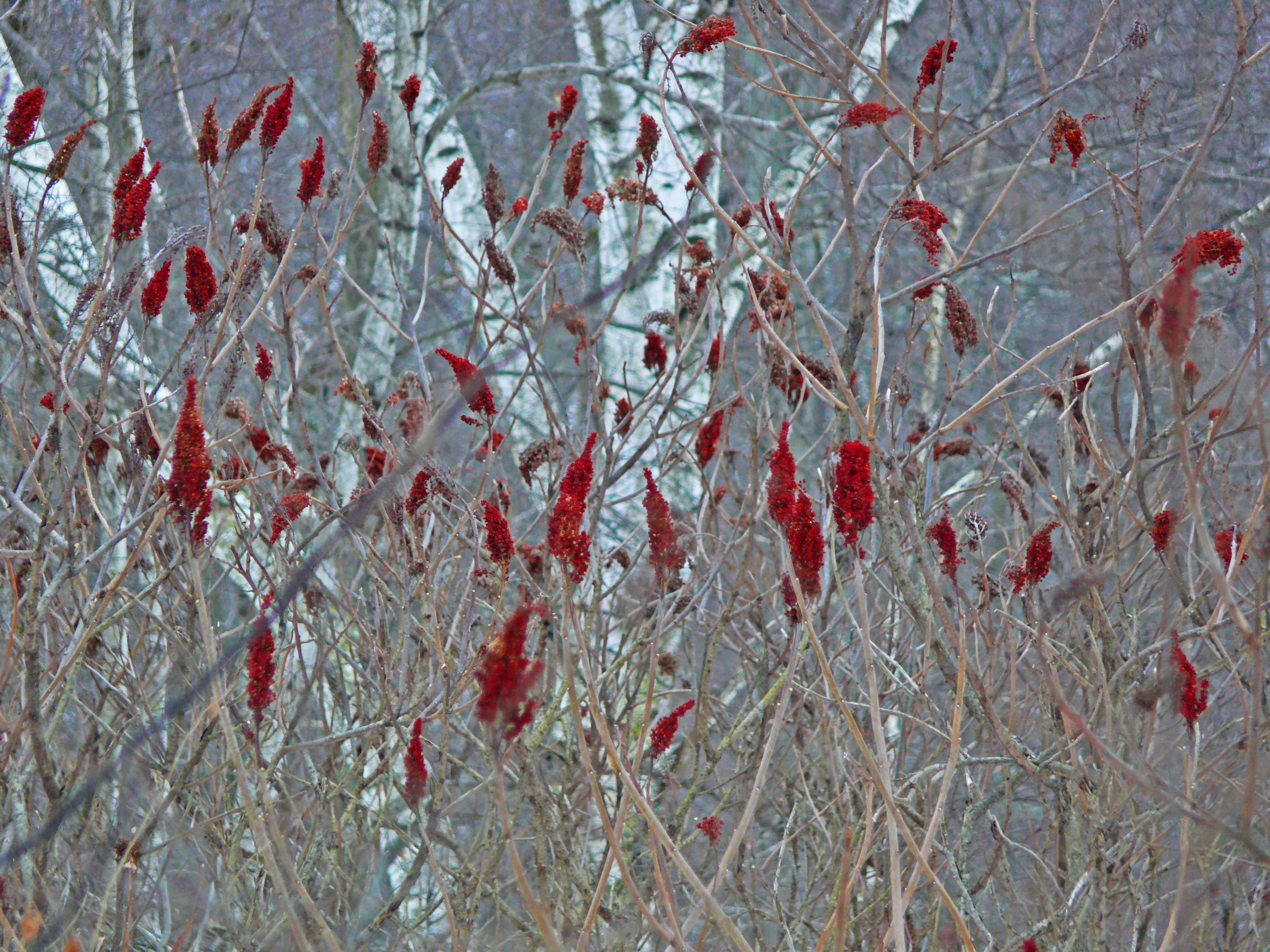
Trees not only inspire, they themselves are paragons of diversity. One look out of a car window while driving on the Taconic and one can see squat pines alongside towering majestic firs, birches interspersed with maple and oak. And together the different brown and tan barks interspersed with evergreens create not only a mosaic of contrasting colors, but display an example to inspire humans to live together in peaceful unity.
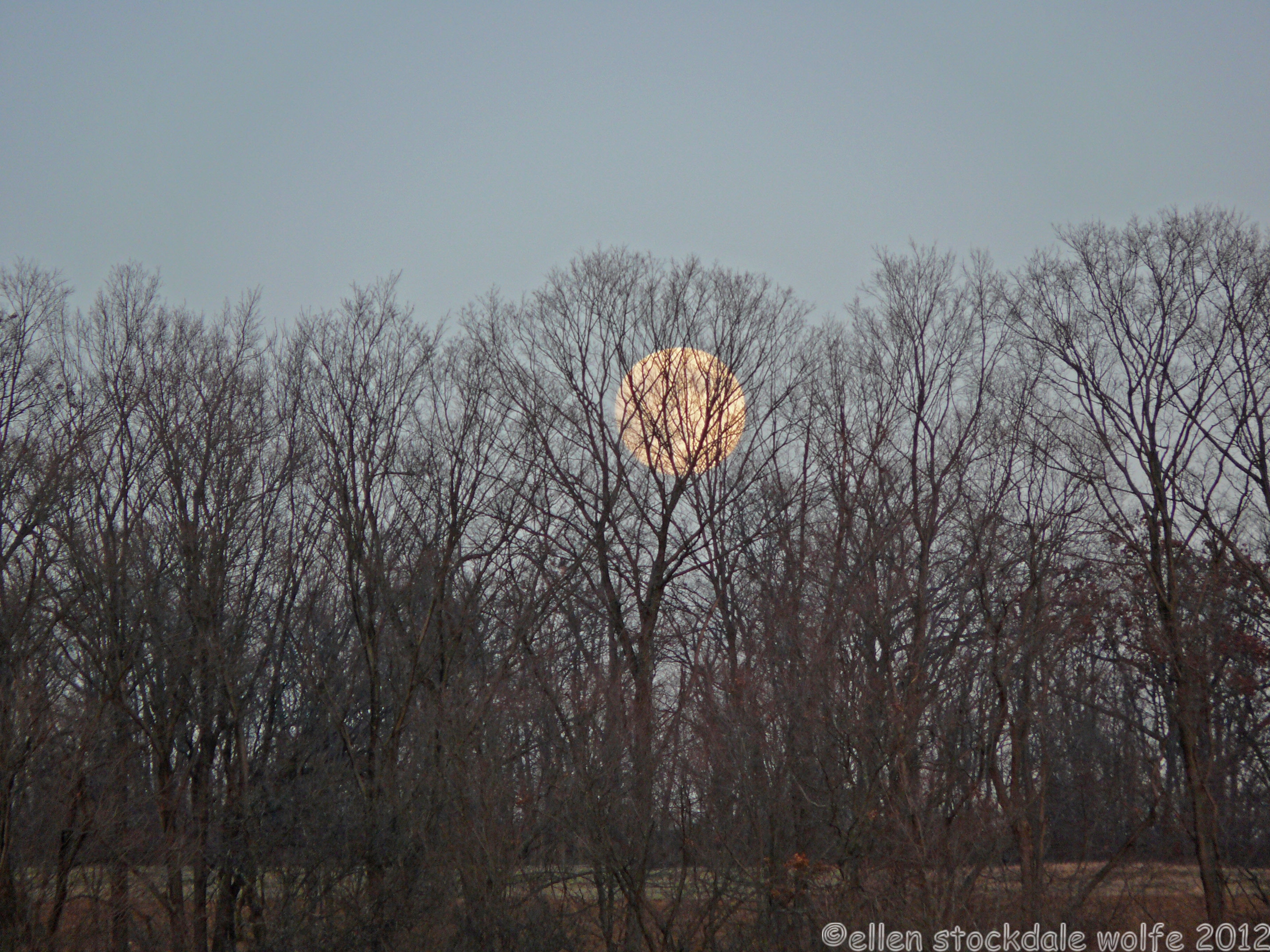
These beneficent beings carry the heavy, dark grey clouds of winter. When it snows the tree trunks become canvases for the abstract patterns of windblown-snow, while the serpentine branches are outlined in white. In ice storms their branches become chandeliers, each enveloped in glassine ice, tinkling in the wind. While in the cold melancholy of a winter rain, the branches become oiled skins of snakes weeping to the ground below. And finally, in the night sky, the branches hold the stars in their arms, those with leaves holding them in their hands, as they nurse the moon.

All trees, no matter what their species, age or height, stand tall in proud humility, their arms reaching up to the heavens to the source in prayer– soft-spoken beings of peace and tranquility towering over us, as we the wee creatures race around distractedly below in our little lives.
The Oneness of It All
In this month of darkness, in this the darkest month, the light of the human spirit shines forth in a fullness shown by so many, in so many ways. As the days grow shorter, houses and trees are decorated, and snow falls. In the hushed silence of the nights, lights shine in windows, and the beauty is shared by all. For this season of giving brings the festivals of lights: Diwali (now past), Hanukkah, Christmas, Kwanzaa. Each tradition incorporates light in its ceremonies and decorations. But all is not well. Millions know no peace in any season.
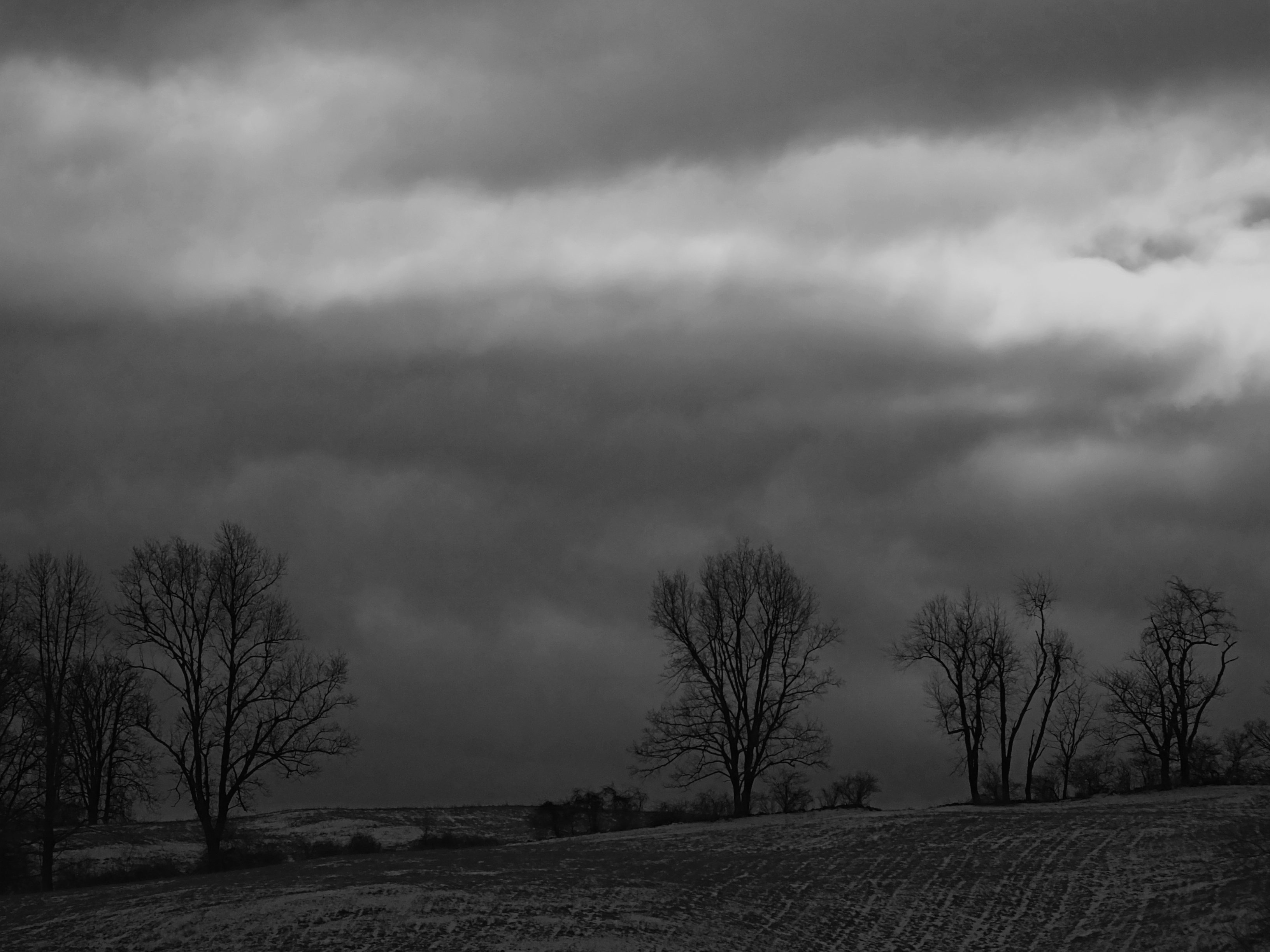
Yet even those living in the worst conditions show the light of the human spirit and celebrate the season of light in personal ways. For the human spirit is indomitable.
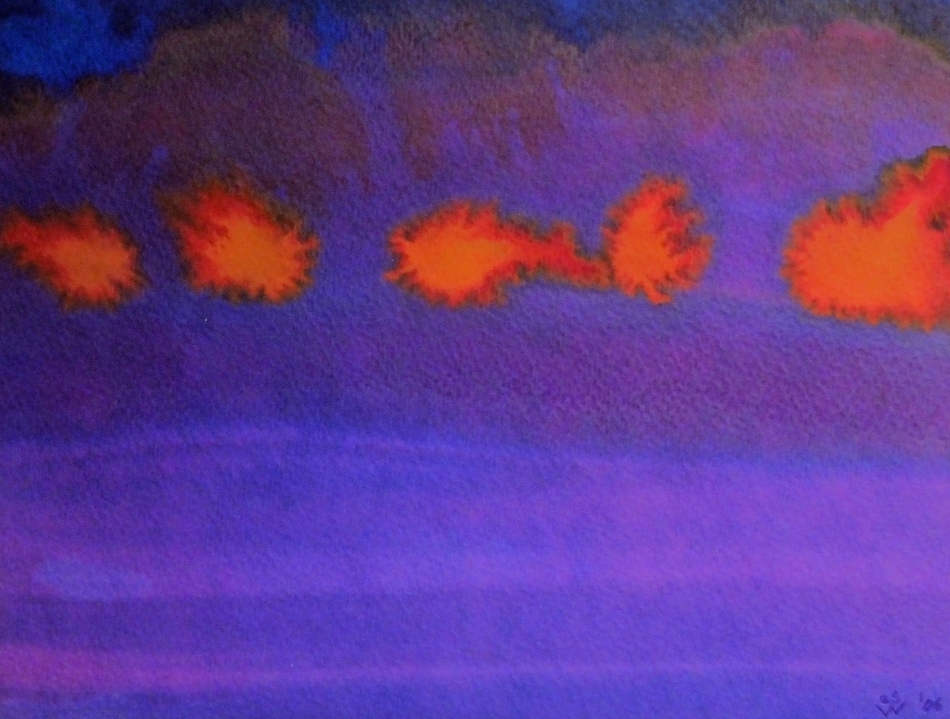
In December’s darkness we light lights. For we are beings of light. A light glows within each one of us. And, at the most basic level, we are beings of light because we are made from stardust. Perhaps that is why the stars hold such majesty for us– we are made from star material.

Einstein said: “A human being is part of the whole, called by us the ‘Universe”– a part limited in time and space. He experiences himself, his thoughts, and feelings, as something separated from the rest– a kind of optical delusion of his consciousness. This delusion is a kind of prison for us, restricting us to our personal desires and to affection for a few persons nearest us. Our task must be to free ourselves from this prison by widening our circles of compassion to embrace all living creatures and the whole of nature in its beauty.”
When Spiders Rule

A chill wind blows the yellowing leaves off the trees. They drift down to the ground like giant snowflakes. The air is pregnant with the feel of the coming holidays. Fall has truly come with the sudden drop in temperatures. November appears as a mirror image of March. November is the vibrant color of decay while March is the decaying color of about-to-burst-forth Spring.

The birds are at the bird feeder all the time now. They are not stopped by our presence when we come to fill the feeder or blow leaves under it. Nothing stops them. They swoop around the feeder and the surrounding trees like Kamikaze pilots, darting here and there recklessly. The squirrels are in a frenzy as well, stock piling and burying acorns and walnuts which they will retrieve without fail in a month or so in a snow-covered land.

The trees are most beautiful for me at this time of year, when many of them are bare and a scattering of leaves remain on dark brown branches. The leaves that remain on the trees blow on the limbs with dainty grace in their precarious positions. Yet these are the survivors. The other leaves have fallen and gone the way all living things eventually go. Most trees have lost all their leaves and they stand in stark contrast against the blue sky, the stormy sky, even the night sky. They are perhaps most beautiful at night, like arms reaching up to the darkness trying to grab at the stars twinkling between the branches. Moonlight dances on their limbs.
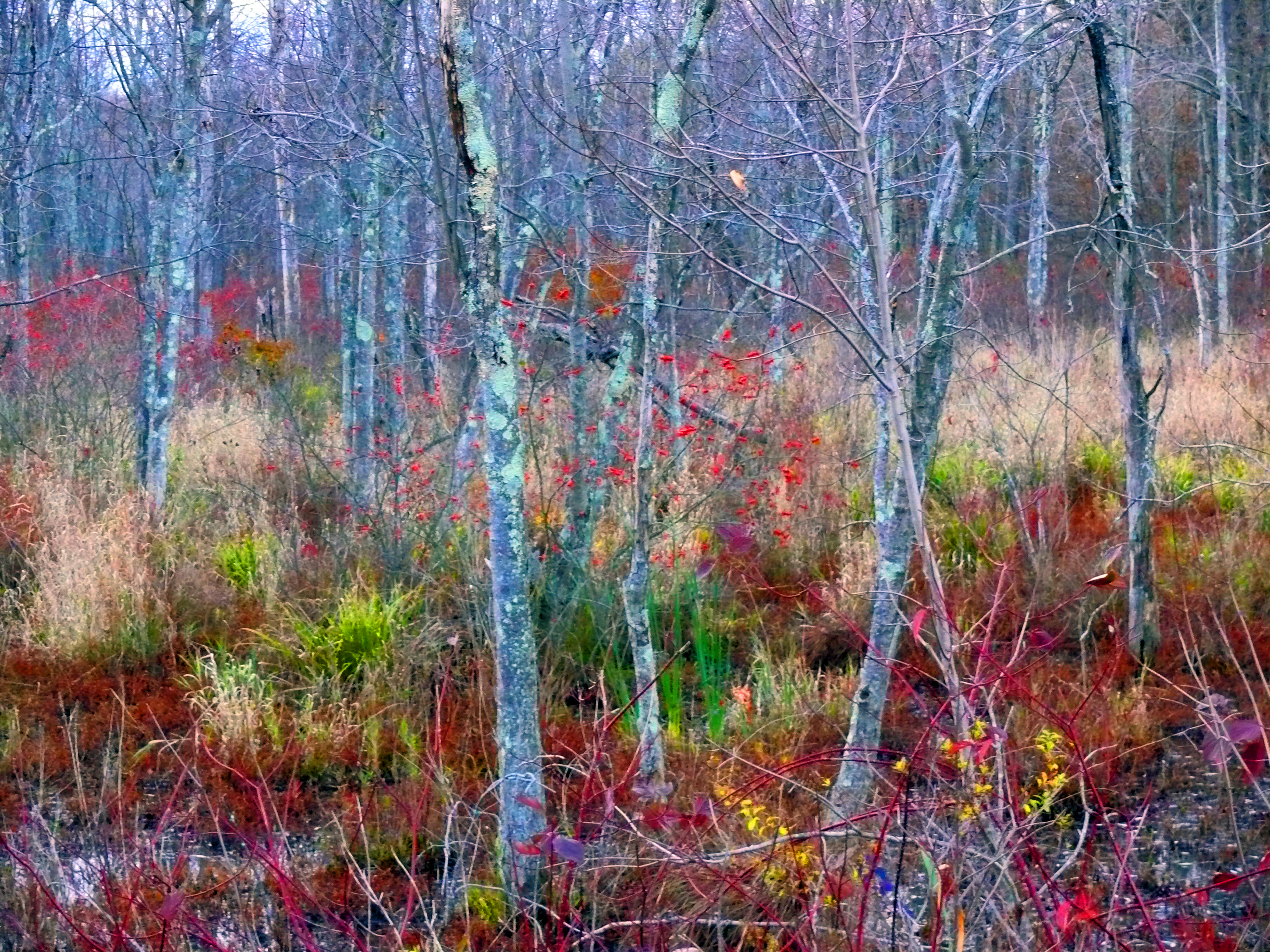
November is the last glimmer of color and in some places the color seems to be predominantly yellow. A carpet of yellow lines the woods now. And now one can see inside the woods, so dark and impenetrable in summer. Some forests have carpets of oak leaves– dark brown tan in color. Or there are forest paths with variegated colors– vibrant crimsons against yellows and faded greens and tawny tans. The unmown lawns are now taken over by the spiders and, at moments, one can see a world of webs covering fields that only appear in a certain slant of sunlight. It is the silent take over of the spiders before the snows come.

The yellow, the brown, the crimson leaves are complemented by the ubiquitous yellow, brown and crimson mums that appear on the roadside near mail boxes, on porches or along driveways. These tough little flowers withstand frosty chills and stand tall throughout most of November. Hearty souls and so giving in their colorful, velvety splendor.

Soon the season of lights will begin. Autumn, as a season, seems the fastest to come and go. I hold each moment in my hands as a treasure, but the moments all sift through my fingers like grains of sand. Then Christmas comes and fades in a flash, and we are into the Nor’Easter blizzards of January. Another year is gone. The years do go faster as you grow older. We go about living our lives, trying, against our natures, to treasure the good moments. Now in November, at Thanksgiving, it is our time to say thank you. Inspired by the Native Americans let us thank the earth. Let us say thank you to the trees for their constantly changing beauty, to the stars for their piercing presence in the night sky, to the leaves for their beauteous colors, to the sun for its life-giving power, to the Spring for its awakening hope, to the Summer for its warm, thriving growth, to the Fall for its bounty, to the Winter for a time of renewal, to the snow flakes for their hushed, white silence that transforms our world, to the animals for their pure souls, to our families and friends for their love, and, lastly but mostly, to the Higher Power of our belief.
Happy Thanksgiving and may you each be blessed with the all embracing, pervasive Love in nature.
A Foretaste of Fall
(revised version)
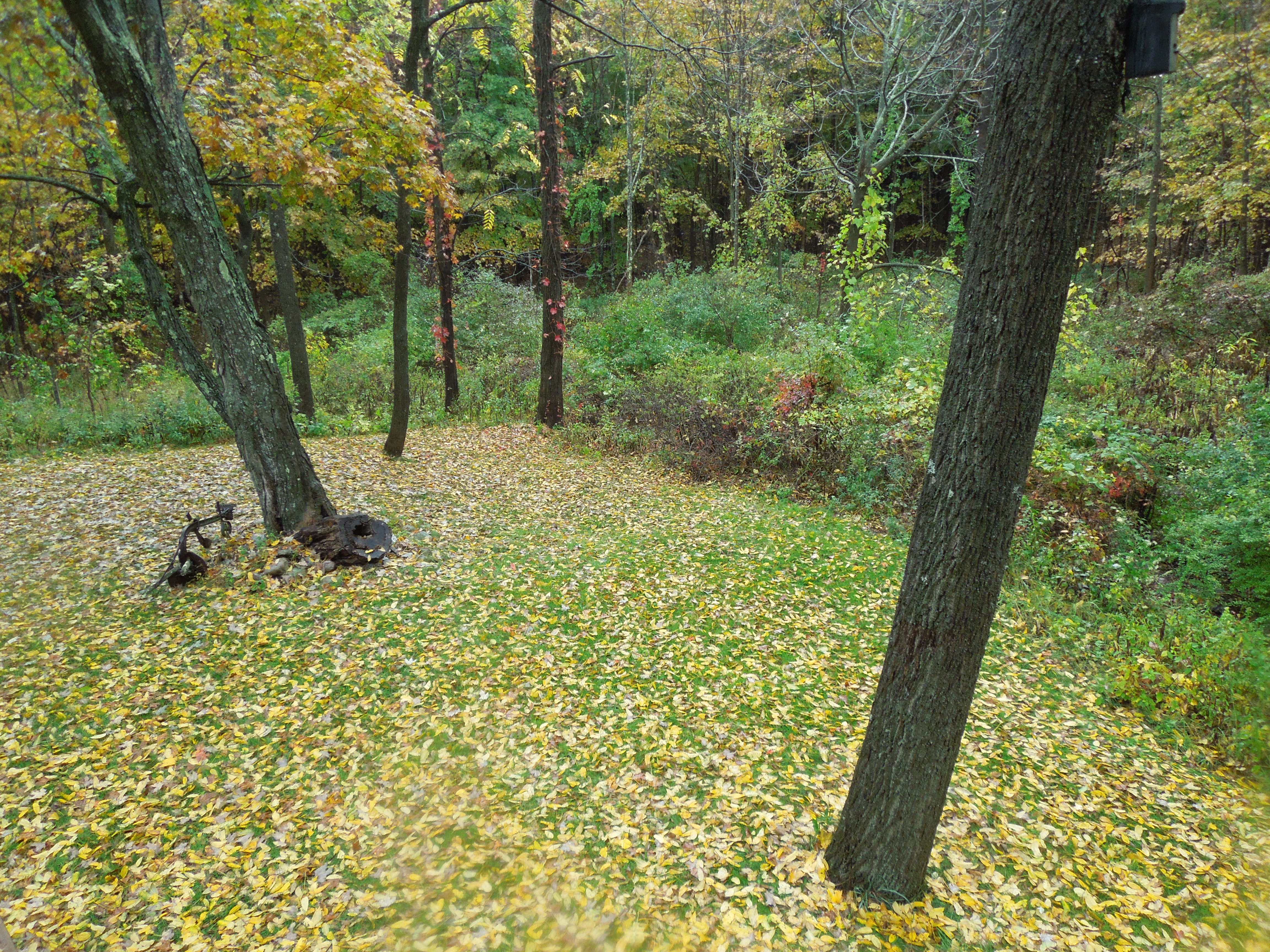
It is the school-imposed end of summer, Labor Day weekend, a weekend I look forward to all summer long for the love of Fall. It is not good to be this way. Religious leaders preach living in the present for that is all we have. I have yet to overcome this and many other bad ways of thinking. I look forward to the crisp days of September when a breeze shimmers through, what I call in my ignorance of the real name, the penny tree. It is so named because when the wind blows the leaves look like so many pennies shimmering down from Heaven. I live for the days when the sun is so hot it tingles on the skin– yet it is not the strong sun of July that burns quickly. The angle of the sun in its diurnal slant is different. Summer is definitely slipping away.
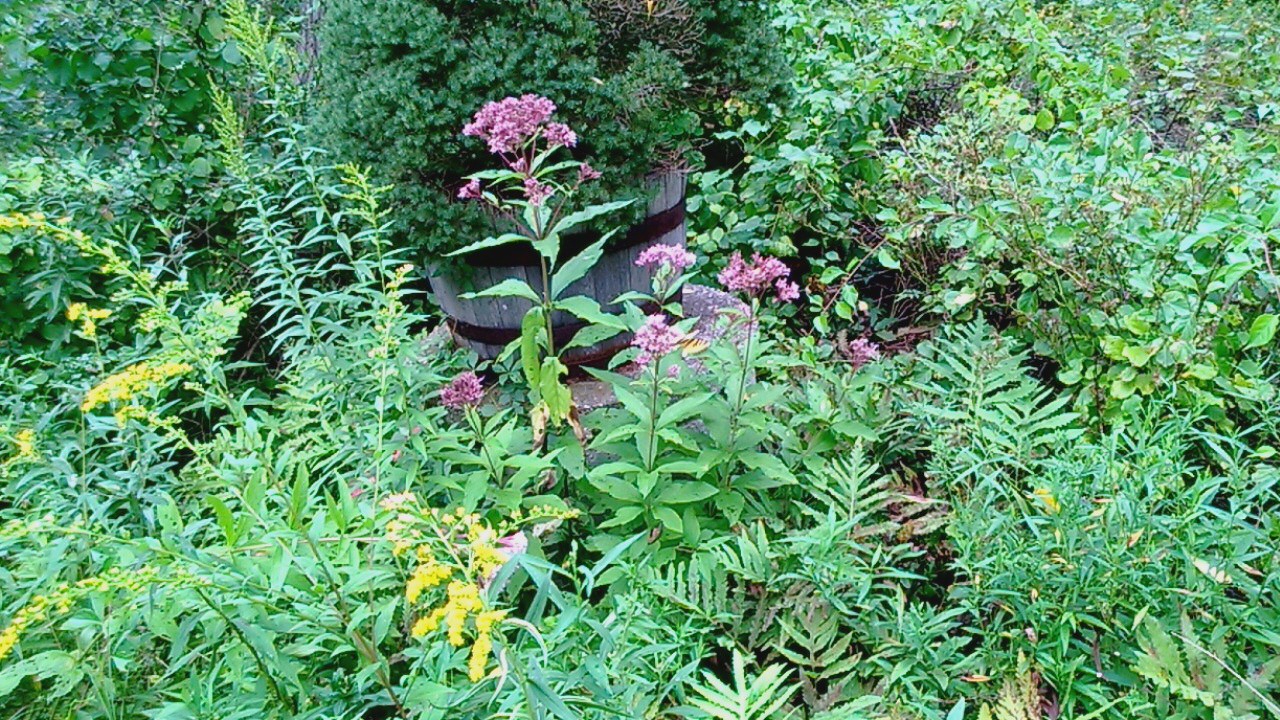
The bees, wasps and yellow jackets are having a heyday in the goldenrod, Joe Pye Weed and Purple Loosestrife. The marsh is thick with flying insects going this way and that. My eyes capture swallowtails. Happily the monarchs are still here. A turkey vulture circles overhead. Some carrion must be nearby. Earlier we saw two golden hawks fly sunlit into the back field. A wisp of a cloud floats by in an otherwise perfectly blue sky. This summer has flown by in the blink of an eye like a fritillary flits by the flowers in the marsh.
The smell of fresh cut lawn is intoxicating to my raw senses. Soon the grass will cease to grow and the lush green will look washed out. All of its inhabitants in the metropolis beneath our feet will dig deep underground or turn off their bodily systems to overwinter– an amazing concept to a mammal. Some fill their bodies with a type of antifreeze. Nature never ceases to astound. This summer I have made my peace with the insects. Terrified of them as a child I have come to love and respect them, indeed hold them in awe for the feats they accomplish. Our accomplishments pale as humans, supposedly so superior.
No longer do I see turtles sunning on rocks or snakes coming out to bask in the heat of the road. Some species of birds have left already– unbeknownst to me. I just know that some I used to see are gone and the bird song of the spring mating season is a fleeting memory. One lone humming bird flies around the marsh intermittently, causing excitement upon spotting him.
It is the time to dead head the flowers of summer. It is the time of Black-Eyed Susans and Peonies and Sebum. And soon it will be the time of the Mums.
With each gust of wind yellow finger-like walnut leaves shower down on our heads– like large yellow snowflakes– a foretaste of snowfalls to come. The sun’s shadows grow long as twilight is near. Soon the white cloud “lions and tigers and bears” will retire into the black cave of night. And the summer will die and in dying, give birth to fall. The comfortable rhythm of the changing season beats in our sometimes unhearing hearts.
(Aknowledgements to “likes” and comments may be delayed. Recuperating from surgery.)
A Midsummer’s Night’s Dream
As twilight falls, as we approach August, the little sparks of light appear nightly… fireflies, lightening bugs, glow worms, whatever one chooses to call them. They start early in July– one sees a few sparks here and there but as July draws to a close, twilights dawn with a display of tiny fireworks. Why do they hold such fascination for young and old alike? Why do they bring us such a sense of wonder as they flicker on and off in some rhythm unknown to us but sparkling in communication with one another?
Of course I remember, like everyone else, catching fireflies. It was a ritual my Sicilian grandfather reenacted with me every summer. Grandma would save me a peanut butter jar, nicely washed with little holes in the top she made with an old-fashioned can opener. Grandpa and I would go out for an after-dinner walk, a treat in itself. It was a journey with a purpose, a hunt to catch those bugs whose tail ends light up, on and off, I learned later, to signal mates.
Grandpa always managed to catch one and we would walk home victorious, with me clutching my precious jar with my favorite kind of bug residing within. There was the exciting story we would tell Grandma and she would give me a lettuce leaf in case the bug should be hungry in the night. Then to bed. And then the real waiting began… lying in the dark with the jar on the bedside table waiting for my captive bug to alight. I would wait and wait but no flickering light appeared and before long I would fall asleep in the arms of disappointment.
It was even worse in the morning. The lightening bug did not look well. His antennae would be damp and sticking to the jar in a bad way. He was not eating the lettuce leaf. And this was my first lesson in the perils of capturing and imprisoning a creature. They did not behave like they did when free. Finally in a child’s form of despair, I would let him go and he would leave so much the worse for wear.
Years later, on my husband’s great aunt’s farm in Ohio, the trees would be filled with lightening bugs mating. It was a sight I had never seen. Whole trees would light up at once and upon close examination one would find hundreds of fireflies. It was a cathedral of flickering lights that brought awe as we beheld the mystery with our hearts.
And now, living in a converted barn which allows many bugs to enter despite window screens, the lightening bugs within are no longer in a jar but free to fly about our house. They bring sheer delight as they light up in the darkness of our bedroom. I am a child again with my beloved grandfather, though now I no longer want to capture the mystery as I stay awake as long as possible, watching the little flickering lights inside the room and outside in the trees. I think of simpler days and after dinner walks with Grandpa. I think a lot of my grandparents, but in the nostalgia, the magic of this tiny bug amazes still. And the magic brings joy as we share it with our children, our grandchildren, our beloved, anyone who can watch with us this Midsummer Night’s dream.
Spring’s Siren Song

It is late afternoon and it is Spring by the calendar although still quite cool. And I have just spent the late afternoon listening to music. Some have likened it to the sound to bells. Others to bird song. And still others with unimaginable disdain, to “some kind of nature noise.” For me it is one of the happiest of sounds. The act of creation transformed into sound decibels for all to hear. A sound that comes from the earth and resounds to the heavens, unwittingly praising the Almighty. I hate to leave, and wish I lived even closer to the pond, so that the sound would surround me totally, filling my ears every evening with the sound of perhaps the single-most highlight of spring for me. The siren song of the Spring Peepers.
How have they cast their spell over so many? I cannot say except that their song is uplifting and filled with hope despite the natural perils they face daily. For, as true of all of us, they may die at any moment– say as a meal for a nearby perching crow or underneath murky waters eaten by a snapping turtle. They call for a mate without ceasing, without fear, single-mindedly, without a thought for their own safety. It is nature at its most elemental, in its most singular scope. They all sing out vying to be heard– so many voices. In some spots, I am told, their song is deafening. How nice to be there; I cannot get enough of their sweet music. It moves me to tears– these tiny creatures singing out their heart’s desire.
As I return home to family “situations” and domestic duties, I yearn for the simplicity of their song. Their total fervor. For if they sing then all is right in that small part of the world. Progress has not paved over their pond. Disdainful humans have not drained a “vernal pool.” David Carroll writes about vernal pools in one of his books on turtles called The Swampwalker’s Journal. As the title suggests, Carroll walks such places in search of turtles and other amphibians. He defines a vernal pool as a pool of water that fills up in Fall and Winter, swells in the Spring and often dries up by end of Summer. But a vernal pool is utmost a place of magic, not only a place where turtles lurk but where mating frogs deposit gelatinous eggs which turn into tadpoles first, and there, later become frogs. And after a requisite series of warm days, followed by spring rains, on the first dark night, vernal pools become the site of the “salamander night.” Salamanders leave their hibernacula to go for a night of endless mating and then return to leaf litter in the woods to disappear for the rest of the year. Some people who know nothing of vernal pools and their function deem them a nuisance, a “big puddle” to be filled in or drained. Some people know little of Spring Peepers except that they are “noisy,” “like some sort of insect.” Poor insects being made out to be the pesky lowest of the low. The natural symphony of hormonal, harmonic sounds sometimes falls on deaf ears.
And when, after finishing my evening chores, I try to read, I find the haunting sound of the Spring Peepers deep within my psyche, making me restless and anxious and wishing to be at that pond, surrounded on all sides by their sex song, inebriated by the unbridled joy in the air, immersed in the utter power of nature manifesting in one of her gentler forms. In the song of the Spring Peepers nature celebrates life-to-be rather than taking lives away. For most of all the song of the Spring Peepers is a song of tremendous faith, faith in love and faith that love will propagate and new life will emerge untouched by the oft destructive hand of man.
When the Walnut Leaves Begin to Fall
It is the school-imposed end of summer, Labor Day weekend has come and gone and I am looking forward to Fall. It is not good to be this way. Ideally one should be living in the present… for that is all we have. I have yet to overcome this and many other bad ways of thinking. A breeze shimmers through what I call (in my ignorance of the real name) the penny tree for when the wind blows the leaves look like so many pennies shimmering down from Heaven. The sun is so hot it tingles on the skin– yet it is not the strong sun of July that burns quickly. The angle of the sun in its diurnal slant is different. Summer is definitely slipping away.

The bees, wasps and yellow jackets are having a heyday in the goldenrod, Joe Pye Weed and Purple Loosestrife. The marsh is thick with flying insects going this way and that. My eyes capture swallowtails. Happily the monarchs are still here. A turkey vulture circles overhead. Some carrion must be nearby. Earlier we saw two golden hawks fly sunlit into the back field. A wisp of a cloud floats by in an otherwise perfectly blue sky. This summer has flown by in the blink of an eye like a fritillary flits by the flowers in the marsh.

The smell of fresh cut lawn is intoxicating to my raw senses. Soon the grass will cease to grow and the lush green will look washed out. All of its inhabitants in the metropolis beneath our feet will dig deep underground or turn off their bodily systems to overwinter– an amazing concept to a mammal. Some fill their bodies with a type of antifreeze. Nature never ceases to astound. This summer I have made my peace with the insects. Terrified of them as a child I have come to love and respect them, indeed hold them in awe for the feats they accomplish. Our accomplishments pale as humans, supposedly so superior.

No longer do I see turtles sunning on rocks or snakes coming out to bask in the heat of the road. Some species of birds have left already– unbeknownst to me. I just know that some I used to see are gone and the bird song of the spring mating season is a fleeting memory. One lone humming bird flies around the marsh intermittently, causing frantic excitement upon spotting him.

It is the time to dead head the flowers of summer. It is the time of Black-Eyed Susans and Peonies and Sebum. And soon it will be the time of the Mums.
With each gust of wind yellow finger-like walnut leaves shower down on our heads– like large yellow snowflakes– a foretaste of snowfalls to come. The sun’s shadows grow long as twilight is near. Soon the white cloud “lions and tigers and bears” will retire into the black cave of night. And the summer will die and in dying, give birth to fall. The comfortable rhythm of the changing season beats in our sometimes unhearing hearts.

Divine Intelligence
“God is manifest in everything! Look at the beautiful earth, and how nature keeps it in balance– how there is a plan, an Intelligence behind everything in creation.”
Paramahansa Yogananda
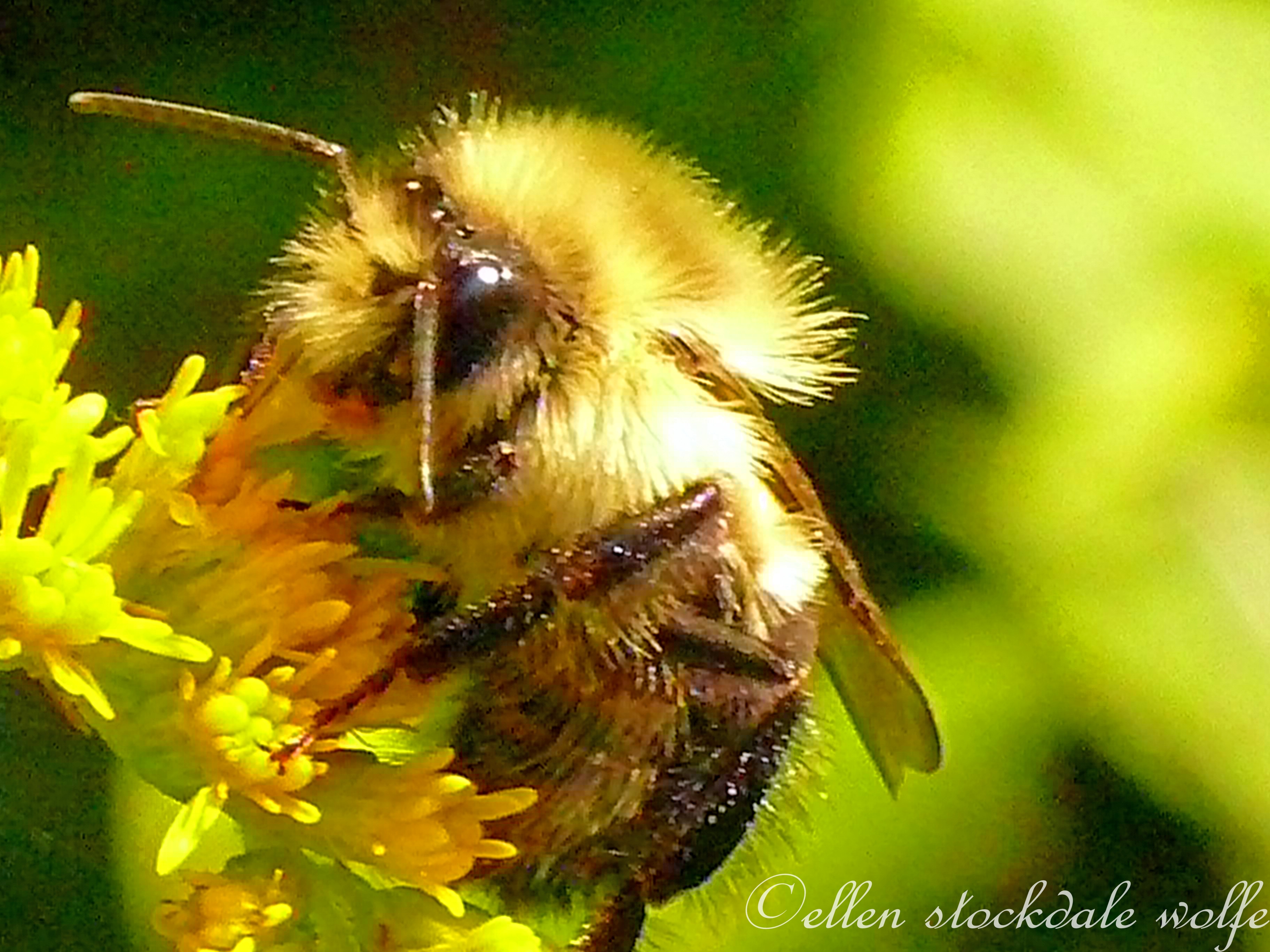

Jeepers Peepers

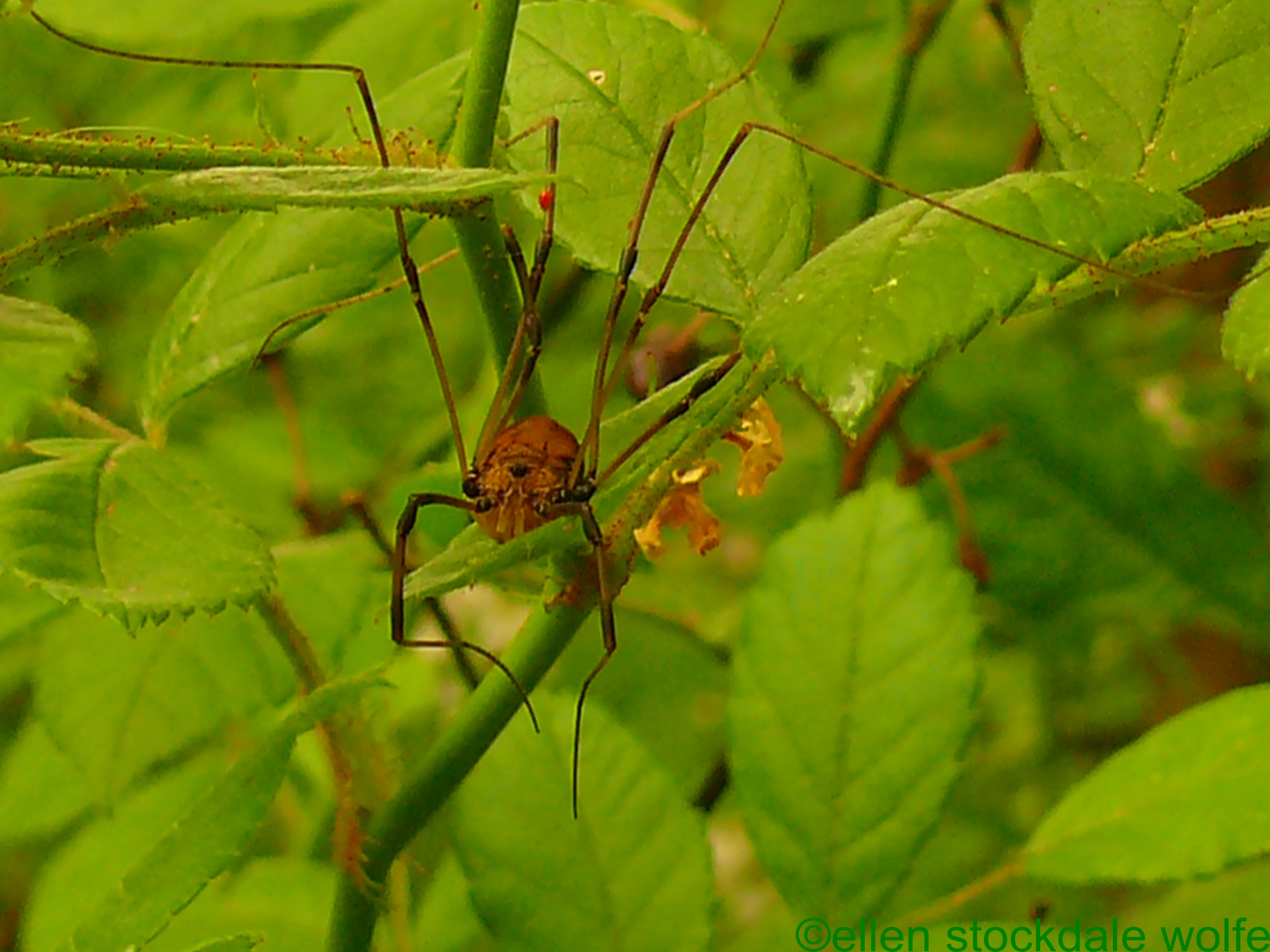
Above: the vernal pool not yet unfrozen and below: the YouTube video to hear the song of the Spring Peepers
It is late afternoon and it is spring according to the calendar although still quite cool. I have just spent the late afternoon listening to “music.” Some have likened it to the sound to bells. Others to bird song. And still others, with unimaginable disdain, to “some kind of nature noise.” For me it is one of the happiest of sounds. The act of creation transformed into sound decibels for all to hear. A sound that comes from the earth and resounds to the heavens, unwittingly praising the Almighty. I hate to leave, and wish I lived even closer to the pond, so that the sound would surround me totally, filling my ears every evening with the sound of perhaps the single-most highlight of spring for me. The siren song of the Spring Peepers.
How have they cast their spell over so many? I cannot say except that their song is uplifting and filled with hope despite the natural perils they face daily. For, as true of all of us, they may die at any moment– say as a meal for a nearby perching crow or underneath murky waters eaten by a snapping turtle. They call for a mate without ceasing, without fear, single-mindedly, without a thought for their own safety. It is nature at its most elemental, in its most singular scope. They all sing out vying to be heard– so many voices. In some spots, I am told, their song is deafening. How nice to be there; I cannot get enough of their sweet music. It moves me to tears– these tiny creatures singing out their heart’s desire.
As I return home to family “situations” and domestic duties, I yearn for the simplicity of their song. Their total fervor. For if they sing then all is right in that small part of the world. Progress has not paved over their pond. Disdainful humans have not drained a “vernal pool.” David Carroll writes about vernal pools in one of his books on turtles called The Swampwalker’s Journal. As the title suggests, Carroll walks through such places in search of turtles and other amphibians. He defines a vernal pool as a pool of water that fills up in Fall and Winter and freezes, swells in the Spring and often dries up by end of Summer. But a vernal pool is utmost a place of magic, not only where turtles lurk, but also where mating frogs deposit gelatinous eggs, which turn first into tadpoles, and then, later, become frogs. Vernal pool habitats hold a galaxy of small things that come to life the instant ice and snow turn back into water. And after a requisite series of warm days, followed by spring rains, on the first dark night, vernal pools become the site of the “salamander night.” Salamanders leave their hibernacula to go for a night of endless mating and then return to leaf litter in the woods to disappear for the rest of the year. Some people, who know nothing of vernal pools and their function, deem them a nuisance, a “big puddle” to be filled in or drained. Some people know little of spring peepers except that they are “noisy,” “like some sort of insect.” (Poor insects being made out to be the pesky lowest of the low.) The natural symphony of hormonal, harmonic sounds sometimes falls on deaf ears.
And when, after finishing my evening chores, I try to read, I find the haunting sound of the spring peepers deep within my psyche, making me restless and anxious and wishing to be at that pond, surrounded on all sides by their sex song, inebriated by the unbridled joy in the air, immersed in the utter power of nature manifesting in one of her gentler forms. In the song of the Spring Peepers nature celebrates life-to-be rather than taking lives away. For most of all the song of the Spring Peepers is a song of tremendous faith, faith in love, and faith that love will propagate and new life will emerge untouched by the often destructive hand of man.
************
To read about and/or give to Michael’s foundation for orphan and street children in Uganda, click on the link below the picture of Michael and Angie:

http://www.gofundme.com/f/sustainability-support-for-the-Makindye-Foundation
Just Renters
The house that we think of as “our” house does not belong to us. Not because we are still paying the mortgage on it. This becomes evident one morning while sitting in a moment of calm before the day has begun, watching the bird feeder which my husband lovingly is filling. He has dumped out the seeds too big to fit through the wire mesh of the feeder. About 10 little birds, sparrows and juncos and sometimes a dashing male cardinal, are feeding on the seeds on the snow-covered ground. They are not scared off by the lone squirrel who comes to eat the peanuts from the mix. Larger birds flock to the now-full feeder. The largest birds, too big to land on the feeder, sometime take over the small bird territory, eating seeds on the ground.
The snow is falling as we prepare to go to work, cleaning up the kitchen and locking up the house. The birds fly around in my mind. So vulnerable they seem yet so brave, so tiny yet enormous in their freedom to take to the air. I want to hold them in my hand and stroke their soft, downy feathers, give them love. But truth is, this is purely a selfish wish on my part for they don’t need my love. They don’t really even need the bird seed my husband religiously puts in the feeder. There are bushes out back with berries which they love. It is I who need them, to make me feel happy, to make me feel loving, to make me feel alive and connected to something larger than myself.
As we pull out of the driveway I take another lingering look at the birds in the brightening light. And then it hits me. They get to stay there all day as we drive off through the snow to our respective jobs in the cement jungle of a nearby city. We drive past horses, grazing in a neighboring meadow. Same deal. Often I make an effort to remember the birds and the squirrels and the horses to bring calm to a fraught work day. Yet I usually get so caught up in my frenetic, little life that I forget to think of them. Or if I manage to conjure them up, the image of them in my mind is thin, pale and lacking in substance.
I imagine the animals laughing at us as we have to drive off to go to work. Our house belongs to them. Sometimes they even invade our living quarters. When we first bought the house, it had 50 or so little brown bats in the attic who would occasionally fly around the bedroom at night. One year we had a pair of squirrels. We even had the company of a milk snake one afternoon. And every fall as the weather turns frigid, the field mice run in.
A little more thought on the subject reveals to me that in actuality we own nothing. Not our house, our spouse, our children nor our pets, not even the body we inhabit. All of these things are on loan to us, rented to us if you will, by the Maker of the sun and the moon and the stars. Such a wealth of beauteous bounty is there for us, ours to enjoy for the mere act of attention. The trees, the summer breeze, the blanket of snow in winter, the flowers of summer, the butterflies, the deer who eat our lilies, the possum, the ever-changing species of birds, the occasional coyote and the thousands, if not millions of insects underfoot in a terrestrial universe, to say nothing of the universe above our heads and the trillions or gazillions of stars, the planets, the sun, the moon. And yet we are so caught up in the dramas of our mundane lives that we fail to duly honor the ever-present gifts except in periodic snatches, when we turn our attention outside ourselves to the piece of earth we rent. We may pay a sum to rent a piece of the earth but that piece contains a seemingly infinite multitude of gifts given for the taking. Or rather, I should say, for the renting.

The Trees of Winter
Every year what budded in autumn, blossoms full blown in winter– my love affair with trees. Trees that were drop-dead gorgeous in their fall colors are now bare, with the exception of evergreens and a few stray deciduous trees that refuse to relinquish their leaves. Now the trees are stripped down to their souls and their souls sing a siren song to the universe.
The tops of trees lift my spirit; brushlike they paint the sky the baby pinks and blues of mornings, and the majestic magentas and violets of day’s end. Each tree has its signature shape against the sky, like a fingerprint or a snowflake, similar yet each unique. Some treetops in their bare state are shaped like a fancy coiffure; others look like wrought iron filigree. On distant mountains, against the snowy ground, some look like stubble on an old man’s unshaven face.
It is the colorful winter sky showing through, and showing off, the bare branches that woo me. The bare curvaceous branches are stark, dark lines against the bright of day and the inky sky of night. These resplendent creatures are living lines that explode. Branches tangle like the lines in a Jackson Pollock painting. Others curve in the sensuous lines of a Brancusi sculpture. Buxom tree trunks stand strong surrounded by their dead blossoms and their burgeoning offspring like a Renaissance Madonna. In truth these trees are not like art at all. Rather art imitates them– their beauty provides the timeless inspiration for artists, writers and poets of all ages and styles.
Trees not only inspire, they themselves are paragons of diversity. One look out of a car window while driving on the Taconic and one can see squat pines alongside towering majestic firs, birches interspersed with maple and oak. And together the different brown and tan barks interspersed with evergreens create not only a mosaic of contrasting colors, but display an example to inspire humans to live together in peaceful unity.
These beneficent beings carry the heavy, dark grey clouds of winter. When it snows the tree trunks become canvases for the abstract patterns of windblown-snow, while the serpentine branches are outlined in white. In ice storms their branches become chandeliers, each enveloped in glassine ice, tinkling in the wind. While in the melancholy of a winter rain, the branches become oiled skins of snakes weeping to the ground below. And finally, in the night sky, the branches hold the stars in their arms, those with leaves holding them in their hands, as they nurse the moon.
All trees, no matter what their species, age or height, stand tall in proud humility, their arms reaching up to the Heavens to our Creator in prayer– soft-spoken beings of peace and tranquility towering over us, while the little creatures race around distractedly below.
Beings of Light

(Click to enlarge)
(Click to enlarge)
December is my favorite time of year. In this month of darkness, in this the darkest month, the light of the human spirit shines forth in a fullness shown by so many, in so many ways. As the days grow shorter in North America, houses and trees are decorated, and snow falls. In the hushed silence of the nights, lights shine in windows, and the beauty is shared by passersby. For this season of giving brings the festivals of lights: Hanukkah, Christmas, Kwanzaa, Diwali. Each tradition incorporates light in its ceremonies and decorations.
A neighbor friend of mine who lived down the road, a donkey in his stable, reminds me of the story of another manger over 2000 years ago. And seeing him snug in his stable with snow on the ground gave the illusion that all was right in the world. But all is not well. Thousands know no peace in any season. Millions are cold and starving. Racism and religious wars prevail. Climate change advances in leaps and bounds, faster than most predicted.
Those who live closer to the land are especially blessed. They share their lives with animals who are constant reminders of humility and simplicity in this rapid, complex, multi-tasking world. They can drive around on a December night and see houses covered in lights with illuminated trees, houses warmed by fires, filled with laughter and conversation and love, and feel blessed. Blessed to have so much when others have so little. Blessed to be able to celebrate as they wish when others cannot. Yet even those living in the worst conditions show the light of the human spirit and celebrate the season of light in personal ways. For the human spirit is indomitable.
Einstein said: “A human being is part of the whole, called by us the ‘Universe”– a part limited in time and space. He experiences himself, his thoughts, and feelings, as something separated from the rest– a kind of optical delusion of his consciousness. This delusion is a kind of prison for us, restricting us to our personal desires and to affection for a few persons nearest us. Our task must be to free ourselves from this prison by widening our circles of compassion to embrace all living creatures and the whole of nature in its beauty.” We are all cut from the same cloth and our inner light unites us.
In December’s darkness we light lights. For we are beings of light. A light glows within each one of us. And, at the most basic level, we are beings of light because we are made from stardust. Perhaps that is why the stars hold such majesty for us– we are all—Muslim, Christian, Jew, Hindu, African, whatever– we are all made from star material.
And in this holiday season we behold the night sky as Christians say shepherds did over two thousand years ago on the birth of the holy infant, in a stable like the one down the road where my donkey friend lives. On that night they say a star lit the whole sky to guide the shepherds to the stable of the infant, Jesus, the son of God.
In these deep, long, silent nights as we light our houses, our candles, our trees, let us look inside ourselves and find the glow that may guide us each, alone but akin, to THE Light!

(Click to enlarge)
The Height Of November and Giving Thanks
(Click to enlarge)
A chill wind blows the yellowing leaves off the trees. They drift down to the ground like giant snowflakes. The air is pregnant with the feel of the coming holidays. Fall has truly come with the sudden drop in temperatures, a full 20 degrees cooler than a week ago. This is the real Fall, no mealy-mouthed disguised Fall, but a Fall that will guide us into winter appropriately. November appears as a mirror image of March. November is the vibrant color of decay while March is the decaying color of about-to-burst-forth Spring.
The birds are at the bird feeder all the time now. They are not stopped by our presence when we come to fill the feeder or blow leaves under it. Nothing stops them. They swoop around the feeder and the surrounding trees like Kamikaze pilots, darting here and there recklessly. The squirrels are in a frenzy as well, stock piling and burying acorns and walnuts which they will retrieve without fail in a month or so in a snow-covered land.
The trees are most beautiful for me at this time of year, when many of them are bare and a scattering of leaves remain on dark brown branches. The leaves that remain on the trees blow on the limbs with dainty grace in their precarious positions. Yet these are the survivors. The other leaves have fallen and gone the way all living things eventually go. Most trees have lost all their leaves and they stand in stark contrast against the blue sky, the stormy sky, even the night sky. They are perhaps most beautiful at night, like arms reaching up to the darkness trying to grab at the stars twinkling between the branches. Moonlight dances on their limbs.
November is the last glimmer of color and in some places the color seems to be predominantly yellow. A carpet of yellow lines the woods now. And now one can see inside the woods, so dark and impenetrable in summer. Some forests have carpets of oak leaves– dark brown tan in color. Or there are forest paths with variegated colors– vibrant crimsons against yellows and faded greens and tawny tans. The unmown lawns are now taken over by the spiders and, at moments, one can see a world of webs covering fields that only appear in a certain slant of sunlight. It is the silent take over of the spiders before the snows come.
The yellow, the brown, the crimson leaves are complemented by the ubiquitous yellow, brown and crimson mums that appear on the roadside near mail boxes, on porches or along driveways. These tough little flowers withstand frosty chills and stand tall throughout most of November. Hearty souls and so giving in their colorful, velvety splendor.
The Halloween pumpkins begin to sag a bit or shine with wetness as if encased in glass. They will soon be tossed, pine combs and wreathes and fir swags will take their places, and the season of lights will begin. Like a child I am filled with anticipation of what is to come although all the spiritual guides teach us to live in the moment. I try to live in the moment all Autumn for as a season it seems the fastest to come and go. I try to hold each moment in my hands as a treasure but they all sift through my fingers like grains of sand. Then Christmas comes and fades in a flash and we are into the Nor’Easter blizzards of January. Another year is gone. The years do go faster as you grow older. Every one has their favorite theory why this is so. I think it is “to-do” lists. They rob us of time as we run around like Kamikaze birds or frenzied squirrels to check things off. And our reliance on calendars. We turn to mark things in our appointment books months ahead of time effortlessly flipping through the seasons with a flick of the wrist. It is no wonder time flies. We are in August and planning Christmas. I am fighting this in November with half the Fall gone: “Stop! Stop!” I try in vain to wish time would stand still so we could be in forever Thanksgiving/Christmas. But, being human, we would soon tire of that. It is good we are defenseless against time.
We go about living our lives, trying against our natures to treasure the good moments. Now in November, at Thanksgiving, it is our time to say thank you. Inspired by the Native Americans let us thank the earth. Let us say thank you to the trees for their constantly changing beauty, to the stars for their piercing presence in the night sky, to the leaves for their inspiring colors, to the sun for its life-giving power, to the Spring for its awakening hope, to the Summer for its warm, thriving growth, to the Fall for its bounty, to the Winter for a time of renewal, to the snow flakes for their hushed, white silence that transforms our world, to the animals for their pure souls, to our families and friends for their love, and, lastly but mostly, to the Higher Power of our belief.
Happy Thanksgiving and may you each be blessed with the all embracing, pervasive Love in nature.

Beginnings & Endings
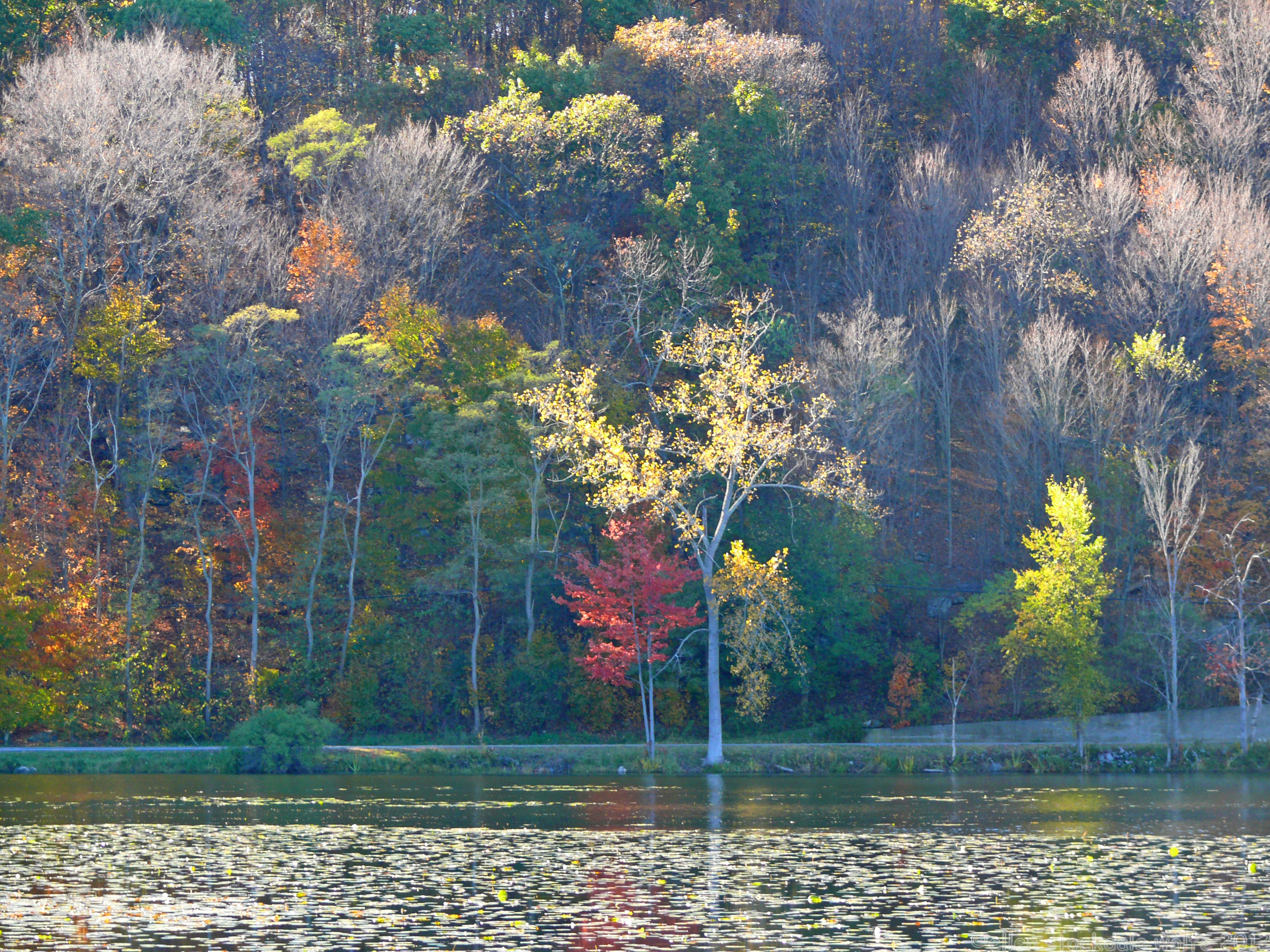
(Click to enlarge)
No one in my family liked summer. Probably because we lived in New York City and summer is not fun there. Moving upstate changed all that– up to a point…though I must admit to a weakness for those beautiful June days when the temperature reaches perfection, the sky is blue with fluffy clouds, and a soporific breeze wafts through the trees. And true, one has much more time with the four or five extra hours of sunlight. Still in all, when the first hints of fall come I am bordering on ecstatic.
First there is the change in light. The sun, still hot in mid-September, does not pack the punch it did in July, when one could be outdoors for an hour and come in with a change in skin color. Temperatures cool. The grass does not grow as fast. The “blood” of the trees starts to flow back into the trunk causing leaves to change color. Walnuts, acorns and apples fall. The bats leave for warmer climes, giving us yet another chance to plug up holes inside to keep them outside next summer. Ads start to appear in early August for “Back to School” specials, bringing the butterflies, that were so rampant outdoors in August, inside the stomach of many a child. Even adults are not immune. Many grown people feel the flutter of back-to-school anxiety come fall. After all September means “back to school” for many, many years. Time to “honker down” again and mean business. Fall offers a new beginning and there is a tinge of excitement added to the anxiety in facing something new.
And most of all, fall is a time of riotous color, when a walk in the woods finds one reveling like a drunk, besotted by the yellow, orange, crimson, russet world which our eyes imbibe like a hefty cocktail. It is a time when Italian comes to the lips in a loud “Que bella!! (“How beautiful!!”) The green of summer is bucolic and raises the spirit, but the many colors of fall intoxicate. People start talking of peak color, and leafing becomes the pastime of many. It is the time to plant bulbs and endlessly rake blowing leaves.
But fall is a time of melancholia, too. Flowers die. Reptiles go into hibernation. Insects die or overwinter. Songbirds migrate. Trees eventually loose their leaves. Anxiety over new beginnings can be uncomfortable. And the end of the lazy days of summer brings with it shorter days, longer nights, and possible depression for many people. Moments of sobriety seep into intoxication with the new world of color as we may remember loved ones who can no longer share the beauty…who can no longer enjoy those cool, crisp days in September when coolness brushes the cheeks… days so coveted in August. For autumn is a celebration of endings, too, perhaps best described by the French poet, Guillaume Appolinaire, in his poem Autumn:
A bow-legged peasant and his ox receding
Through the mist slowly through the mists of autumn
Which hides the shabby and sordid villages
And out there as he goes the peasant is singing
A song of love and infidelity
About a ring and a heart which someone is breaking
Oh the autumn the autumn has been the death of summer
In the mist there are two gray shapes receding
Our Prehistoric Visitor Returns
Last year I wrote about our special visitor, Shelley, who has appeared in our driveway around Memorial Day for the past three years to lay her eggs in the exact same spot. Shelley, to introduce her once again, is a large snapping turtle with a muddy, mossy shell and a long jagged tail. In my ignorance the first year she came I tried to save her from getting run over, while all the time unbeknownst to me, she was trying to find the right spot on the side of the road to lay her eggs. Good-natured, she took my meddling in stride and only gently snapped once after the third time I had returned her to the marsh out in back of our house in a snow shovel. Only then did I realize what she was up to. Shelley communicated simply and without malice. Shelley was a class act.
(Click on all photos to enlarge)
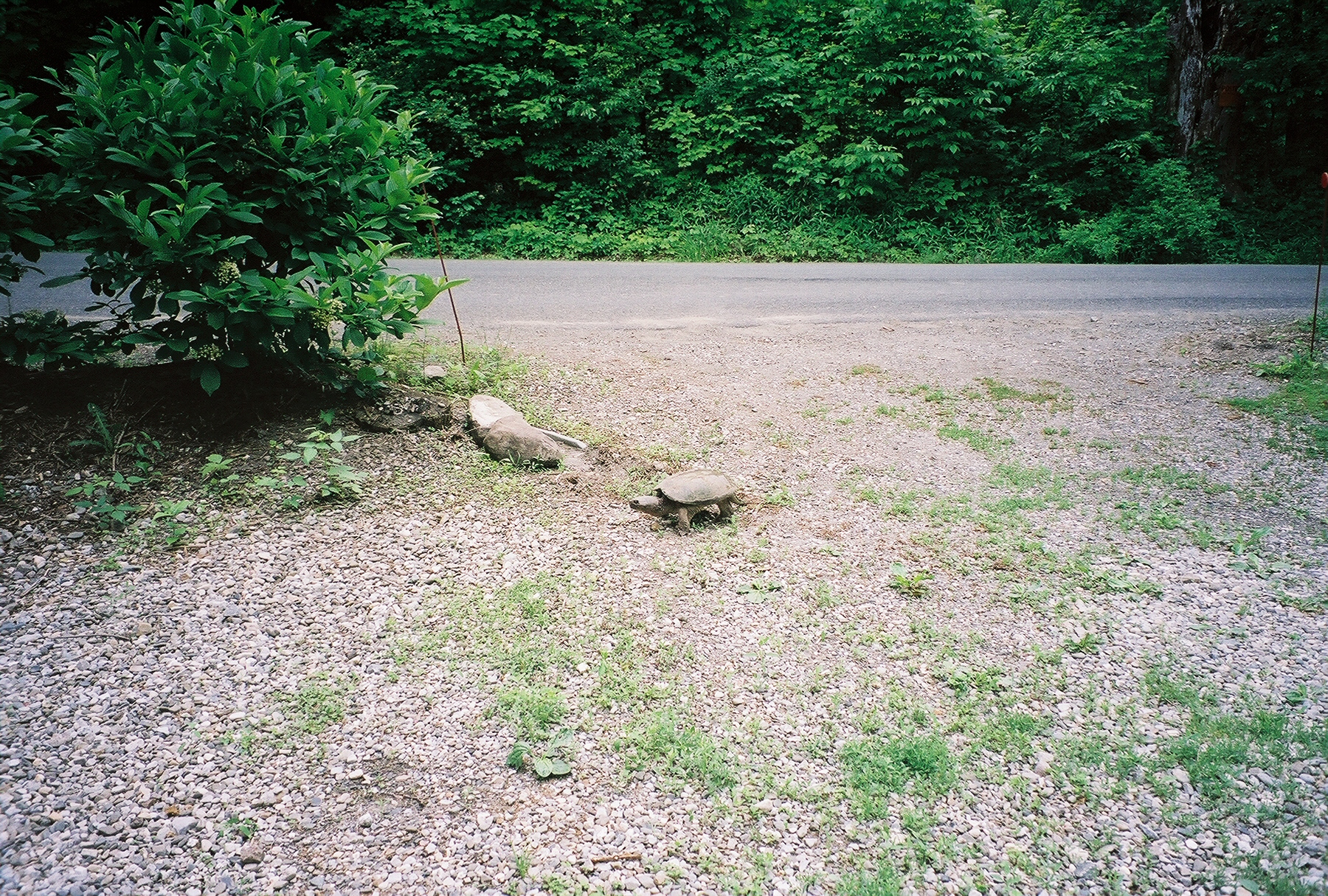
Every year, according to some inner time mechanism, Shelley would come early in the morning to lay her eggs in the swale in the corner of our driveway. A big snapper, she, majestic in her reptilian grandeur. Her shell measured (yes, we measured it) 13 inches, but like all snappers her head juts out of the shell about 4 inches and her spiked, dinosaur-looking tail adds on another 5 inches or so.
This year we checked our driveway early each morning worrying as trucks barreled by dangerously close to where she has laid her eggs in the past. Days went by. No Shelley. Judging by the size of her shell and the speed of her gait, Shelley was not young. Each year we saw her Shelley was walking slower and slower. We wondered if she made it through the winter.
In addition, in the early spring her pond was dug up and drained by the new owner to make it deeper and with each dig of the steam shovel we imagined our snapper being snapped up.
Memorial Day came and went and each day was sunny. Shelley liked overcast days to lay her eggs. The very last day of May was a perfect day for laying eggs, overcast and humid. We checked our driveway. No Shelley. We checked up and down the road. No Shelley. My husband didn’t say anything but disappointment and worry were written on his face. I was feeling worried, too.

We held our breath and waited. And then…
We first noticed her at 6:30 in the morning and watched her as she spent the next 3 hours or so looking for a suitable spot to lay her eggs, digging a hole for them, and then depositing them in the hole. She picked the same spot she picks every year after much mulling around and searching.
It was a delight to see those mighty claws dig a deep hole and then the back feet dig deeper. She rested for awhile and we took pictures which she did not seem to mind. Then we left to give her privacy and the back of her rocked from side to side as she deposited the eggs.
Normally she takes a hair-raising walk crisscrossing a somewhat busy road and I accompany her to make sure no car hits her. But this year she surprised us yet again and took the safer route across our back yard, after a few false starts (stopping at our front door).


Though she could have taken an easier route in our yard, she followed a stream in back of our house following a logic that has worked for 200 million years. Maneuvering over large rocks and crawling between crevices that looked impossibly narrow, we were not sure she could make it home and were wondering how we would rescue her.
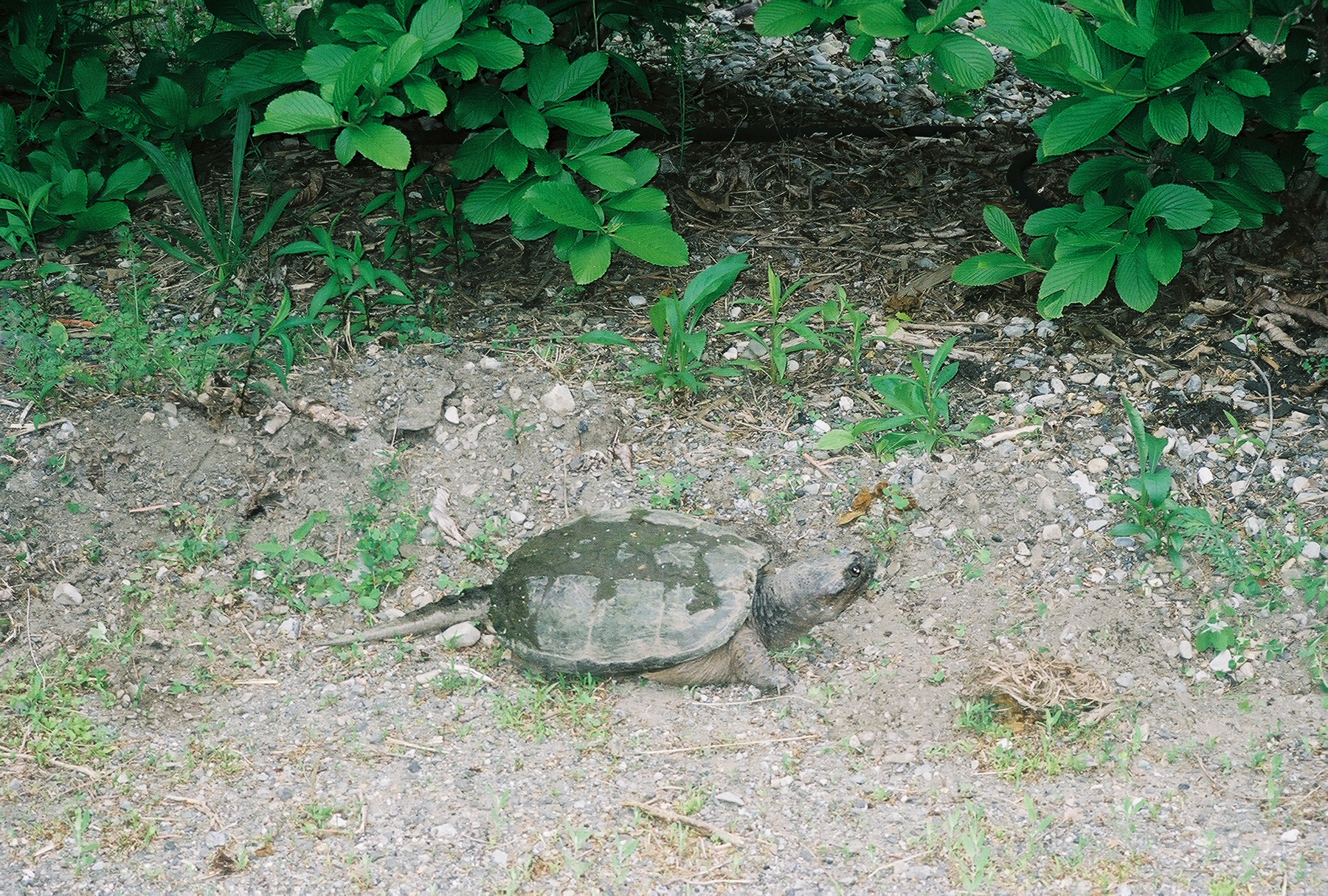

We were the fools. She arrived triumphantly and magnificently in her exhausted state in the marsh on our side of the pond and quickly submerged herself under the mud until she was no longer visible, a living submarine.

After her departure we felt sad. We can only assume this brave lady made it home to her now-deeper pond having survived despite the hand of man and the worry of her next door neighbors. The brilliant naturalist and “turtle man”, David M. Carroll, explains the tinge of sadness we felt after seeing Shelley lay her eggs when he writes in his Self-Portrait with Turtles: a Memoir: “The furtive turtles were utterly silent in their nesting, but the sandy fields and road edges somehow seemed to go quiet with their departure.” Shelley’s departure meant a break in our one-sided bond with her and David Carroll sheds light so poetically on our experience of loss when he writes of his relentless study of turtles: “Through these children of the sun’s dialogue with the earth I could continue to pass out of human time and place and enter the soul of the seasons.” That was Shelley’s gift to us.
Welcome to samples of my work in various art forms showcasing “Eye-locks and Other Fearsome Things.” “Eye-locks” is a Bipolar/Asperger’s memoir in narrative form that describes the triumph of love over mental illness.
Jeepers, Peepers
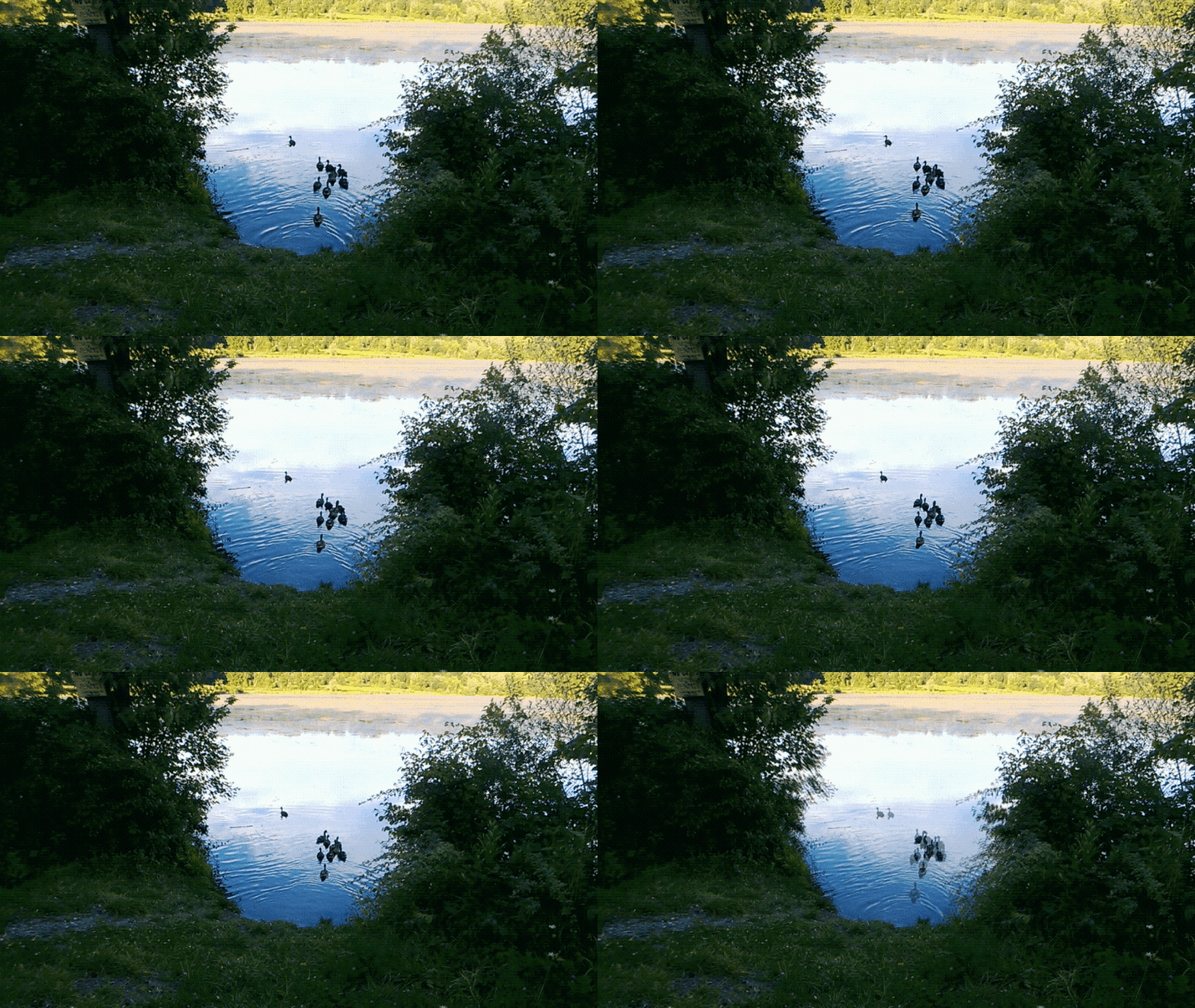
When nature awakens in late March or early April, sap starts flowing in the trees and ice changes to water marking the end of hibernation. This is the grand opening of the wetlands and the pilgrimage to the vernal pools as David M. Carroll writes in his “Swampwalker’s Journal: a Wetlands Year.” A vernal pool is a body of water which fills up in autumn and winter and is swollen in the spring but often dries up completely by the end of the summer. Carroll describes vernal pools so beautifully: “It is at snowmelt and ice-out, the last sleets, first rains, and the earliest warming breaths of spring that they beckon wood frogs, salamanders, and spring peepers from surrounding upland woods, where they have passed the winter in rotted-out trees roots [a reason not to ‘clean up’ the woods], under layers of bark and litter, in small mammal tunnels and other hibernacula in the earth.” The melting snow heralds the march of the amphibians. “Vernal pool habitats hold a galaxy of small things that come to life the instant ice and snow turn back into water.”
Carroll walks the swamps, as the title of his book suggests, in search of mating salamanders and spotted turtles, bogs, fens and all wetland flora and fauna. He tells us that there must be a certain collusion of events– several warm days in a row followed by a darkest of nights with temperatures ideally in the mid-50s with rain preferably two nights in a row. And then the magical migration begins. The salamanders begin their “annual pilgrimage” to the vernal pond to mate.
My husband and I are lucky enough to have a vernal pond on the property next door to us and when Spring comes the sound at night from that pond makes us feel as if we are camping out next to a vast wetland. The music of the spring peepers plays through the night throughout the house, often starting overeagerly in the late afternoon. This manic symphony thrills us every year. It is the first sign of Spring for us. The quality of joyousness and the affirmation of life gladdens our souls. Going to sleep with that sound makes us remember what we so often forget, to give thanks to our Creator for his magnificent creatures.
Inspired by Carroll, one year we awaited the first dark, rainy warm night after a succession of warm days. In our rain gear, armed with flashlights we set out around 11PM to look for the march of the salamanders. We walked to the nearby pond. Nothing. We walked quite aways down a nearby dirt road that has run off but is not quite a vernal pond. We shone the flashlight this way and that. Nothing. We finally headed home disappointed and dejected and my husband started towards the front door when I yet out a yelp. There in the doorway was a 6 inch spotted salamander in all its glory! We never found the march of the salamanders but we were greeted by one of these fantastic amphibians right at our front door!
This story, however, does not have a happy ending. In his epilogue to the “Swampwalker’s Journal,” David Carroll explains why it took him more than 7 years to complete this book. He writes that he became involved in saving some of the wetlands in his book and says sadly nearly all of his interventions have or will become “losing battles.” He describes the plight of the wetlands, bogs and fens as a “landscape of loss.” And he scorns our human selfishness as he writes how it “reveals explicitly the extent to which we think of ourselves as owning all living things, along with the very earth, air, and water in which they live, as if we possessed some divinely mandated dominion over all creation.” He warns: “As we will learn in time none of this belongs to us.” I read these words, knowing them to be true and I think of the soon-to-be-extinct bog turtle and other creatures with the same possible fate. I think of the spotted salamander who came to our door, as did Shelley, the snapping turtle who returns to our drive way every year to lay her eggs and I think of the spring peepers whose joyous song heralds spring and I fear for their future.
Winter Doldrums
(Click to enlarge)
It is frigid outside and has been for a few days now. It is frigid in many parts of the country. The holidays have come and gone. Now begins the nitty gritty of hard winter work. I find myself listless and not wanting to go out or exercise or paint or take pictures or do much of anything I usually love to do. I have a cold but that does not excuse this lassitude and when I go to my favorite deli, I find that Terry is in the same mood. “I was ready to go home the moment I came in,” she said. And I wondered. My husband was dour and I was sour. What is this? Could it be some vestigial remnants of human hibernation? Maybe we should hibernate for awhile each winter. We binge on food and drink over the holidays. Perhaps we should be sleeping off the extra pounds.
I who love winter and live for Fall each summer find myself longing to hear the music of the spring peepers. It is months away– well, about a month and a half away. They are the first harbingers of new life for me. Terry, who also loves winter, tells me today she is sick of winter. Perhaps it is this string of Arctic air and grey days and icy road conditions. Perhaps it is the human condition to always be dissatisfied with something or other.
I miss the squirrels. It has been so cold they seem to be laying low in their nests. Judging from the tracks in the back yard the only animals on the move are the deer. And as much as I love the silence of winter, I find myself longing for the sweet dulcet music of birdsong at mating season in spring.
We bought this calendar that has a celestial map of the sky for each month so you can find the constellations in the night sky. But it has been too overcast or too cold or too something. We have yet to go out with flashlights and match the map with the canopy of stars. But I am still humbled in a dazzled psyche over the view of the stars through the stripped down trees that we see out our window from bed every night.
Then again maybe it is laziness. Too many sugar highs in December have led to a deep low in February. And with a tease of spring one day in which the temperature reached almost 50 degrees maybe we were let down even further. Not liking being unproductive I think I can overcome this– but maybe the thing is to go with the flow and allow a period of inactivity, let the land lay fallow, so that an increase in productivity may eventually result.
Maybe the thing to do is not to panic. Spring will come. Hopefully, if man has not destroyed all the vernal pools, the spring peepers will return and, if pesticides have not destroyed all the birds, sweet mating songs will be sung and bees and other insects will buzz. And if the weather turns more clement, our spirits will once again soar and we will be busy buzzing with the business of living.
(Click to enlarge)
When the Snows Come

My husband and I sit in our living room with all the little still-intact dairy barn windows showing flakes falling as if we are on ship at sea in a snowfall. Except for the high ceiling the living room has the feeling of a ship cabin, our converted dairy barn, and I think it is most beautiful when the snow is falling.
The glass doors at the pentagon of the far end of the barn gives us perfect view of the suet bird feeder. We only feed the birds suet in winter because in summer a fat raccoon comes and eats the whole suet cake in one sitting. The bird feeder in winter is our television. We watch male cardinals, bright red in the stark white, feed and contend with the beautiful, bullying blue jays. And the more modest and gentle little juncos and sparrows touch our hearts with their humility.
One winter, when the snow had covered the ground for a month or so and turned to solid ice we watched horrified as squirrels clawed at the feeder and fought with one another for a chance to feed making their shrill cries of territoriality. That hasn’t happened since and we think the ground was too frozen for them to retrieve the nuts and such that they buried in the fall and they were fighting off starvation.
Waking up in the morning there is no need for a weather report as we see the snow piled high on the surrounding trees and we see the sky through the second story doorway in the barn where they used to bring hay inside, now a cathedral window in our bedroom. The thermometer in the former hay loft tells us how cold it is though we can feel how chill the air is. It is great to wake up to see the squirrels running along the limbs of the trees, cleaning off the heavy snow. They seem friskiest just aftter a snowfall.
And if we are lucky and the snow is deep enough we get out our snow shoes and climb up the hill behind our little barn to what we were once told was a Christian Indian burial ground. There are no markers left but the spot has the air of the sacred and it affords a small view of the Catskills in winter. High on the hill overlooking the valley, it seems a perfect place for a burial ground. The snowfall makes it easier to walk the hill which in the summer is too full of saplings and underbrush to be able to walk the “meadow” as we call it. We only get it brush hog mowed once a year.
Our property does not include the entire meadow but on our half of the meadow there is a squat fir tree there which provides a great shelter for deer in a storm and the deer love the meadow. There are a few blown over trees. And as we snow shoe we see all kinds of animal tracks which we attempt to identify. And animal shelters from the harsh elements.
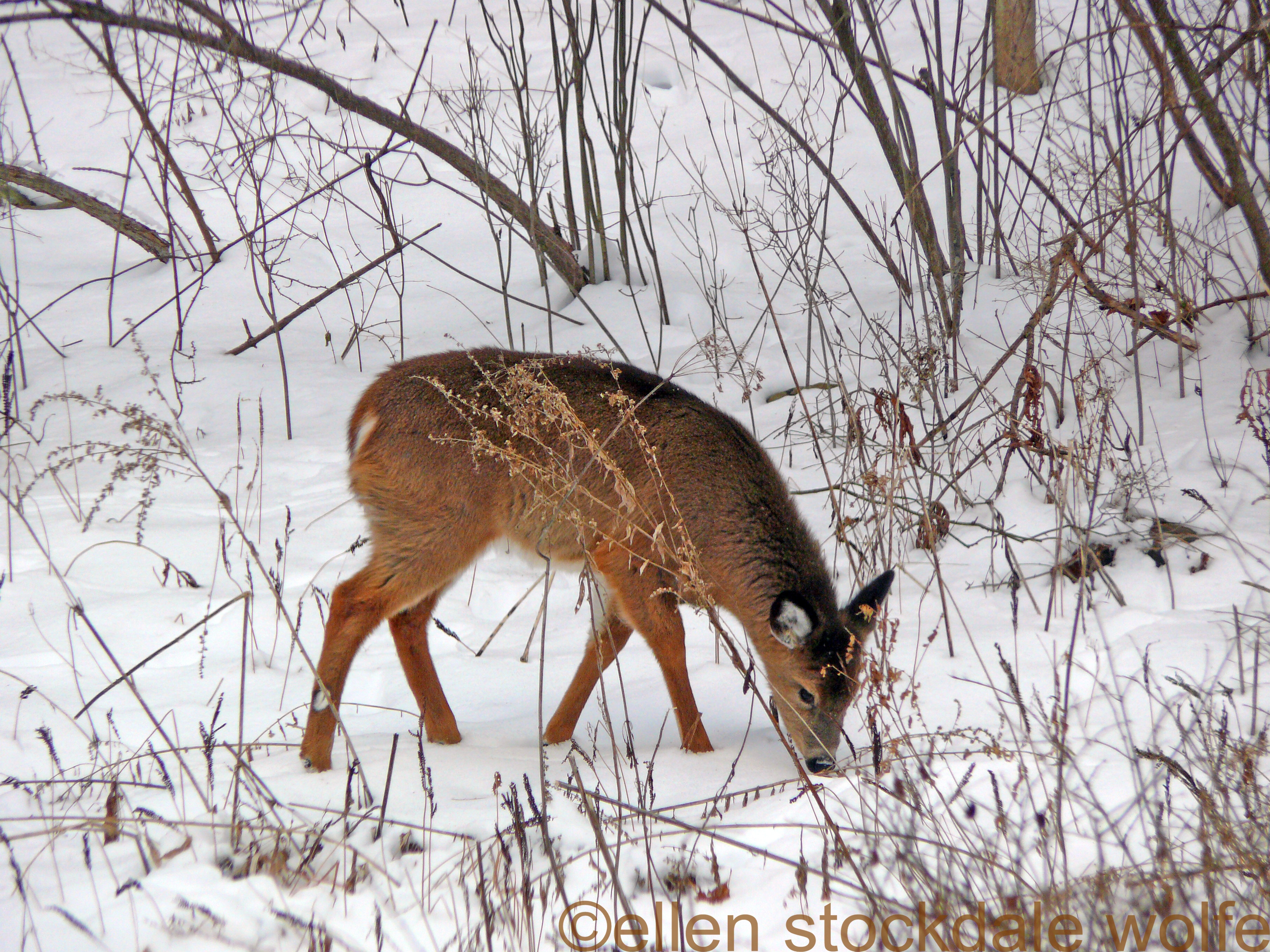
Like many barns, ours was built near the road so we do get some traffic noise. But in the meadow we are far removed from the road and its bustle. And when it snows, it is so beautiful in the quiet, looking at the animal tracks and feeling the spirits in the graveyard. Our secret little piece of Paradise. And to stand there in the silence, in the virgin white, and see the abstract patterns of the snow on the surrounding hundreds of trees is divine.

Welcome to samples of my writing and art work showcasing “Eye-locks and Other Fearsome Things.” “Eye-locks” is a Bipolar/Asperger’s memoir in narrative form that describes the triumph of love over mental illness.
BEINGS OF LIGHT

(Click to enlarge)
December is my favorite time of year. In this the month of darkness, in this the darkest month, the light of the human spirit shines forth in a fullness shown by so many, in so many ways. As the days grow shorter in North America, houses and trees are decorated, and snow falls. In the hushed silence of the nights, lights shine in windows, and the beauty is shared by passersby. For this season of giving brings the festivals of lights: Hanukkah, Christmas, Kwanza. Each tradition incorporates light in its ceremonies and decorations.
An animal friend who lived down the road, a donkey in his stable, reminded me of the story of another manger over 2000 years ago. And seeing him snug in his stable with snow on the ground gave the illusion that all was right in the world. But all was not well and all is not right now. Thousands know no peace in any season. Millions are cold and starving. Racism and religious wars prevail. Climate change advances in leaps and bounds, faster than most predicted.
Those who live closer to the land are especially blessed. They share their lives with animals who are constant reminders of humility and simplicity in this rapid, complex, multi-tasking world. They can drive around on a December night and see houses covered in lights with illuminated trees, houses warmed by fires, imagining them filled with laughter and conversation and love, and feel blessed. Blessed to have so much when others have so little. Blessed to be able to celebrate as they wish when others cannot.
Yet even those living in the worst conditions show the light of the human spirit and celebrate the season of light in personal ways. For the human spirit is indomitable.
(Click to enlarge)
Einstein said: “A human being is part of the whole, called by us the ‘Universe”– a part limited in time and space. He experiences himself, his thoughts, and feelings, as something separated from the rest– a kind of optical delusion of his consciousness. This delusion is a kind of prison for us, restricting us to our personal desires and to affection for a few persons nearest us. Our task must be to free ourselves from this prison by widening our circles of compassion to embrace all living creatures and the whole of nature in its beauty.” We are all cut from the same cloth and our inner light unites us.
In December’s darkness we light lights. For we are beings of light. A light glows within each one of us. And, at the most basic level, we are all beings of light because we are made from stardust. Perhaps that is why the stars hold such majesty for us– we are all– Muslim, Christian, Jew, Hindu, Buddhist– whatever– we are all made from star material.
And in this holiday season we behold the night sky as Christians say shepherds did over two thousand years ago on the birth of the holy infant, in a stable like the one down the road. On that night they say a star lit the whole sky to guide the shepherds to the stable of the infant, Jesus, the son of God.
In these deep, long, silent nights as we light our houses, our candles, our trees, let us look inside and try to find the glow that may guide us each, alone but intrinsically one, to the LIGHT!

(Click to enlarge)
Welcome to samples of my writing and art work showcasing “Eye-locks and Other Fearsome Things.” “Eye-locks” is a Bipolar/Asperger’s memoir in narrative form that describes the triumph of love over mental illness.
Omens and Miracles
(Click to enlarge)
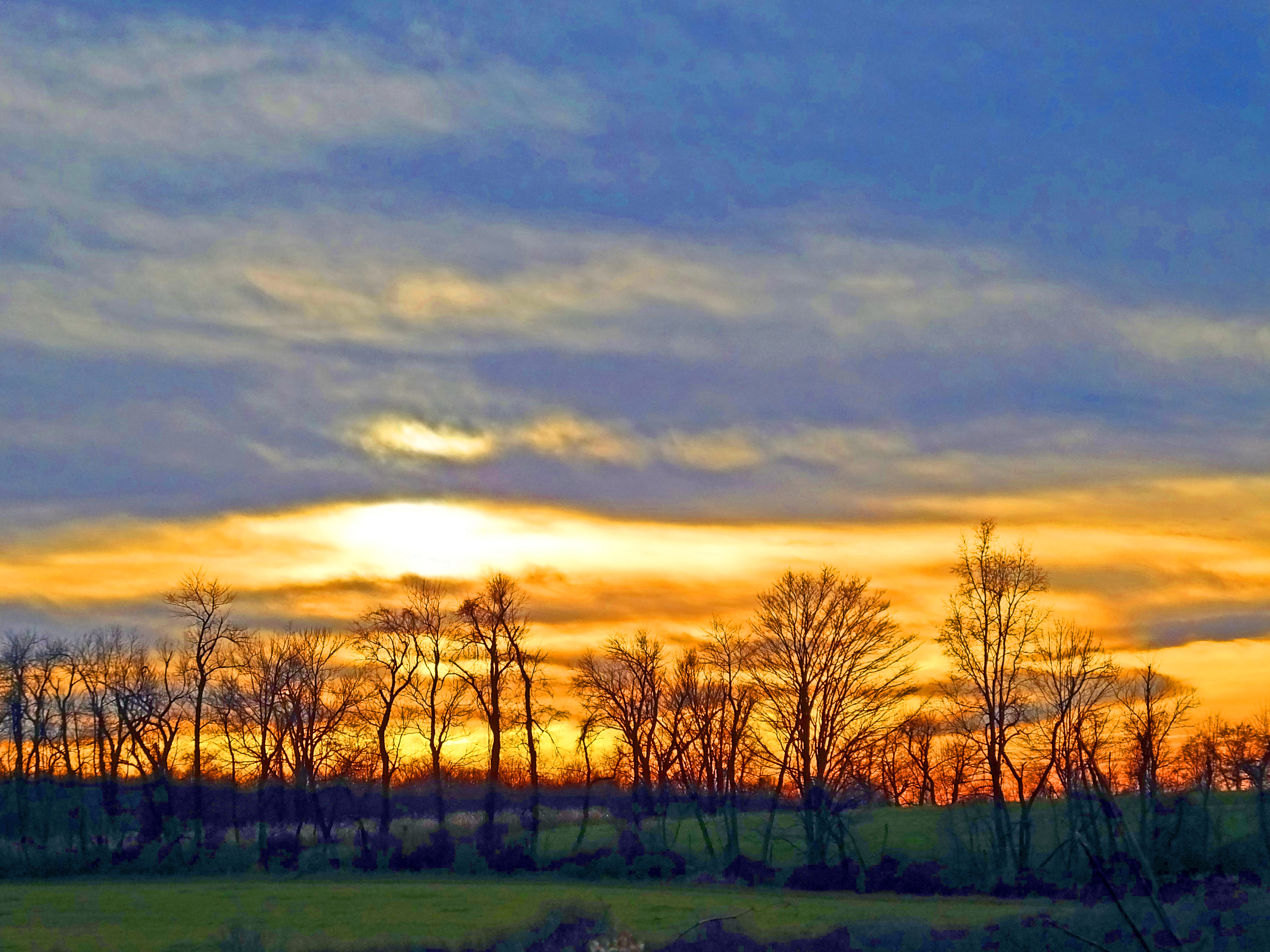
It was a beautiful day in the fleeting footfall of late autumn. The air was the icy cool that late November and early December bring and the birds and the squirrels were in a feeding frenzy. I barely noticed though because all morning was spent cleaning resistant rust stains with some horrid acid cleaner with all kinds of warnings on it. And I had a low fever and was feeling kind of lousy. A phone call set the afternoon on a downward spiral. It had been an angry phone call. I had called my husband at lunch time and he was showing all the signs of extreme job stress. He was a psychiatric social worker and at times it seems all his clients act out at once and intakes happen and hospitalizations happen and whatever can go wrong, does. It was one of those kind of days. He proceeded to yell at me, for what seemed like fifteen minutes but was probably only five, about all that went wrong that day. Then suddenly the phone went dead. I called back immediately and got a fast busy signal. Tried again with the same result. And again. Tried the cell but his cell was turned off. So there was no getting through. And he had a long commute home and considering his mood and all, I was totally alarmed. I tried him on and off all afternoon and finally left a message on his cell asking him to call me. He didn’t. Until well after the time he should have left work.
“Are you still speaking to me?” he asked right away. “Yes, of course, why do you ask?” “Because I was yelling at you at lunch time.” “I know and I was wondering why but I didn’t hang up. The phone went dead.” “Okay, I am on my way home. It will take some time because I was delayed and traffic is worse at this time.” “Okay,” I said. I didn’t say my usual “Be careful!” or other worried dictums. I was just happy he had called. When I hung up the phone I thanked God he had called and he seemed to have calmed down some since lunchtime. Things were looking better than they had at midday.
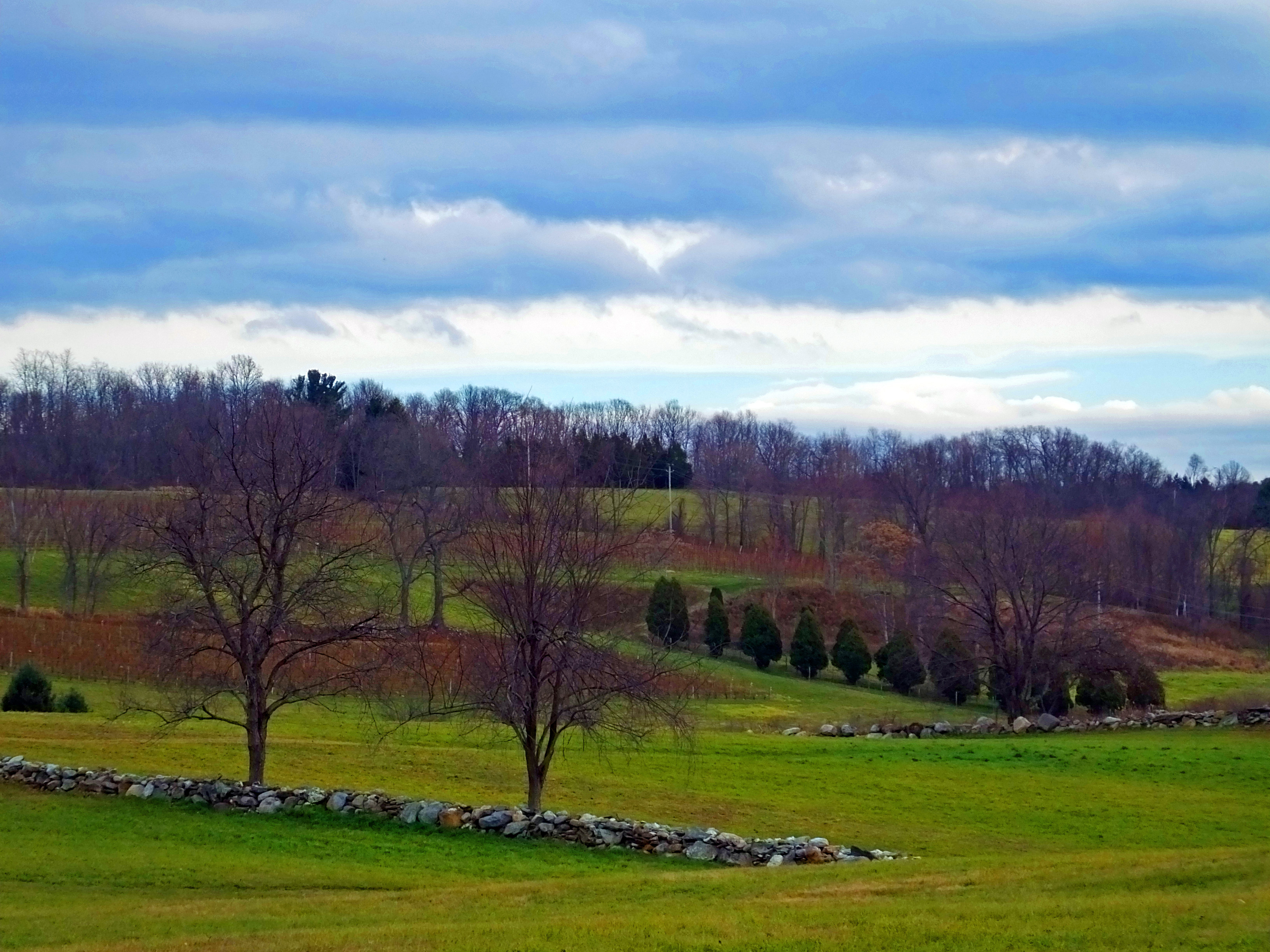
And then there was the unmistakable thud on the window. I hoped in vain that it was one of the last of the falling walnuts that start to fall in October. But two feathers on the window pane left telltale marks. I was sick. We had just put up a wooden bird house with suction cups in the window above to prevent bird collisions according to the advertisement. I looked out the window on the deck for a body. None. I went outside. No bird. Such a loud thud though was unmistakable. When I turned the corner of the deck onto the lawn, sure enough, I saw the bird. He saw me and seemed too stunned to be afraid so I did a quick form of Japanese energy healing technique some of you may know as Reiki on him. Deciding my gigantic presence was probably stressing him out further I went inside. I could see him from the window. I did the symbols for distant healing and sent him the animal healing symbol. He sat there with his head resting on the ground. At least he did not have his beak open in a screech like a wounded blue jay a few months ago but things did not look good.
Now half of me comes from a Sicilian background and it is a strong strain in my psyche. My maternal grandfather was a peasant working in the stone quarries of Sicily when, at 16, he fulfilled his dream of coming to the United States. Here he wound up becoming a lawyer but only after first doing stone work to finance his night schooling. Among his carving work was the Lincoln Gettysburg address at the Lincoln Memorial in Washington, D.C. He was an exceptional man and I was very close to him as a little girl. His peasant background never left him. This was both good and bad. The bad, he and his wife and my mother were very superstitious. They believed in omens and signs. And this was instilled in me. Now to have this bird fly into the window just after talking to my husband about his long commute home was all too much. I argued in my mind against omens and superstitions but in my gut I was sick.
I kept checking on the bird, wondering if he was dead yet and if I should go bury him so he wouldn’t get eaten. I did more Reiki. I cried. It was not only that this poor little bird was hurt and probably going to die but what he represented. The birds had been in a feeding frenzy these past few days. I had just refilled the bird feeder yesterday and it was half empty not even 24 hours later. And it was bird central. Birds flying like kamikaze planes all over the front yard. When I went to fill the bird feeder a bird stayed on eating to the very last minute, unafraid of my approach. And as soon as I put the feeder back up in the tree he was back, not even waiting for me to leave. It was no wonder there was an accident.
I went back to the window to check the bird again. His head had been resting on the ground and things definitely did not look good! But, did I see his head up now? Yes, he had lifted up his head and he was moving his head right and left and up and down. I prayed in desperation. And I kept watching feeling guardedly hopeful. And next thing I knew he took to the air and flew to the swamp somewhere lost to my eyes. I was ecstatic. I got down on my knees and thanked God. This was truly a miracle. In my pessimism and superstition that I must battle with it seems daily I have lost all faith in miracles. But miracles do happen. The guy at work who was on death’s door after collapsing outside the library and wound up having cancer, was now fully tumor free and working out at the gym. Another miracle. People and birds don’t always die even when things look their bleakest. Sometimes there are miracles. And my husband came home safe and sound and apologized to me and was happy to be home. Sometimes, too, there are happy endings.
(Click to enlarge)
Welcome to samples of my writing and art work showcasing “Eye-locks and Other Fearsome Things.” “Eye-locks” is a Bipolar/Asperger’s memoir in narrative form that describes the triumph of love over mental illness.
The Trees of Late Fall & the Promise of Winter
(Click to enlarge)
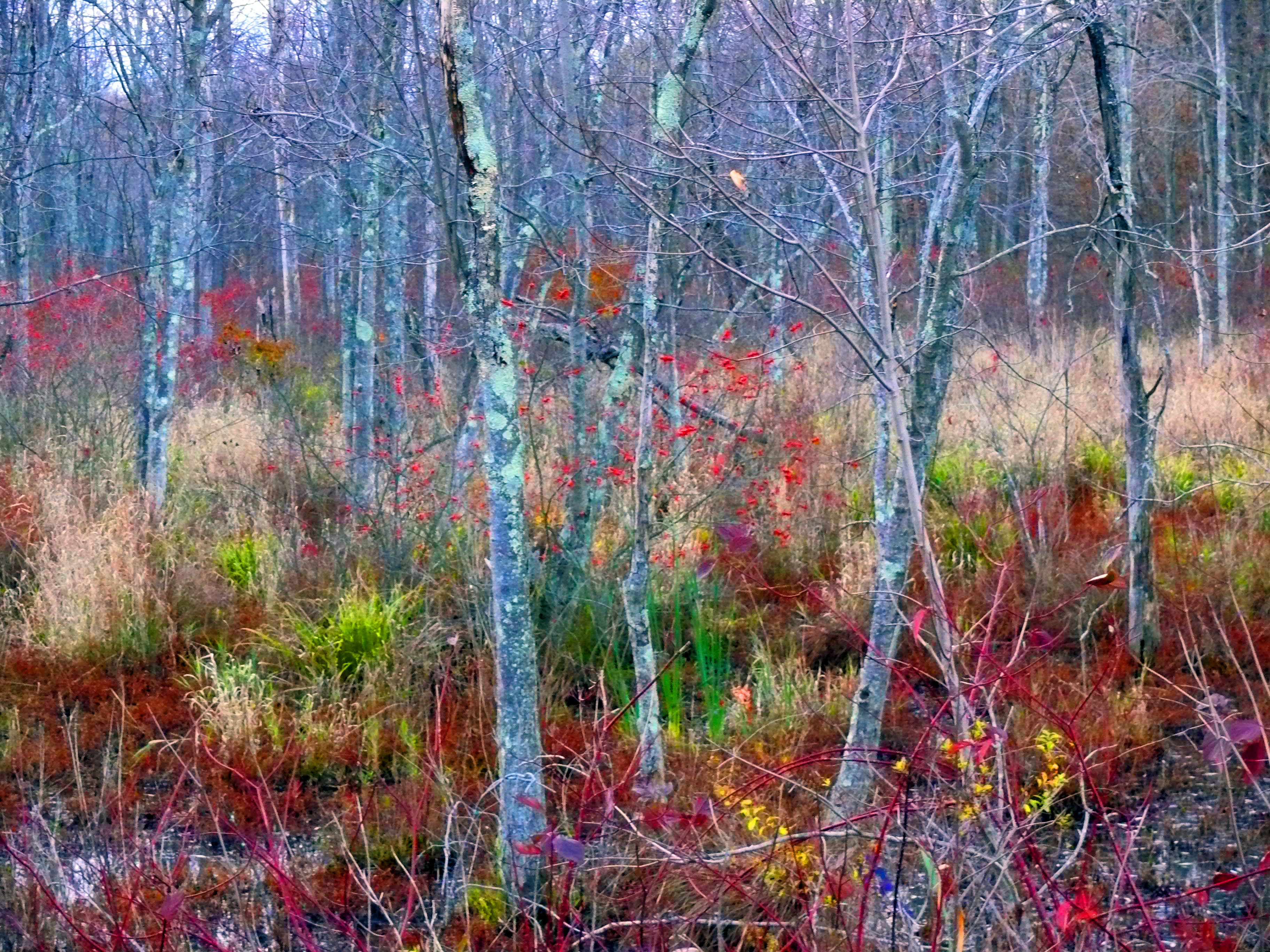
Bontecou Lake Swamp, Millbrook, New York
Every year what budded in autumn blossoms full blown in the weeks before official winter– my love affair with trees. Trees that were drop-dead gorgeous in their fall colors are now bare, with the exception of evergreens and a few stray deciduous trees that refuse to relinquish their leaves. Now the trees are stripped down to their souls and their souls sing a siren song to the universe.
The tops of trees lift my spirit; brushlike they paint the sky the baby pinks and blues of mornings, and the majestic magentas and violets of day’s end. Each tree has its signature shape against the sky, like a fingerprint or a snowflake, similar yet each unique. Some treetops in their bare state are shaped like a fancy coiffure; others look like wrought iron filigree. On distant mountains, against the snowy ground, some look like stubble on an old man’s unshaven face.
It is the cold, colorful pre-winter sky showing through, and showing off, the bare branches that woos me. The bare curvaceous branches are stark, dark lines against the bright of day and the inky sky of night. These resplendent creatures are living lines that explode. Branches tangle like the lines in a Jackson Pollock painting. Others curve in the sensuous lines of a Brancusi sculpture. Buxom tree trunks stand strong surrounded by their colorful, dead blossoms amid the ground cover and their burgeoning berries, the offspring of a Renaissance Madonna. In truth these trees are not like art at all. Rather art imitates them– their beauty provides the timeless inspiration for artists, writers and poets of all ages and styles.
Trees not only inspire, they themselves are paragons of diversity. One look out of a car window while driving on the Taconic and one can see squat pines alongside towering majestic firs, birches interspersed with maple and oak. And together the different brown and tan barks interspersed with evergreens create not only a mosaic of contrasting colors, but display an example to inspire humans to live together in peaceful unity.
These beneficent beings carry the heavy, dark grey clouds of winter. When it snows the tree trunks become canvases for the abstract patterns of windblown-snow, while the serpentine branches are outlined in white. In ice storms their branches become chandeliers, each enveloped in glassine ice. While in the melancholy of a winter rain, the branches become oiled skins of snakes weeping to the ground below. And finally, in the night sky, the branches hold the stars in their arms, those with leaves holding them in their hands, as they nurse the moon.
All trees, no matter what their species, age or height, stand tall in proud humility, their arms reaching up to the Heavens to our Creator in prayer– soft-spoken beings of peace and tranquility towering over us, while we wee, little creatures race around distractedly below.

(Click to enlarge)
Hammond Road, Millbrook, NY
Electrified, Giggling Flowers, Talking Trees, and Thanksgiving


(Click to enlarge)
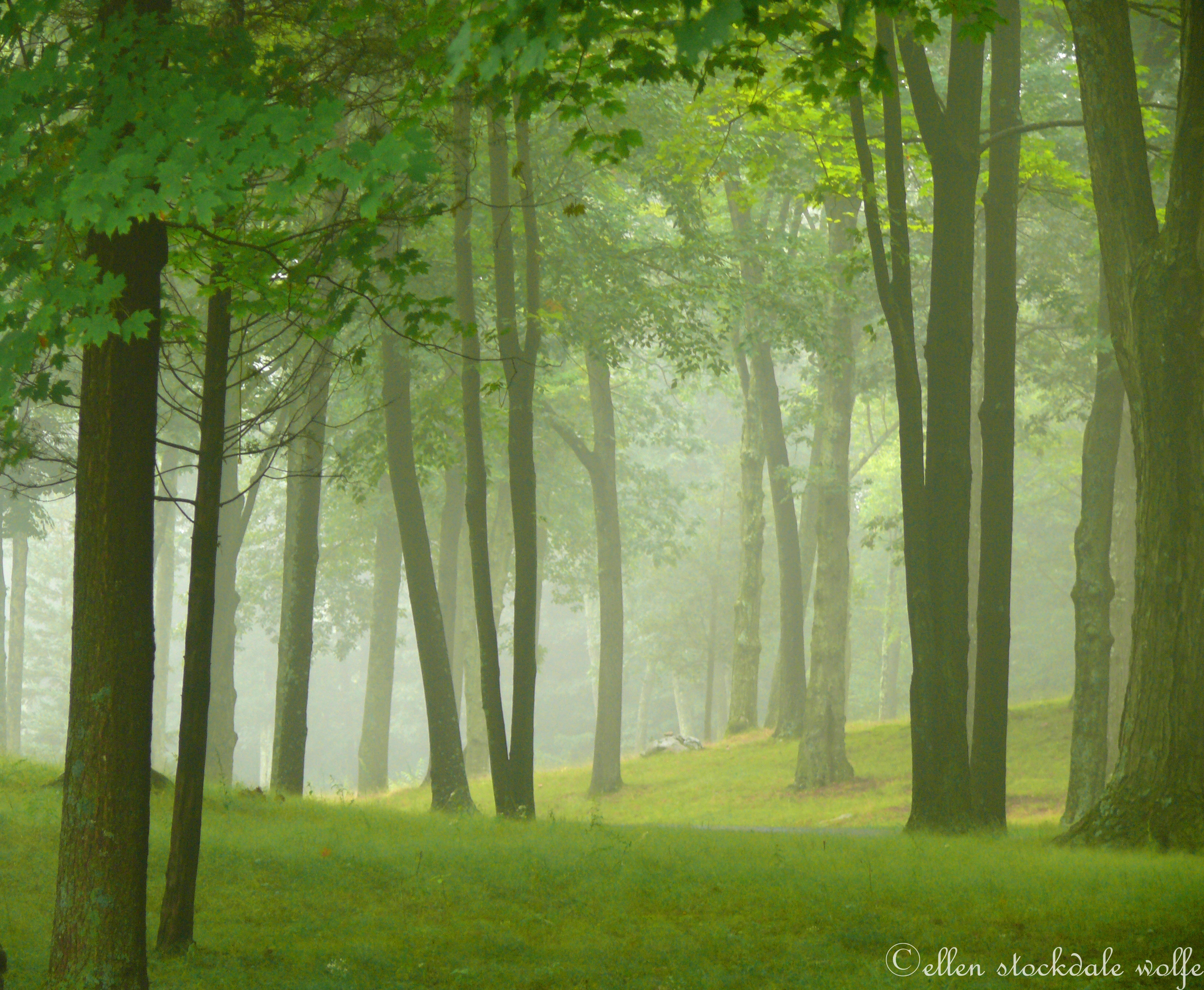
He wasn’t the only one who spoke of these things. I spent much time in grammar school at the house of my Polish friend whose mother was an artist. She told us about trees talking and, she used to say, talking to them made her feel happy. At the time I did not think much of it. But now, many years later, on walks, occasionally a tree will say something. Utter a benevolent greeting. And now, I find myself so in love with trees, I shoot portraits of them constantly, singly or in groups, with their “friends and relations.”
(Click to enlarge)
Any doubts I had about trees communicating were put to rest when I read in J.Gordon Douglas’s column in the now defunct Dutchess CountyRegister Herald, about how trees in an area communicate with one another in planning their reproduction strategies for the season or warning each other chemically about caterpillar infestations. Scientists are not sure how. Maybe through the roots.
Not only do plants have feelings, they can also generate energy. See the website by artist, Caleb Charland. He used apple trees to generate light. Perhaps one day we will use plants for alternative energy– just another amazing aspect to nature’s ways:
Of course, hearing them “talk” is a little different. However, Valerie Wormwood, one of the world’s leading aromatherapists, in her book entitled The Fragrant Heavens, tells us not only does the earth hum but it emits a low frequency radio signal known as the ‘Shumann resonance” and this signal can be detected coming off trees. She relays that researchers in America wanted to know if this signal could be altered by human thoughts or feelings. They had a group of people circle a tree and say Native American prayers, sending the tree love. They attached electrodes like those measuring human brain waves to the tree. A response not only registered but the sensors went off the scale. Clearly some form of communication went on, confirming my Polish friend’s mother’s belief and many others as well. When trees are cut down we are not only destroying the tree we are cutting down and giving it a terminal sentence as firewood or worse, but we are also upsetting all the trees around the “victim.” The surrounding trees must witness their friend and neighbor being chopped down. Do they feel outrage, fear, sadness?
(Click to enlarge)
We do know now that they feel something. Wormwood tell us that in 1966 Cleve Backster, a lie detector expert in New York, had a group of students go into a room with 2 plants next to each other on a table. One of the 6 students was chosen to “murder” one of the plants, hacking it to bits and then they all left the room. After the attack Backster attached the lie detector to the “survivor” and had the students enter the room again one by one. The sensors were quiet as the “innocent” students entered but when the “attacker” entered they started jumping “wildly.” I think of this as I weed the gardens in the summer. Sometimes we are forced to cut down a tree and we must pick vegetables to eat. And we have to weed the gardens. But perhaps it is in how we do it. If we can express gratitude and appreciation and maybe an apology. Or if we could ask permission perhaps, as the Native Americans do. When they take from the earth they give an offering as well.
The Native Americans had the real idea for giving thanks, for thanksgiving. It was not about stuffing oneself with sweet potatoes and gorging on gravy and turkey. They gave Thanksgiving to Spirit in the earth, in the trees, in the animals, for whatever they took. Flowers “giggle” and trees “talk”. If only we would be attuned enough to listen. Sentient beings surround us and we must follow the lead of the Native Americans at Thanksgiving and give thanks for what we take from the earth, and, of course, from the animal kingdom, and give back something in return. Even if it is only words, but words with heart behind them, words that understand the sacrifice made by sentient beings for us, words that capture the true spirit of Thanksgiving.

(Click to enlarge)
HAPPY THANKSGIVING TO THOSE WHO CELEBRATE THANKSGIVING AND HAPPY AUTUMN TO THOSE WHO DON’T!
Reaching for the Stars
“I think that I shall never see a poem lovely as a tree… a tree that looks at God all day and lifts her leafy arms to pray.” The opening lines of the poem,“Trees,” by Joyce Kilmer. Indigenous peoples through the ages have talked of tree spirits and trees as wise ones. Trees are striking as they permanently lift their arms to the Heavens in seeming prayer, day and night in communication with the Creator, their outstretched arms reaching for the stars.
Reaching for the stars. The image calls to mind a dance of the Kalahari Bushmen who were featured in the movie “The Gods They Must be Crazy.” The Kalahari, the last men born of the Stone Age culture according to Laurens Van Der Post, have no sense of individuality and so share all they have. They have a dance of gratitude which Van Der Post describes in his book entitled “A Mantis Carol”: “I never see their dancing without feeling deeply moved and utterly irreverent and blasphemous because of our own incapacity for acknowledging what life will give if only we will let it in.” And then there is their dance of the “great hunger,” a dance that says we do not live by bread alone, a dance at life’s end fraught with longing, with arms outstretched taughtly towards the Heavens as they reach for the stars.
My grandfather reached for the stars. He came here, a 16-year-old peasant stonecutter from the mountains of Sicily, knowing no English. He wound up carving the Lincoln Gettysburg address at the Lincoln Memorial in DC. While working on the Gettysburg Address he studied English at night school. I remember him telling me how he was the laughing stock of his fellow stone cutters because, inspired by Lincoln’s words, he carved his initials at the top of the monument, “A.L.” for Anthony LaManna (and, of course, for Abraham Lincoln), followed by: “Attorney at Law.” Working his way through school, he actually did eventually become a VA lawyer. He reached for the stars and touched them without ever forgetting where he came from. And he was childlike as he took care of me, as we danced to records on the victrola or as he played the mandolin and sang to me. I always think of him with a tinge of sadness, for more than anyone, he taught me to reach for the stars.
Reach for the creator– that is what the trees say. At this time of year I yearn for the days of childhood in which God seemed close. This yearning fully ripens each year at Thanksgiving/Christmas/Hanukkah when the people brighten their houses with festive lights. It is a time of year in which we light up our hearts and look to the heavens and sing songs of love to a babe born not so very long ago, or in which we give thanks for the oil to light the lights of the temple for eight days. We are all really seeking the love that motivated the Kalahari Bushmen to do their dance. We are seeking a savior, and yearning for the Light in this overlit, commercialized, complicated world in which the inspiring simplicity of the Bushmen, the peasant, is rapidly disappearing. And the trees touch my heart in their upward reach for the Heavens. For at this time so many millions of them are sacrificed as they become our Christmas trees and Hanukkah bushes, to be discarded after the holidays are over.
May we enter this holy season with a simpler yearning, not for presents and parties and hoopla, but with our hearts full of gratitude, taking lessons from the trees, from the Kalahari Bushmen, from our ancestors, and seek Love, in whatever form it takes in our souls.










 MOONSIDE
You must be logged in to post a comment.