The Orchestra of Spring
“The orderly manner in which the universe is run shows that it is guided by some form of intelligence that permeates all created things.”
Paramahansa Yogananda
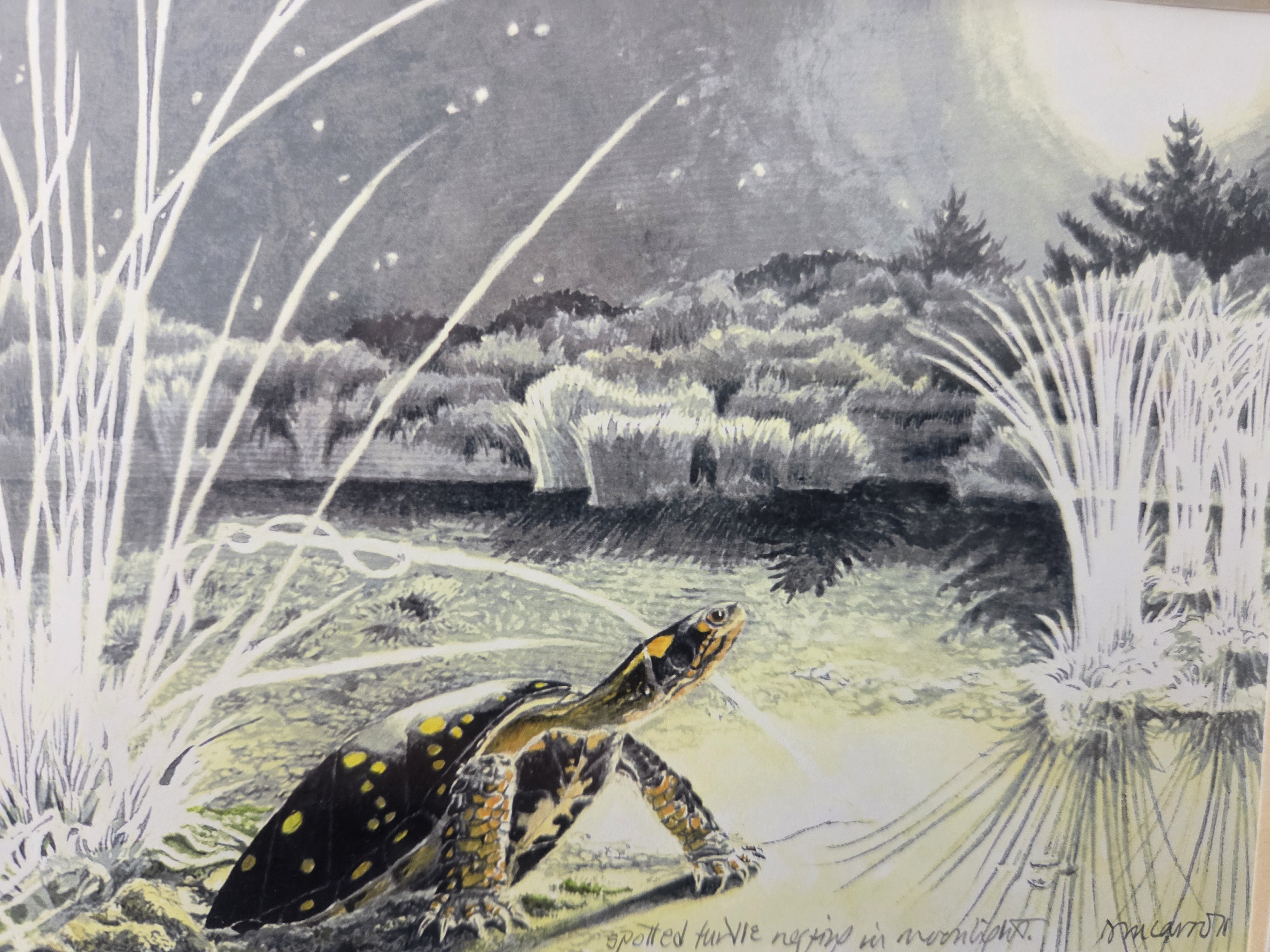
Watercolor by David M. Carroll
“Spotted Turtle Nesting in Moonlight”
When nature awakens in late March or early April, sap starts flowing in the trees and ice changes to water marking the end of hibernation. This is the grand opening of the wetlands and the pilgrimage to the vernal pools as David M. Carroll writes in his “Swampwalker’s Journal: a Wetlands Year.” A vernal pool is a body of water which fills up in autumn and winter and is swollen in the spring but often dries up completely by the end of the summer. Carroll describes vernal pools so beautifully: “It is at snowmelt and ice-out, the last sleets, first rains, and the earliest warming breaths of spring that they beckon wood frogs, salamanders, and spring peepers from surrounding upland woods, where they have passed the winter in rotted-out trees roots [a reason not to ‘clean up’ the woods], under layers of bark and litter, in small mammal tunnels and other hibernacula in the earth.” The melting snow heralds the march of the amphibians. “Vernal pool habitats hold a galaxy of small things that come to life the instant ice and snow turn back into water.”
Carroll walks the swamps, as the title of his book suggests, in search of mating salamanders and spotted turtles, bogs, fens and all wetland flora and fauna. He tells us that there must be a certain collusion of events– several warm days in a row followed by a darkest of nights with temperatures ideally in the mid-50s with rain preferably two nights in a row. And then the magical migration begins. The salamanders begin their “annual pilgrimage” to the vernal pond to mate.
My husband and I were lucky enough to have a vernal pond on the property next door to us and when Spring sprang out of the depths of winter, the sound at night from that pond made us feel as if we are camping out next to a vast wetland. The music of the spring peepers played through the night throughout the house, often starting overeagerly in the late afternoon. This manic symphony thrilled us every year. It was the first sign of Spring for us. The quality of joyousness and the affirmation of life gladdened our souls. Going to sleep with that sound made us remember what we so often forget, to give thanks to our Creator for his magnificent creatures.
This story, however, does not have a happy ending. In his epilogue to the “Swampwalker’s Journal,” David Carroll explains why it took him more than 7 years to complete this book. He writes that he became involved in saving some of the wetlands in his book and says sadly nearly all of his interventions have or will become “losing battles.” He describes the plight of the wetlands, bogs and fens as a “landscape of loss.” And he scorns our human selfishness as he writes how it “reveals explicitly the extent to which we think of ourselves as owning all living things, along with the very earth, air, and water in which they live, as if we possessed some divinely mandated dominion over all creation.” He warns: “As we will learn in time none of this belongs to us.”
Spring’s Siren Song

It is late afternoon and it is Spring by the calendar although still quite cool. And I have just spent the late afternoon listening to music. Some have likened it to the sound to bells. Others to bird song. And still others with unimaginable disdain, to “some kind of nature noise.” For me it is one of the happiest of sounds. The act of creation transformed into sound decibels for all to hear. A sound that comes from the earth and resounds to the heavens, unwittingly praising the Almighty. I hate to leave, and wish I lived even closer to the pond, so that the sound would surround me totally, filling my ears every evening with the sound of perhaps the single-most highlight of spring for me. The siren song of the Spring Peepers.
How have they cast their spell over so many? I cannot say except that their song is uplifting and filled with hope despite the natural perils they face daily. For, as true of all of us, they may die at any moment– say as a meal for a nearby perching crow or underneath murky waters eaten by a snapping turtle. They call for a mate without ceasing, without fear, single-mindedly, without a thought for their own safety. It is nature at its most elemental, in its most singular scope. They all sing out vying to be heard– so many voices. In some spots, I am told, their song is deafening. How nice to be there; I cannot get enough of their sweet music. It moves me to tears– these tiny creatures singing out their heart’s desire.
As I return home to family “situations” and domestic duties, I yearn for the simplicity of their song. Their total fervor. For if they sing then all is right in that small part of the world. Progress has not paved over their pond. Disdainful humans have not drained a “vernal pool.” David Carroll writes about vernal pools in one of his books on turtles called The Swampwalker’s Journal. As the title suggests, Carroll walks such places in search of turtles and other amphibians. He defines a vernal pool as a pool of water that fills up in Fall and Winter, swells in the Spring and often dries up by end of Summer. But a vernal pool is utmost a place of magic, not only a place where turtles lurk but where mating frogs deposit gelatinous eggs which turn into tadpoles first, and there, later become frogs. And after a requisite series of warm days, followed by spring rains, on the first dark night, vernal pools become the site of the “salamander night.” Salamanders leave their hibernacula to go for a night of endless mating and then return to leaf litter in the woods to disappear for the rest of the year. Some people who know nothing of vernal pools and their function deem them a nuisance, a “big puddle” to be filled in or drained. Some people know little of Spring Peepers except that they are “noisy,” “like some sort of insect.” Poor insects being made out to be the pesky lowest of the low. The natural symphony of hormonal, harmonic sounds sometimes falls on deaf ears.
And when, after finishing my evening chores, I try to read, I find the haunting sound of the Spring Peepers deep within my psyche, making me restless and anxious and wishing to be at that pond, surrounded on all sides by their sex song, inebriated by the unbridled joy in the air, immersed in the utter power of nature manifesting in one of her gentler forms. In the song of the Spring Peepers nature celebrates life-to-be rather than taking lives away. For most of all the song of the Spring Peepers is a song of tremendous faith, faith in love and faith that love will propagate and new life will emerge untouched by the oft destructive hand of man.
The Edge of Winter

It is an overcast day. Brightly colored birds stand out like jewels in the greyness. The winter birds– jays and cardinals, juncos, black-capped chickadees, white-breasted nuthatches and downy woodpeckers flock to the bird feeder and it has to be filled up almost every day. The red berries on the bushes are nearly all gone and the feeder is becoming a matter of survival. On our walks we see empty nests held in the bare arms of winter trees. An empty robin’s nest is filled with snow– the hatchlings and the mother long gone to fairer climes. The trees are stripped down to their souls. With ice storms they become tinkling chandeliers. In the rain the few remaining dead leaves drip icy tear drops.
Occasionally a dove visits the feeder. The chipmunk, who gathered scattered seeds under the feeder all fall, is not to be seen. He must be in torpor in his den. According to Bernd Heinrich in: The Winter World: the Ingenuity of Animal Survival, the eastern chipmunk builds a twelve foot storage system with a nest chamber some three feet down and a tunnel system which includes a food storage chamber. Heinrich says chipmunks go in and out of torpor. He reasons that they would not gather food if they were to be in torpor all winter long. We will probably not see our chipmunk for the rest of the winter for, in his stuporous state, he would be easy prey. However he can be roused to eat and venture outdoors if need be, especially in March when there still may be snow on the ground but mating season begins.
The grey squirrels are busy clearing snow from branches as they run along tree limbs. On the ground they dig through the snow for the walnuts we watched them bury in the ground with their noses this fall. They do not need to hibernate for they have food stores which they built up in the autumn and leafy, well-insulated nests. The red squirrels survive winter by putting on a thick, insulating fur.
The back yard is a maze of tunnels. We think they are deer mouse tunnels as many have tunneled their way into our house. But they must get by the feral cat who sometimes waits out a snow storm under our deck. In the woods, the occasional deer waits out the same storm under a squat fir tree. The tracks in the snow tell the story of how they weathered a Nor’Easter.
Beneath the tracks in the snow, in the frozen leaf litter, the insect world is dormant. Some hibernate. Others fill their bodies with antifreeze, glycerol, to stay alive. Heinrich talks about woolly bears hibernating but they are also capable of freezing solid and surviving, coming to life again as they thaw in the spring. The pupae, however, don’t survive being frozen.
In Winter: an Ecological Handbook, authors, James C. Halfpenny, Elizabeth Besiot and Roy Douglas Ozonne, tell us that the reptiles and amphibians pick out a “microclimate for hibernation that does not freeze” for their winter, such as the “bottoms of ponds, streams, or deep in the ground.”
Our stream flows out back in the marsh under ice and snow and one can see the elongated bubbles of running water. In the pond next door the turtles lay beneath the ice in their hibernacula. At the end of the book, The Year of the Turtle, David M. Carroll, the naturalist, author and artist, has his watercolor of a spotted turtle hibernating. This picture is hypnotic and in its spell, I think of all the animals hibernating beneath our feet in lugubrious gloom. It reminds me of the penguins in the film, The March of the Penguins, in the dead of an Antarctic winter, huddled together for warmth in the harsh, strong winds and snow, taking turns being on the outside of the huddle. Winter can be magnificent in its transformations yet tragic in its harshness: hibernating animals who freeze to death and deer starving to death in the snow among the victims of its violence.
Carroll’s drawing shows the turtle all alone, withdrawn into its shell under less than two feet of water lodged firmly in the mud under ice under snow in a sunny winter’s day, a far better clime than the penguin’s– and yet it evokes a certain sadness for this little creature all alone beneath the snow, in a torpid state. The turtle is missing out on a sunny day, sleeping a deep sleep in a “half year of stillness.”
Carroll’s writing is sheer poetry as he describes the turtle’s hibernation: “Mounting layers of snow silently cover the ice. Night after night in the harshest depth of winter, as Orion and the Pleiades burn distant and brilliant in the black sky and strong winds howl off the mountain to the northwest, the turtles rest beneath the ice. With the life in them nearly suspended, reduced to its most tenuous hold, all but extinct in the vast, inhospitable regime that reaches above them to the limits of the universe, they lie within their shells, waiting for the earth to make its required turnings and return them to the sun that will awaken them to another season.”
I think of the turtles below, along with all the other beautiful creatures. I wish them a kind sleep from which they will safely stir with the life force surging through their veins as the sun brings them to the fullness of life again. The death of some, and the half life of so many, proffers the poignancy of winter.
When the Walnut Leaves Begin to Fall
It is the school-imposed end of summer, Labor Day weekend has come and gone and I am looking forward to Fall. It is not good to be this way. Ideally one should be living in the present… for that is all we have. I have yet to overcome this and many other bad ways of thinking. A breeze shimmers through what I call (in my ignorance of the real name) the penny tree for when the wind blows the leaves look like so many pennies shimmering down from Heaven. The sun is so hot it tingles on the skin– yet it is not the strong sun of July that burns quickly. The angle of the sun in its diurnal slant is different. Summer is definitely slipping away.

The bees, wasps and yellow jackets are having a heyday in the goldenrod, Joe Pye Weed and Purple Loosestrife. The marsh is thick with flying insects going this way and that. My eyes capture swallowtails. Happily the monarchs are still here. A turkey vulture circles overhead. Some carrion must be nearby. Earlier we saw two golden hawks fly sunlit into the back field. A wisp of a cloud floats by in an otherwise perfectly blue sky. This summer has flown by in the blink of an eye like a fritillary flits by the flowers in the marsh.

The smell of fresh cut lawn is intoxicating to my raw senses. Soon the grass will cease to grow and the lush green will look washed out. All of its inhabitants in the metropolis beneath our feet will dig deep underground or turn off their bodily systems to overwinter– an amazing concept to a mammal. Some fill their bodies with a type of antifreeze. Nature never ceases to astound. This summer I have made my peace with the insects. Terrified of them as a child I have come to love and respect them, indeed hold them in awe for the feats they accomplish. Our accomplishments pale as humans, supposedly so superior.

No longer do I see turtles sunning on rocks or snakes coming out to bask in the heat of the road. Some species of birds have left already– unbeknownst to me. I just know that some I used to see are gone and the bird song of the spring mating season is a fleeting memory. One lone humming bird flies around the marsh intermittently, causing frantic excitement upon spotting him.

It is the time to dead head the flowers of summer. It is the time of Black-Eyed Susans and Peonies and Sebum. And soon it will be the time of the Mums.
With each gust of wind yellow finger-like walnut leaves shower down on our heads– like large yellow snowflakes– a foretaste of snowfalls to come. The sun’s shadows grow long as twilight is near. Soon the white cloud “lions and tigers and bears” will retire into the black cave of night. And the summer will die and in dying, give birth to fall. The comfortable rhythm of the changing season beats in our sometimes unhearing hearts.

Our Prehistoric Visitor Returns
Last year I wrote about our special visitor, Shelley, who has appeared in our driveway around Memorial Day for the past three years to lay her eggs in the exact same spot. Shelley, to introduce her once again, is a large snapping turtle with a muddy, mossy shell and a long jagged tail. In my ignorance the first year she came I tried to save her from getting run over, while all the time unbeknownst to me, she was trying to find the right spot on the side of the road to lay her eggs. Good-natured, she took my meddling in stride and only gently snapped once after the third time I had returned her to the marsh out in back of our house in a snow shovel. Only then did I realize what she was up to. Shelley communicated simply and without malice. Shelley was a class act.
(Click on all photos to enlarge)
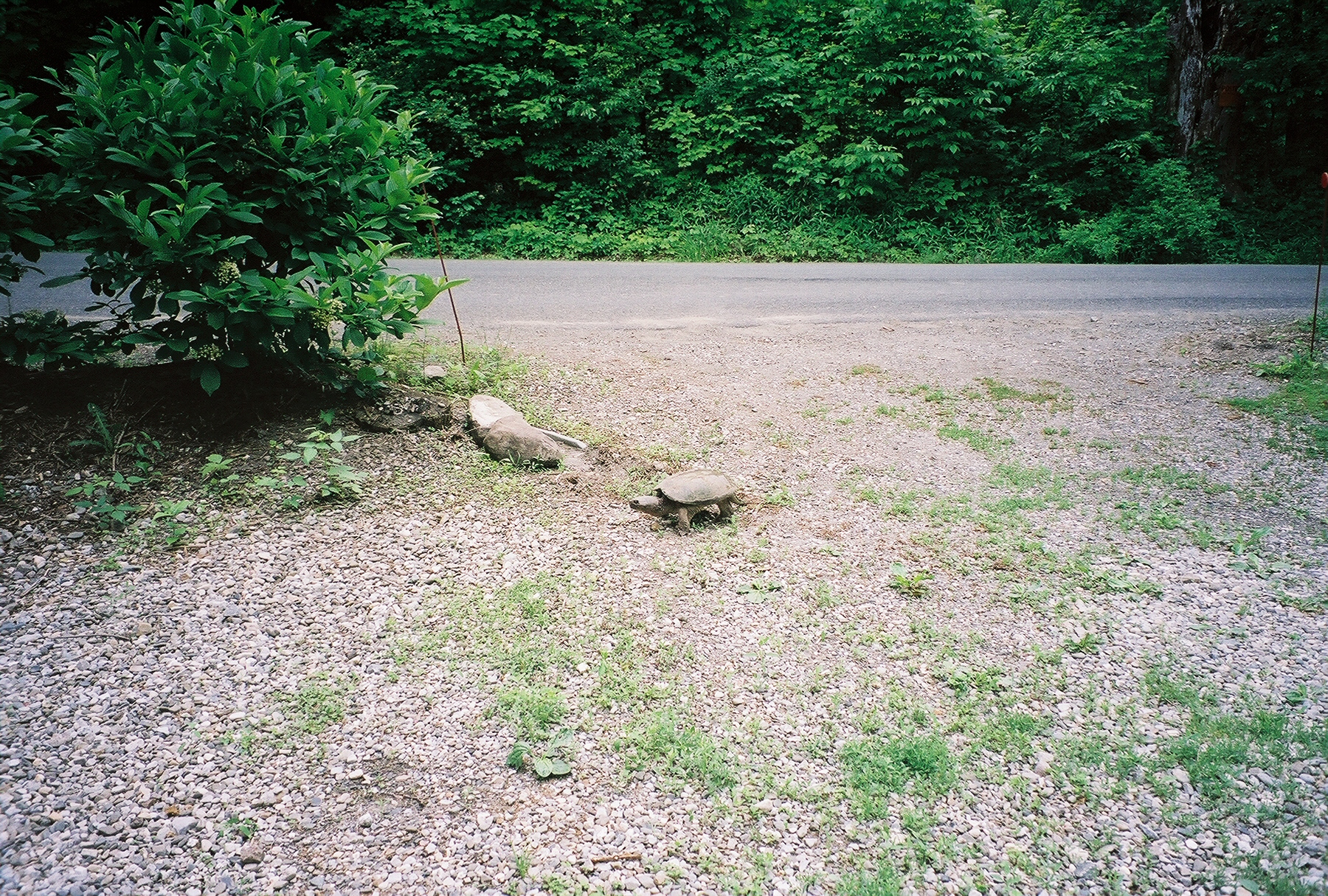
Every year, according to some inner time mechanism, Shelley would come early in the morning to lay her eggs in the swale in the corner of our driveway. A big snapper, she, majestic in her reptilian grandeur. Her shell measured (yes, we measured it) 13 inches, but like all snappers her head juts out of the shell about 4 inches and her spiked, dinosaur-looking tail adds on another 5 inches or so.
This year we checked our driveway early each morning worrying as trucks barreled by dangerously close to where she has laid her eggs in the past. Days went by. No Shelley. Judging by the size of her shell and the speed of her gait, Shelley was not young. Each year we saw her Shelley was walking slower and slower. We wondered if she made it through the winter.
In addition, in the early spring her pond was dug up and drained by the new owner to make it deeper and with each dig of the steam shovel we imagined our snapper being snapped up.
Memorial Day came and went and each day was sunny. Shelley liked overcast days to lay her eggs. The very last day of May was a perfect day for laying eggs, overcast and humid. We checked our driveway. No Shelley. We checked up and down the road. No Shelley. My husband didn’t say anything but disappointment and worry were written on his face. I was feeling worried, too.

We held our breath and waited. And then…
We first noticed her at 6:30 in the morning and watched her as she spent the next 3 hours or so looking for a suitable spot to lay her eggs, digging a hole for them, and then depositing them in the hole. She picked the same spot she picks every year after much mulling around and searching.
It was a delight to see those mighty claws dig a deep hole and then the back feet dig deeper. She rested for awhile and we took pictures which she did not seem to mind. Then we left to give her privacy and the back of her rocked from side to side as she deposited the eggs.
Normally she takes a hair-raising walk crisscrossing a somewhat busy road and I accompany her to make sure no car hits her. But this year she surprised us yet again and took the safer route across our back yard, after a few false starts (stopping at our front door).


Though she could have taken an easier route in our yard, she followed a stream in back of our house following a logic that has worked for 200 million years. Maneuvering over large rocks and crawling between crevices that looked impossibly narrow, we were not sure she could make it home and were wondering how we would rescue her.
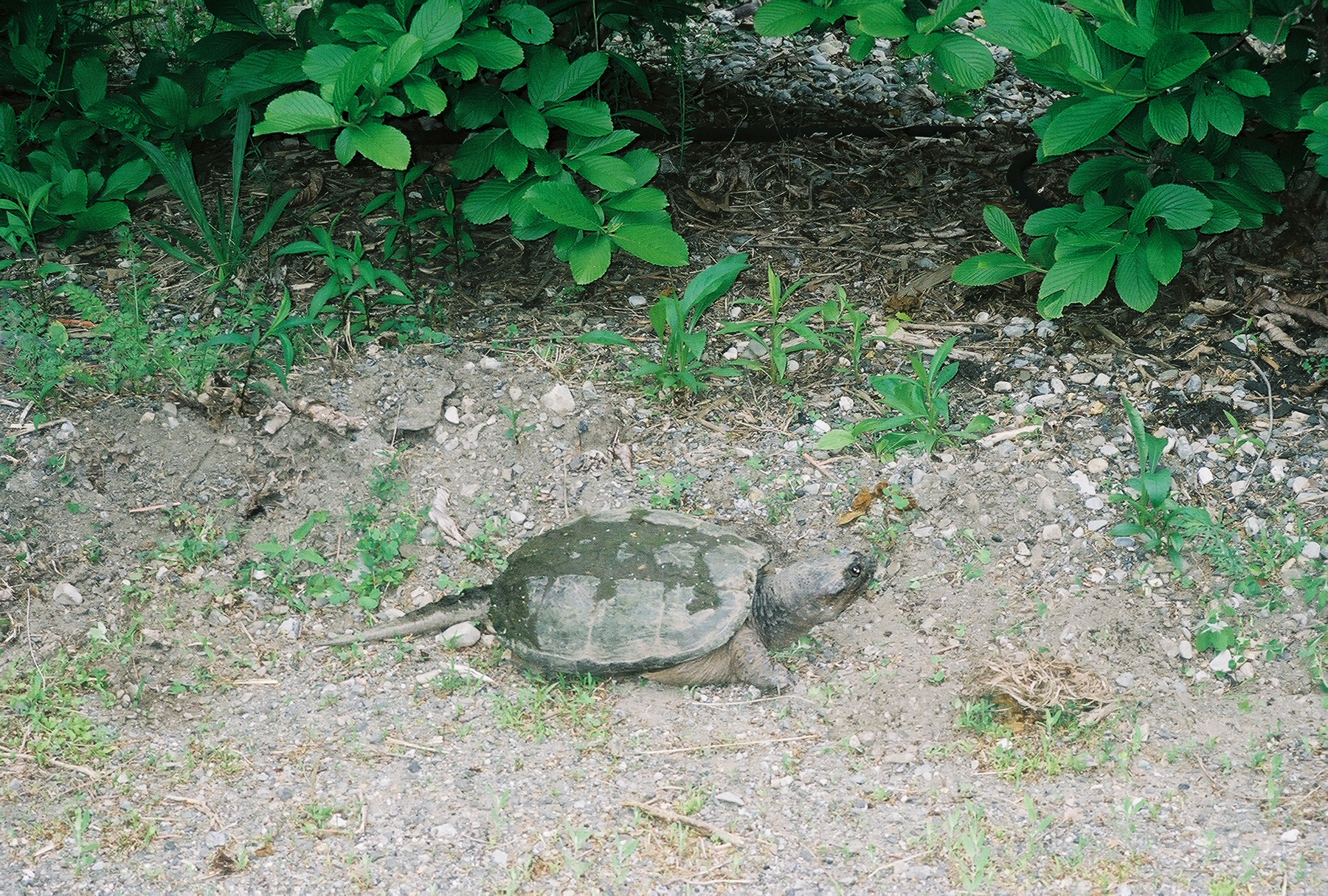

We were the fools. She arrived triumphantly and magnificently in her exhausted state in the marsh on our side of the pond and quickly submerged herself under the mud until she was no longer visible, a living submarine.

After her departure we felt sad. We can only assume this brave lady made it home to her now-deeper pond having survived despite the hand of man and the worry of her next door neighbors. The brilliant naturalist and “turtle man”, David M. Carroll, explains the tinge of sadness we felt after seeing Shelley lay her eggs when he writes in his Self-Portrait with Turtles: a Memoir: “The furtive turtles were utterly silent in their nesting, but the sandy fields and road edges somehow seemed to go quiet with their departure.” Shelley’s departure meant a break in our one-sided bond with her and David Carroll sheds light so poetically on our experience of loss when he writes of his relentless study of turtles: “Through these children of the sun’s dialogue with the earth I could continue to pass out of human time and place and enter the soul of the seasons.” That was Shelley’s gift to us.
Welcome to samples of my work in various art forms showcasing “Eye-locks and Other Fearsome Things.” “Eye-locks” is a Bipolar/Asperger’s memoir in narrative form that describes the triumph of love over mental illness.
The Edge of Winter

(Click to enlarge)
It is an overcast day. Brightly colored birds stand out like jewels in the greyness. The winter birds– jays and cardinals, juncos, black-capped chickadees, white-breasted nuthatches and downy woodpeckers flock to the bird feeder and it has to be filled up almost every day. The red berries on the bushes are nearly all gone and the feeder is becoming a matter of survival. On our walks we see empty nests held in the bare arms of winter trees. An empty robin’s nest is filled with snow– the hatchlings and the mother long gone to fairer climes. The trees are stripped down to their souls. With ice storms they become tinkling chandeliers. In the rain the few remaining dead leaves drip icy tear drops.
Occasionally a dove visits the feeder. The chipmunk, who gathered scattered seeds under the feeder all fall, is not to be seen. He must be in torpor in his den. According to Bernd Heinrich in: The Winter World: the Ingenuity of Animal Survival, the eastern chipmunk builds a twelve foot storage system with a nest chamber some three feet down and a tunnel system which includes a food storage chamber. Heinrich says chipmunks go in and out of torpor. He reasons that they would not gather food if they were to be in torpor all winter long. We will probably not see our chipmunk for the rest of the winter for, in his stuporous state, he would be easy prey. However he can be roused to eat and venture outdoors if need be, especially in March when there still may be snow on the ground but mating season begins.
The grey squirrels are busy clearing snow from branches as they run along tree limbs. On the ground they dig through the snow for the walnuts we watched them bury in the ground with their noses this fall. They do not need to hibernate for they have food stores which they built up in the autumn and leafy, well-insulated nests. The red squirrels survive winter by putting on a thick, insulating fur.
The back yard is a maze of tunnels. We think they are deer mouse tunnels as many have tunneled their way into our house. But they must get by the feral cat who sometimes waits out a snow storm under our deck. In the woods, the occasional deer waits out the same storm under a squat fir tree. The tracks in the snow tell the story of how they weathered a Nor’Easter.
Beneath the tracks in the snow, in the frozen leaf litter, the insect world is dormant. Some hibernate. Others fill their bodies with antifreeze, glycerol, to stay alive. Heinrich talks about woolly bears hibernating but they are also capable of freezing solid and surviving, coming to life again as they thaw in the spring. The pupae, however, don’t survive being frozen.
In Winter: an Ecological Handbook, authors, James C. Halfpenny, Elizabeth Besiot and Roy Douglas Ozonne, tell us that the reptiles and amphibians pick out a “microclimate for hibernation that does not freeze” for their winter, such as the “bottoms of ponds, streams, or deep in the ground.”
Our stream flows out back in the marsh under ice and snow and one can see the elongated bubbles of running water. In the pond next door the turtles lay beneath the ice in their hibernacula. At the end of the book, The Year of the Turtle, David M. Carroll, the naturalist, author and artist, has his watercolor of a spotted turtle hibernating. This picture is hypnotic and in its spell, I think of all the animals hibernating beneath our feet in lugubrious gloom. It reminds me of the penguins in the film, The March of the Penguins, in the dead of an Antarctic winter, huddled together for warmth in the harsh, strong winds and snow, taking turns being on the outside of the huddle. Winter can be magnificent in its transformations yet tragic in its harshness: hibernating animals who freeze to death and deer starving to death in the snow among the victims of its violence.
Carroll’s drawing shows the turtle all alone, withdrawn into its shell under less than two feet of water lodged firmly in the mud under ice under snow in a sunny winter’s day, a far better clime than the penguin’s– and yet it evokes a certain sadness for this little creature all alone beneath the snow, in a torpid state. The turtle is missing out on a sunny day, sleeping a deep sleep in a “half year of stillness.”
Carroll’s writing is sheer poetry as he describes the turtle’s hibernation: “Mounting layers of snow silently cover the ice. Night after night in the harshest depth of winter, as Orion and the Pleiades burn distant and brilliant in the black sky and strong winds howl off the mountain to the northwest, the turtles rest beneath the ice. With the life in them nearly suspended, reduced to its most tenuous hold, all but extinct in the vast, inhospitable regime that reaches above them to the limits of the universe, they lie within their shells, waiting for the earth to make its required turnings and return them to the sun that will awaken them to another season.”
I think of the turtles below, along with all the other beautiful creatures. I wish them a kind sleep from which they will safely stir with the life force surging through their veins as the sun brings them to the fullness of life again. The death of some, and the half life of so many, proffers the poignancy of winter.
(Click to enlarge)
Welcome to samples of my writing and art work showcasing “Eye-locks and Other Fearsome Things.” “Eye-locks” is a Bipolar/Asperger’s memoir in narrative form that describes the triumph of love over mental illness.
Turtle Tears

It is before dawn on a moonlit night. The moon has swept the trees and grass in silver. I await the sun. The moon wakes me to whisper about the silent beauty of the predawn hours. The yard is white magic and I imagine a monarch butterfly now sleeping, awaken to find a turtle to drink its tears. Monarch butterflies drink turtle tears. Why are the turtles crying? They cry for the ailing earth. They cry for those who suffer. They cry for the dying. They cry for those striving to become one with all. They cry for the sap in the trees flowing. They cry for the animals who are constantly on guard for their lives. They cry for the bird egg which will not ever hatch. They cry for the dying stars in an ever expanding universe. They cry for the unawareness of the high and mighty. Turtle tears are like diamonds sparkling in candlelight. like dew drops on a drooping Lily of the Valley. Come now to drink my tears, dear Monarch. Your beauty gladdens my heart. Your heart drops manna from the heavens into my soul. Come now, dear Monarch. Come lick the dew drops in my eyes.


Turtle Tears

It is before dawn on a moonlit night. The moon has swept the trees and grass in silver. I await the sun. The moon woke me to whisper about the silent beauty of the predawn hours. The yard is white magic and I imagine a monarch butterfly now sleeping, awaken to find a turtle so it can drink its tears. Monarch butterflies drink turtle tears. Why are the turtles crying? They cry for the ailing earth. They cry for those who suffer. They cry for the dying. They cry for those striving to become one with all. They cry for the sap in the trees flowing. They cry for the animals who are constantly on guard for their lives. They cry for the bird egg which will not ever hatch. They cry for the dying stars in an ever expanding universe. They cry for the unawareness of the high and mighty. Turtle tears are like diamonds sparkling in candlelight, like rain drops on a drooping Lily of the Valley. Come now to drink my tears, dear Monarch. Your beauty gladdens my heart. Your heart drops manna from the heavens into my soul. Come now, dear Monarch. Come lick the dew drops in my eyes.
A Barn in Winter

Bare branches
yearning towards
turquoise sky
with fast floating
sunlit white clouds
white above
white below
the snow
hides the land
of insects
and mice
and moles
and snakes
and in the vernal pool
next door
turtles sleep
in their hernaculum
while frogs lay
dormant in the mud
I sit in sleepy
surrender
glad to be
in our little hideaway
in the woods
of our young dreams
wondering
if we will all
awaken
to another Spring.

Nature’s Prayers
Still yourself
and fold your hands

humbly

stand in awe

radiate His light
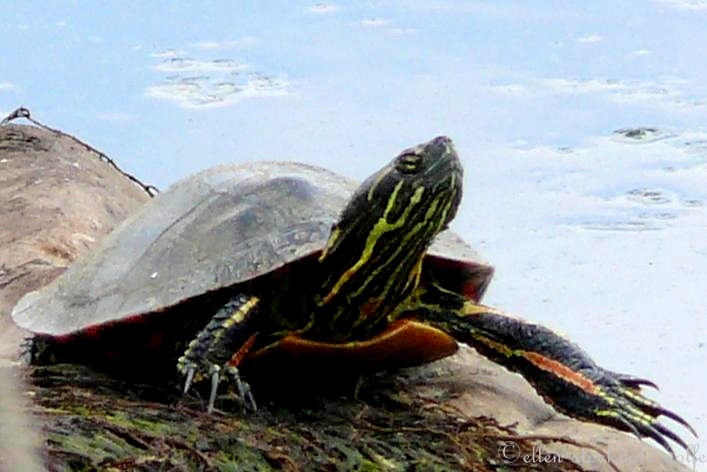
with eyes upwards
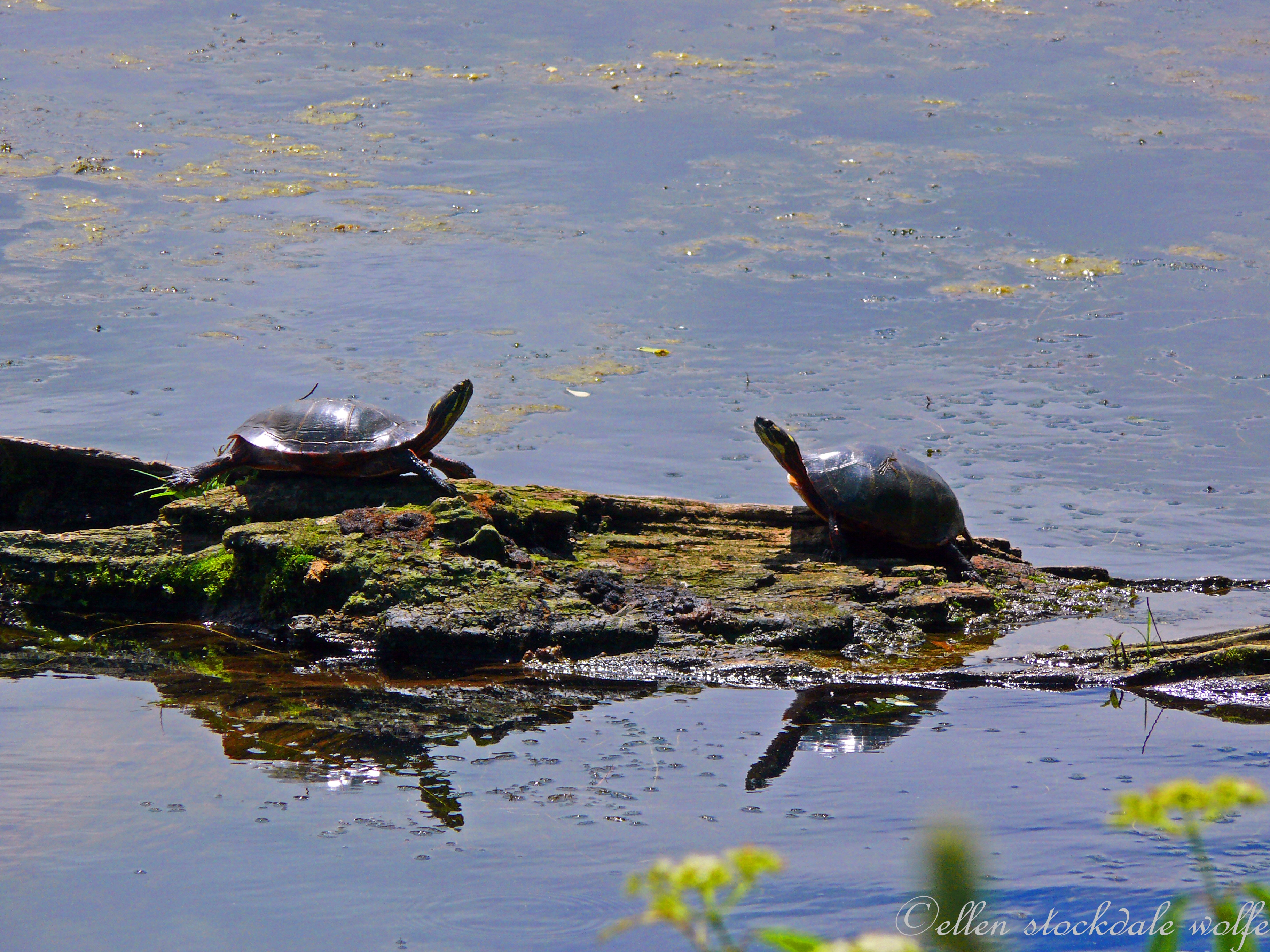
towards

the telephone
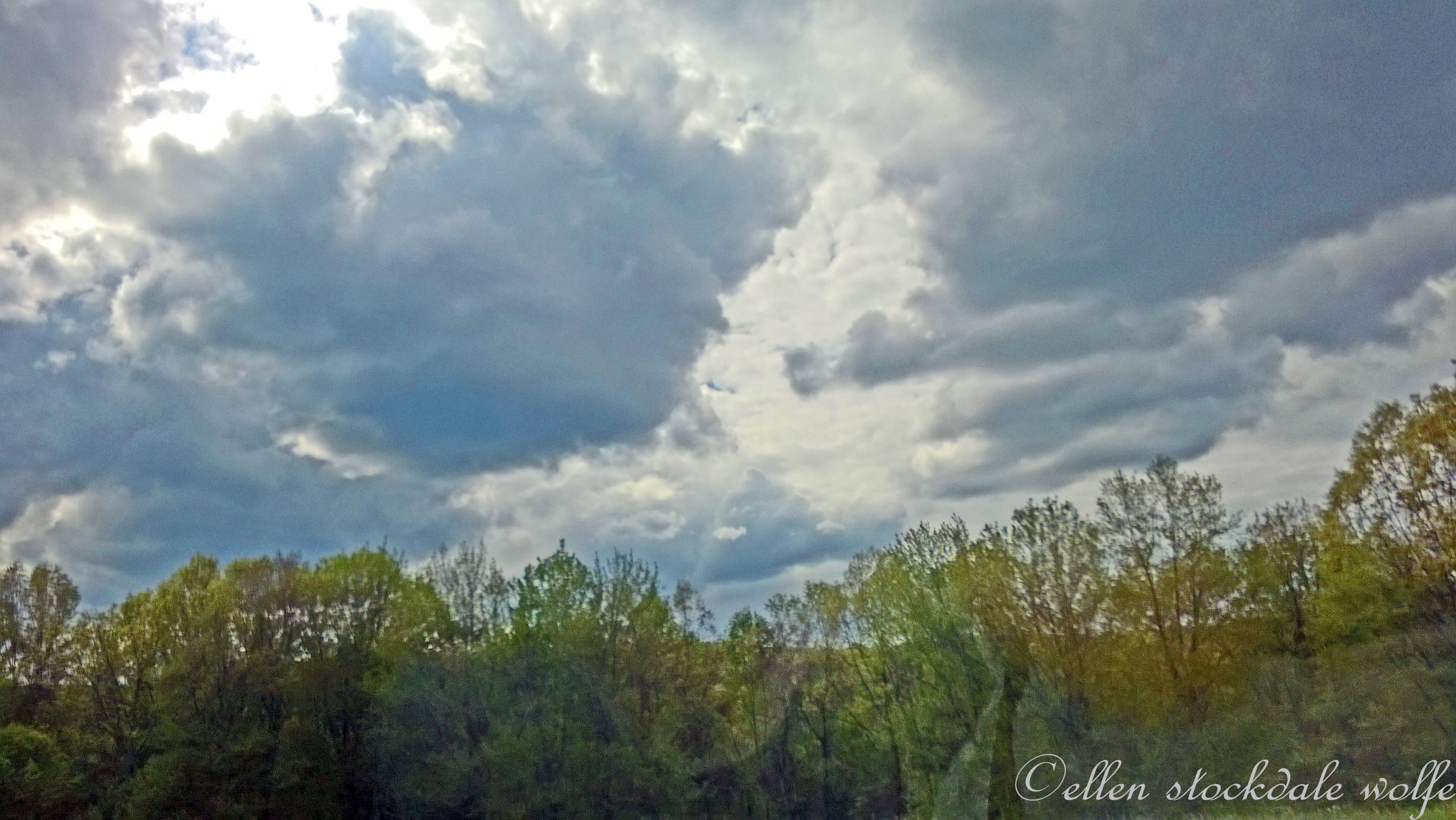
to the sky
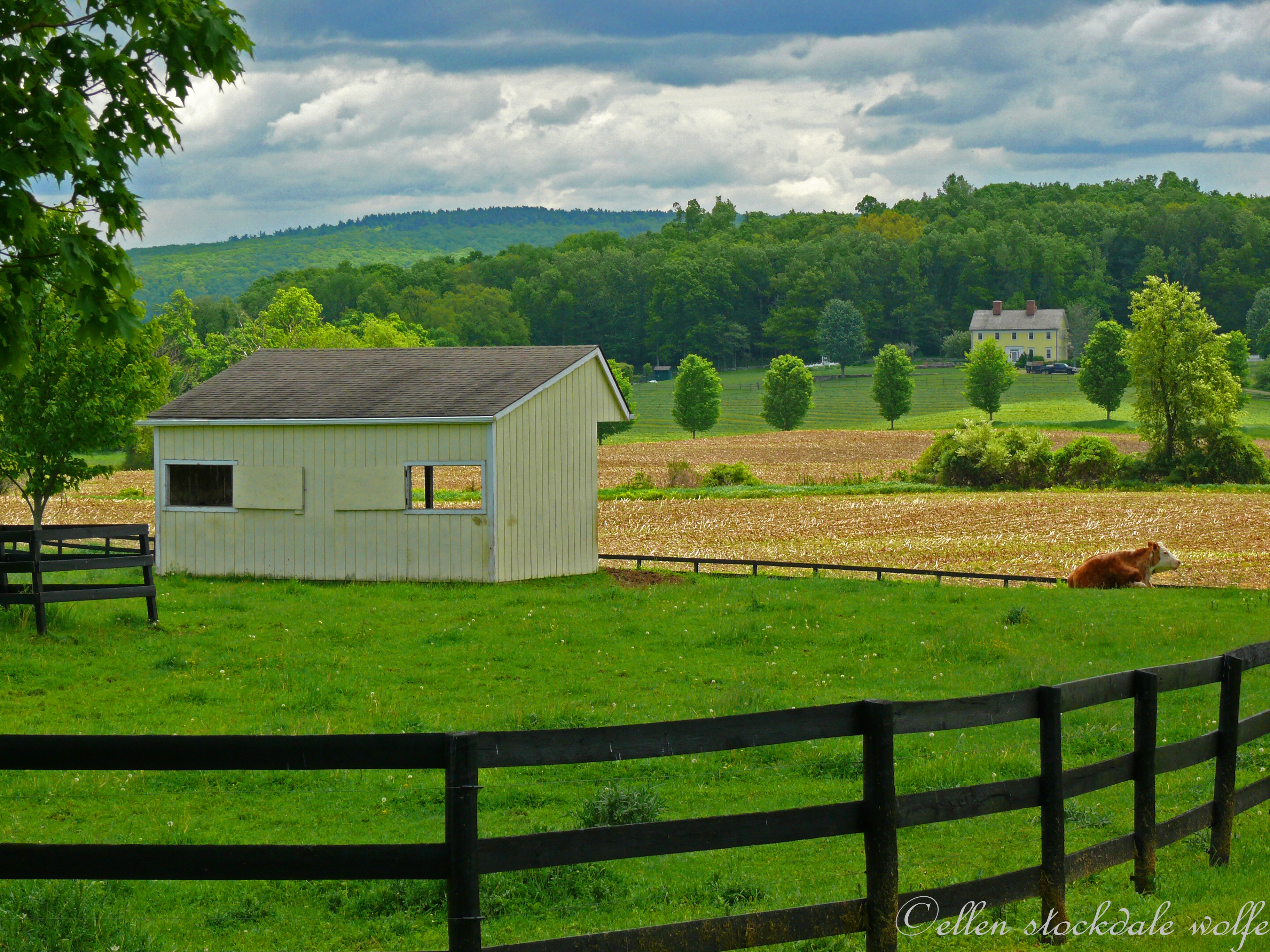
and comtemplate

the glory that is He


Denizens of the Deep

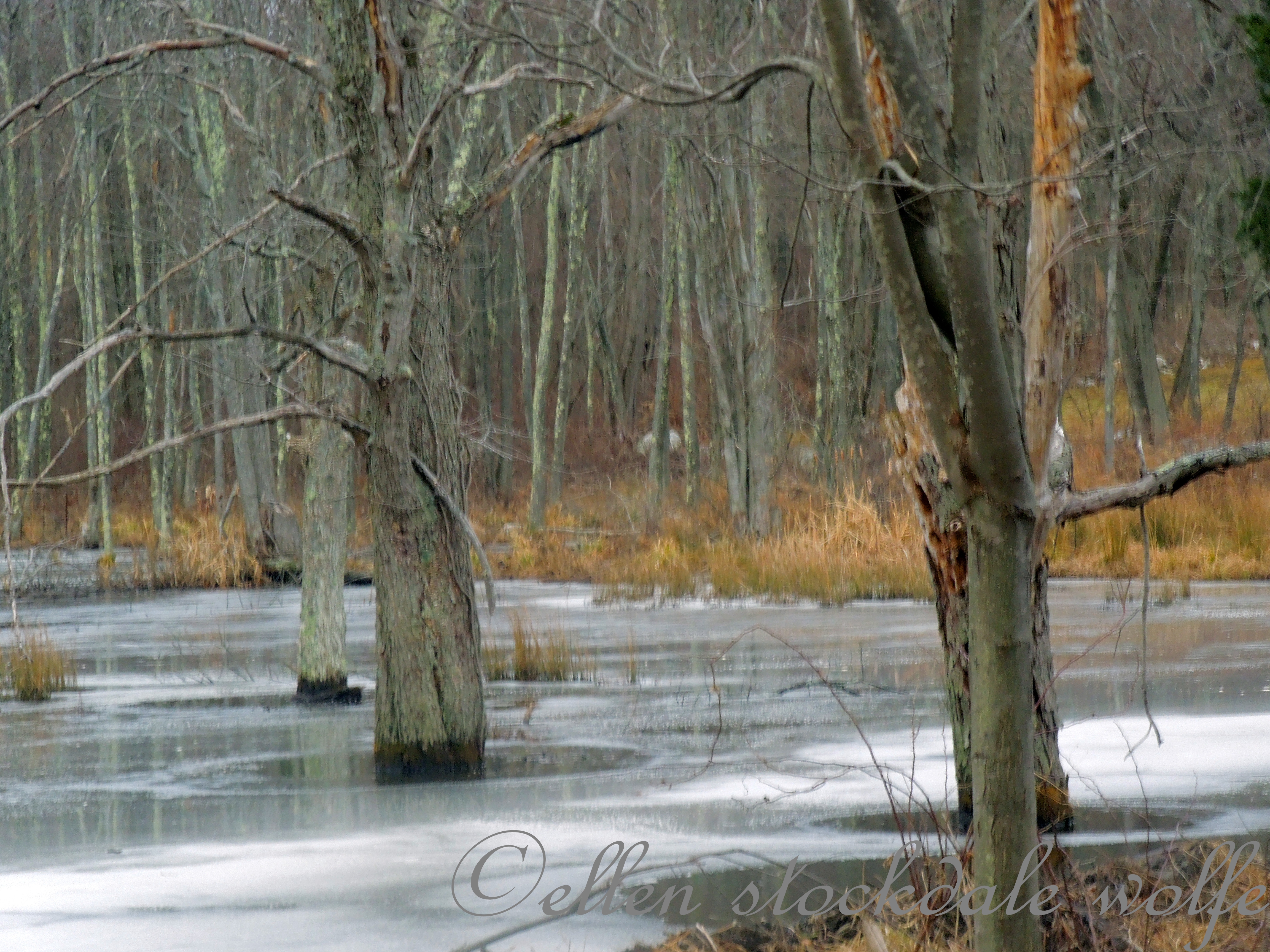
The marsh is melting
and
all the turtles in their hibernacula
deep down under the melting ice
will soon emerge
and the marsh will sing
the chorus of the Spring Peeper
and the salamanders will emerge
with the urge to murge
and joy and the life force
will fill the air
and lift the fog
enveloping my soul.
Whirling October
Fleet-footed October
with
leaves floating down
swirling
in
whirlwinds
while days dance away
as the last leaf-colored
butterflies
flutter by
before you know
turtles
will bury deep
for a long winter’s sleep
My Former Life

In my former life I was a bee.
Why else would I keep sticking my nose
into the private, pollinated parts of flowers?
In my former life I was a turtle.
Why else would I hunch my shoulders
into a seeming shell, my back a carapace
to shield me from a sometimes dangerous world?
In my former life I loved thee.
How else could I account for my “knowing” you
from before the first time we met,
for “seeing” the you in your inner depths?
Some would say I risk damnation
for a belief in reincarnation.
Yet this answer satisfies me on so many levels
and requities my thirst, quieting my myriad of questions
that the old belief system did not.
Unpopular in the west,
woven into the fabric of life in the east
in which I clothe myself, sewn by a strong affinity,
a strange familiarity,
attraction mystifies.
Most of us cannot remember
the details of the other lives,
and are left with fractured fragments of the past
glistening like sea glass in our hands, on the seashores of our minds,
trying to piece together a picture
of a previous existence.
Love is timeless and mysterious
and though I dread the inevitable,
the loss of our life together
in this life,
I know we will be together again in the next and the next
ad infinitium
for something as sacrosanct as our love
is eternal.
Welcome to samples of my work in various art forms showcasing “Eye-locks and Other Fearsome Things.” “Eye-locks” is a Bipolar/Asperger’s memoir in narrative form that describes the triumph of love over mental illness.
Animal Highs
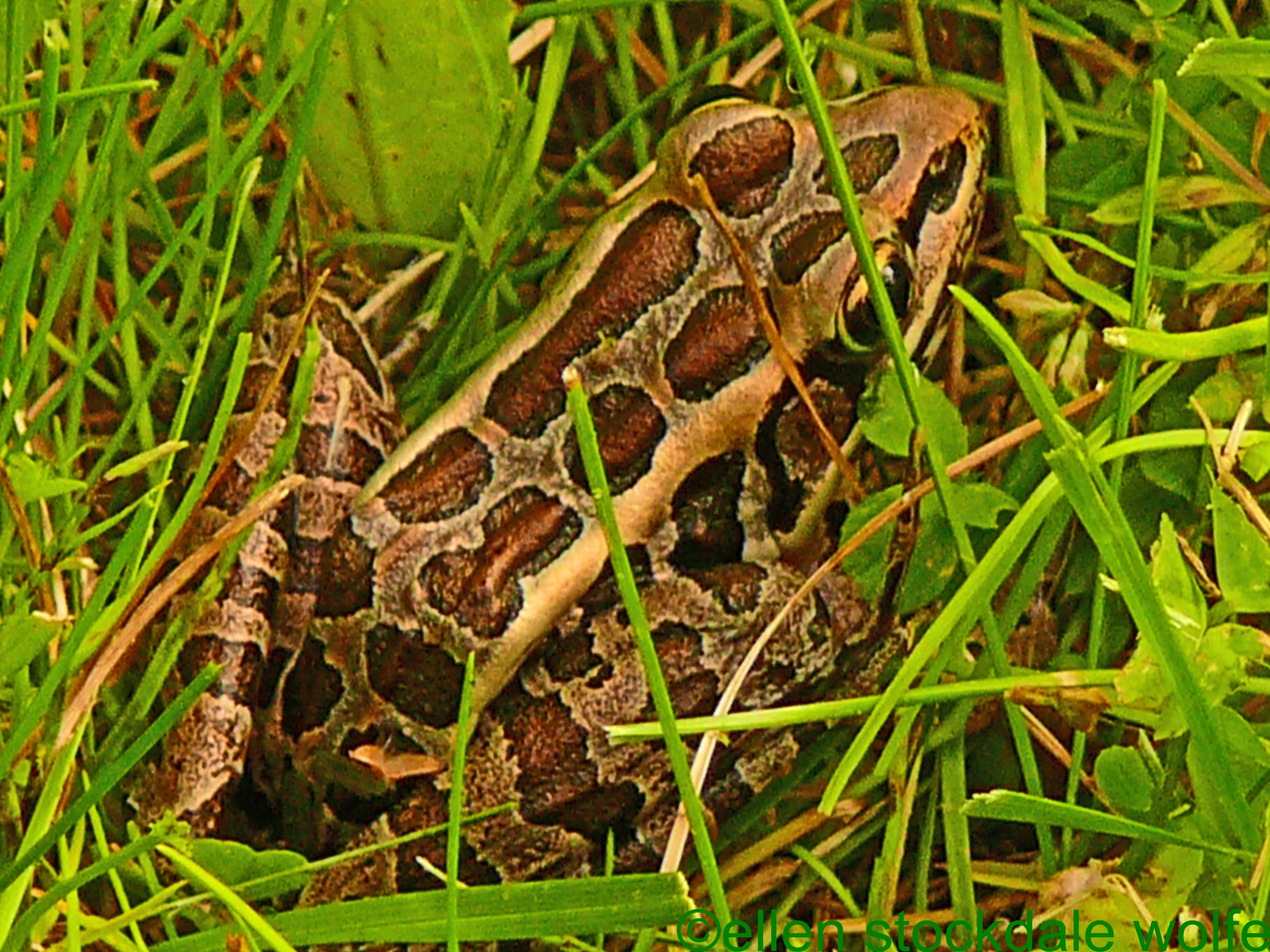
Last week my husband called me from the back yard. “Come quick, come see what I found.” I ran to the back door where he was, holding out his arm, and there in his hand sat a teeny green frog, about the size of a thumbnail. I oooed and aahhed over it and thanked him for calling me. The frog had jumped onto his arm while my husband was unrolling the garden hose, its temporary home. “How wonderful!” I said. And then I thought some more about it and I realized I was jealous. Jealous of the fact the frog had jumped on my husband’s arm and not mine. “Well, he deserves the frog more than I do,” I found myself thinking, as if any of us deserve such things.
Today I began to think more about this. I remembered when we had first moved in. My husband was at work and I saw a mound in the grass moving out the back door window. Upon closer examination I found to my utter delight it was a box turtle. This time it was my husband, an affirmed reptile lover, who was jealous and even admitted to being so. Okay, jealousy of such things is obvious and on the surface in children. Yet we were dealing with adults here who, it seems, covet visits from animals. We cherish an interchange with a creature. And why?
I remember the Sunday night a few years ago, apprehensive about a challenging week ahead, when I saw a stag in the woods behind our house. I called to my husband to come see him. He was stunning with huge antlers, an imposing presence. And suddenly I knew everything would be alright. Why? Because the stag in the distance– majestic, princely, beautiful was a sign.
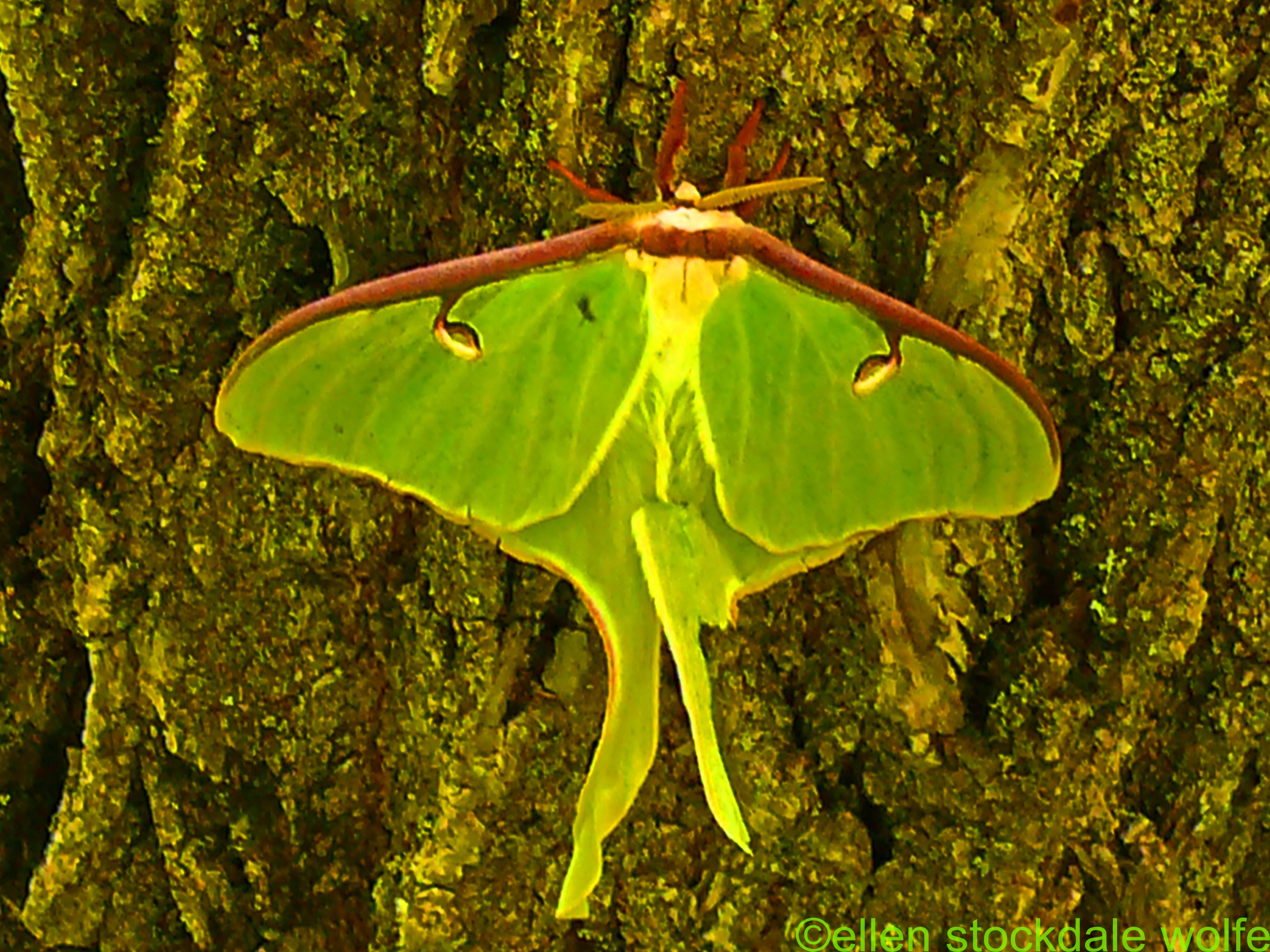
And how thrilled we are to have a snapping turtle return every year to lay her eggs in our driveway. We feel privileged. Again, blessed. Or when, with delighted guests, we saw a giant luna moth flying in the porch light one night. And the countless times a butterfly lands on one’s body, on a shoulder or head, or a dragonfly visits an arm or a sleeve. And, the beautiful hummingbirds. We even had a hummingbird nest in our Black Birch. Such visits feel so special– to have these delicate, exquisite creatures land near us or live in the trees near our house. Even when my least favorite reptile makes an appearance out from under his home on our back deck, a tiny garter snake, the spirit soars.
Research has shown how having pets is therapeutic. We are blessed by animals who trust us utterly. We feel their trust and it is pure, unalloyed by human characteristics. We don’t deserve such trust and yet we receive it as a gift. We have made contact with a being of a different species who lives in a different world whose being synchronizes with different biological rhythms. The native Americans believed animals to be spiritual guides that have much to teach us. Psychology tells us Nature is a natural antidepressant. An animal can disarm the most defensive, enchant the most mentally ill, bring out the goodness in the criminal, and bring a smile to the face of the young, old and in-between.
And, yes, animals can be pests when they get into where they don’t belong or become aggressive or defensive in a bad way. But our world is a richer, more vibrant place because of them. Animals bring us out of ourselves and into the experience of awe. Their innocence lightens our loads, allowing us to share the “mystery of the other” with others, drawing us closer to our friends and family. We share the world with animals and they share their hearts with us. And their innocent interactions with us are blessings from God.
Through the Green Lightly…

through the pale veil of green
the tusset grasses grow
as the greening of the marsh
intensifies each longer day
while below frogs
and turtles
and fairy shrimp
dance their rite of spring
prey for the ducks,
crows, bald eagles,
ephemeral lives
we watch
nature raw
unawares
of the fragility
of us
“Landscape of Loss”

Sap is flowing through ice and snow
When nature awakens in late March or early April, sap starts flowing in the trees and ice changes to water marking the end of hibernation. This is the grand opening of the wetlands and the pilgrimage to the vernal pools as David M. Carroll writes in his “Swampwalker’s Journal: a Wetlands Year.” A vernal pool is a body of water which fills up in autumn and winter and is swollen in the spring but often dries up completely by the end of the summer. Carroll describes vernal pools so beautifully: “It is at snowmelt and ice-out, the last sleets, first rains, and the earliest warming breaths of spring that they beckon wood frogs, salamanders, and spring peepers from surrounding upland woods, where they have passed the winter in rotted-out trees roots [a reason not to ‘clean up’ the woods], under layers of bark and litter, in small mammal tunnels and other hibernacula in the earth.” The melting snow heralds the march of the amphibians. “Vernal pool habitats hold a galaxy of small things that come to life the instant ice and snow turn back into water.”
Carroll walks the swamps, as the title of his book suggests, in search of mating salamanders and spotted turtles, bogs, fens and all wetland flora and fauna. He tells us that there must be a certain collusion of events– several warm days in a row followed by a darkest of nights with temperatures ideally in the mid-50s with rain preferably two nights in a row. And then the magical migration begins. The salamanders begin their “annual pilgrimage” to the vernal pond to mate.
My husband and I are lucky enough to have a vernal pond on the property next door to us and when Spring comes the sound at night from that pond makes us feel as if we are camping out next to a vast wetland. The music of the spring peepers plays through the night throughout the house, often starting overeagerly in the late afternoon. This manic symphony thrills us every year. It is the first sign of Spring for us. The quality of joyousness and the affirmation of life gladdens our souls. Going to sleep with that sound makes us remember what we so often forget, to give thanks to our Creator for His magnificent creatures.
Inspired by Carroll, one year we awaited the first dark, rainy warm night after a succession of warm days. In our rain gear, armed with flashlights we set out around 11PM to look for the march of the salamanders. We walked to the nearby pond. Nothing. We walked quite aways down a nearby dirt road that has run off but is not quite a vernal pond. We shone the flashlight this way and that. Nothing. We finally headed home disappointed and dejected and my husband started towards the front door when I let out a yelp. There in the doorway was a 6 inch spotted salamander in all its glory! We never found the march of the salamanders but we were greeted by one of these fantastic amphibians right at our front door!
This story, however, does not have a happy ending. In his epilogue to the “Swampwalker’s Journal,” David Carroll explains why it took him more than 7 years to complete this book. He writes that he became involved in saving some of the wetlands in his book and says sadly nearly all of his interventions have or will become “losing battles.” He describes the plight of the wetlands, bogs and fens as a “landscape of loss.” And he scorns our human selfishness as he writes how it “reveals explicitly the extent to which we think of ourselves as owning all living things, along with the very earth, air, and water in which they live, as if we possessed some divinely mandated dominion over all creation.” He warns: “As we will learn in time none of this belongs to us.” I read these words, knowing them to be true and I think of the soon-to-be-extinct bog turtle and other creatures with the same possible fate. I think of the spotted salamander who came to our door, as did Shelley, the snapping turtle who used to return to our drive way every year to lay her eggs. I think of the spring peepers whose joyous song heralds spring next door every year, and I fear for the future of them all.
Vestigial Remnants of Hibernation?
It is frigid outside and has been for a long time. It is very cold in many parts of the country. The holidays have come and gone. The hoopla of the inauguration is over. Now begins the nitty-gritty of hard winter work. I find myself listless and not wanting to go outside or exercise or paint or take pictures or do much of anything I usually love to do. I have a cold but that does not excuse this lassitude. When I go to my favorite deli, I find that Terry, the sandwich lady, is in the same mood. “I was ready to go home the moment I came in,” she says. My husband was dour and I was sour. What is the meaning of this discontent? Could it be some vestigial remnant of human hibernation? While man has never hibernated, science finds his metabolism slows down in winter and he becomes less active. Binging on food and drink over the holidays may not be the sole reason for weight gain in winter. Perhaps we should be sleeping off the extra pounds.
I who love winter and live for fall each summer, find myself longing to hear the music of the spring peepers. It is months away– well about a month and a half away. They signal for me the first harbingers of new life. Terry, who also loves winter, tells me today she is sick of winter as she makes our sandwiches. Perhaps it is this string of Arctic air and grey days and icy road conditions and snow every few days. Perhaps, and more likely, it is the human condition to always be dissatisfied.
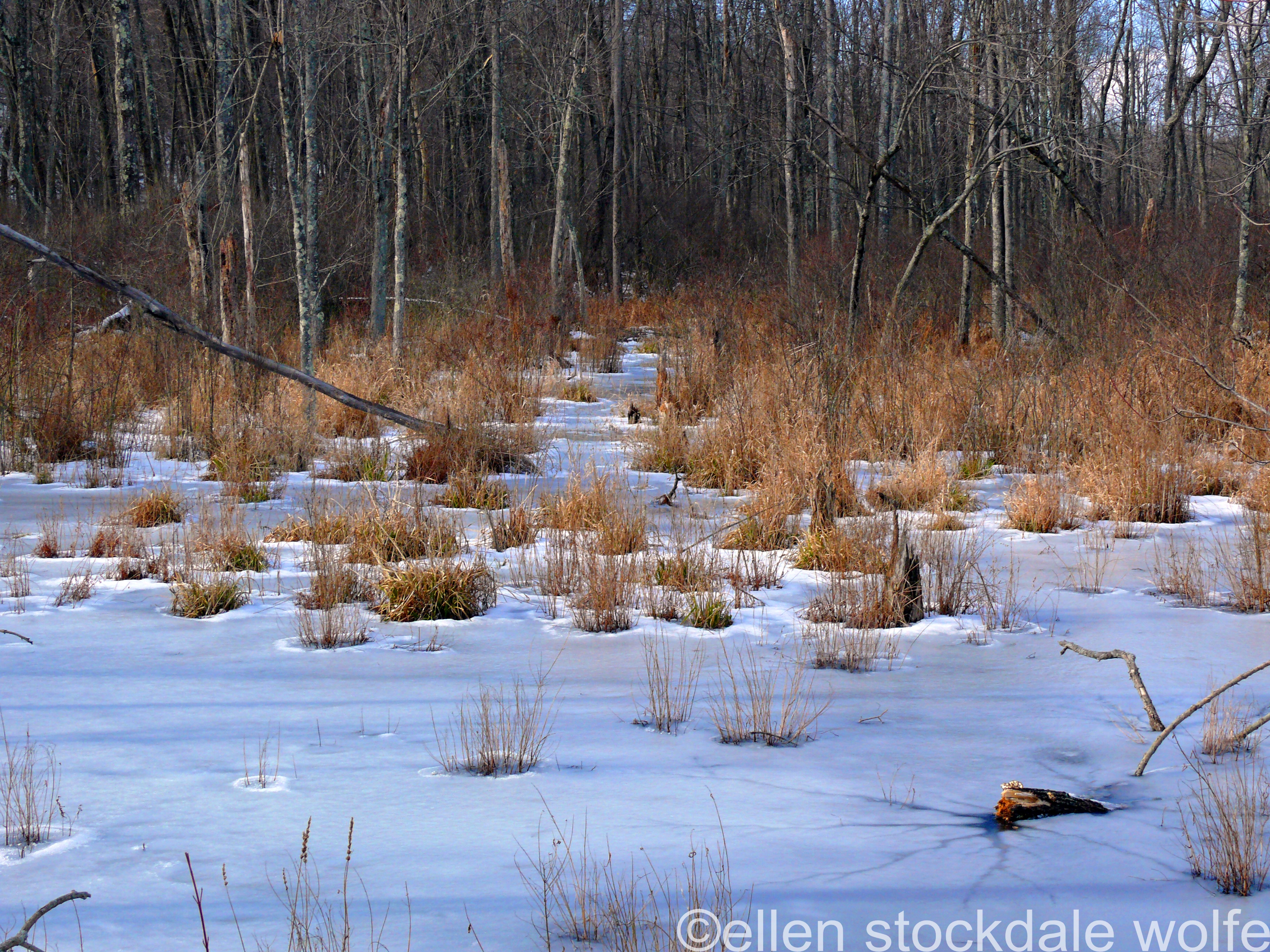 Hibernaculum for turtles and other animals
I miss the squirrels. It has been so cold and snowy they seem to be laying low in their nests. Judging from the tracks in the snow the animals most on the move are the deer. And as much as I love the silence of winter, I find myself longing for the sweet dulcet music of birdsong at mating season in spring.
We bought a calendar for the new year with a celestial map of the sky for each month so you can find the constellations in the night sky. We have yet to go out with flashlights and match the map with the canopy of stars. It has been too overcast or too cold or too something. But my dazzled psyche is humbled by the view of the stars through the stripped down trees that we see from bed every night.
Then again maybe it is laziness. Too many sugar highs in December have led to a deep low in February. And after a tease of spring one day in which the temperature reached almost 60 degrees we were let down even further. Not liking being unproductive, I think I can overcome this. But maybe I should just go with the flow and accept a period of inactivity, let the land lay fallow, so that an increase in productivity may eventually result.
I know I should focus on what is positive. Winter is the season of silent beauty that I so long for in the summer heat. I delight in the quiet of winter days. The snows bring a hushed stillness good for the soul. It is a time to regroup. Spring will come. Hopefully if man has not destroyed all the vernal pools, the spring peepers will return. And if pesticides have not destroyed all the birds, sweet mating songs will be sung. And if the weather turns more clement, our spirits will soar once again, and we will be busy bees making honey while the sun shines.
The Edge of Winter
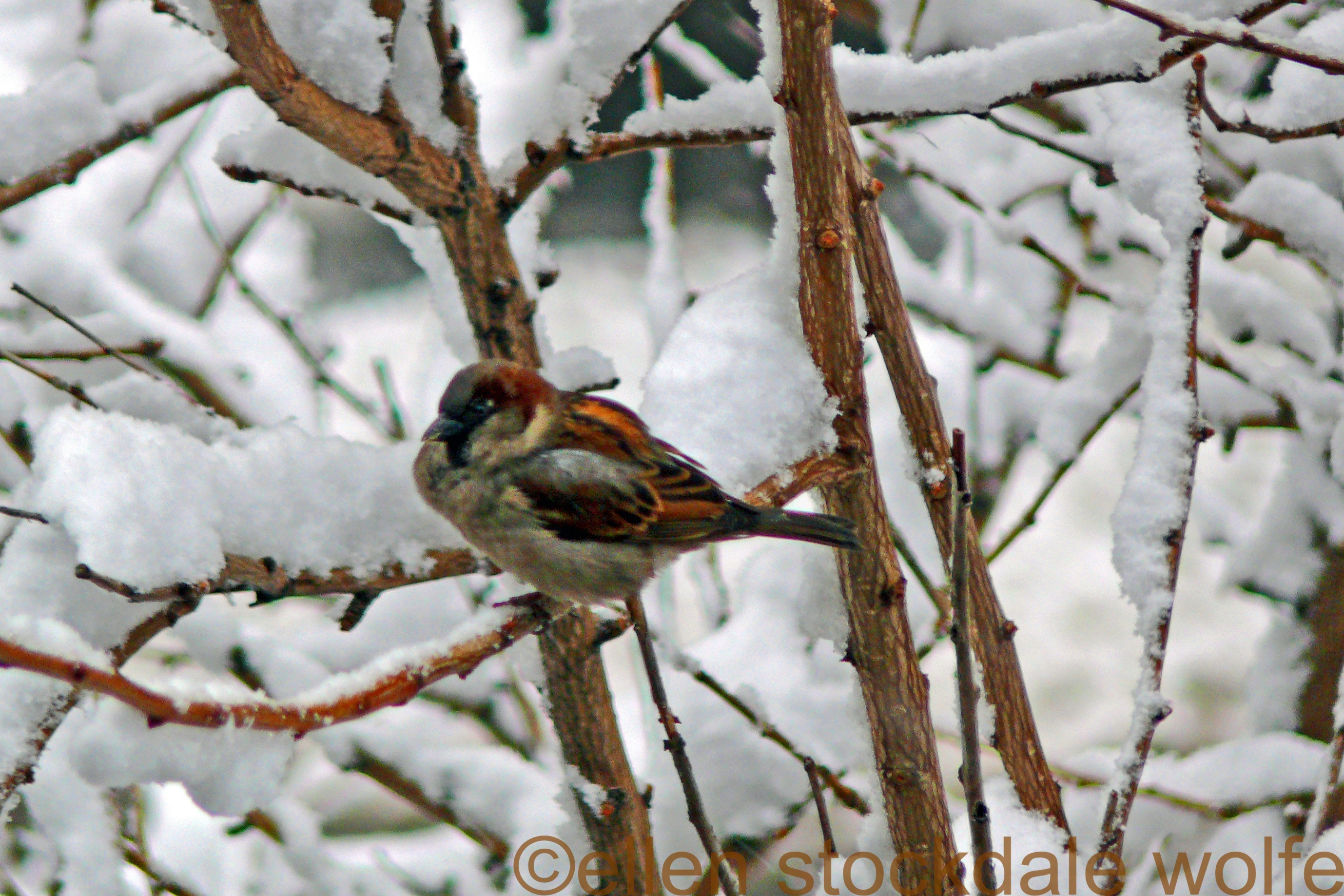 It is an overcast day. Brightly colored birds stand out like jewels in the greyness. The sparrows blend into the wooded grey/brown of snow-covered shrubs. The ever-present sparrows and the winter birds– jays and cardinals, juncos, black-capped chickadees, white-breasted nuthatches and downy woodpeckers– flock to the bird feeder which now has to be filled up almost every day. The red berries on the bushes are nearly all gone and the feeder is becoming a matter of survival. On our walks we see empty nests held in the bare arms of winter trees. An empty robin’s nest is filled with snow– the hatchlings and the mother long gone to fairer climes. The trees are stripped down to their souls. With ice storms they become tinkling chandeliers. In the rain the few remaining dead leaves drip drops of icy tears.
Occasionally a dove visits the feeder. The chipmunk, who gathered scattered seeds under the feeder all fall, is not to be seen. He must be in torpor in his den. According to Bernd Heinrich in: The Winter World: the Ingenuity of Animal Survival, the eastern chipmunk builds a twelve-foot storage system with a nest chamber some three feet down and a network of tunnels which includes a food storage chamber. Heinrich says chipmunks go in and out of torpor. He reasons that they would not gather food if they were to be in torpor all winter long. We will probably not see our chipmunk for the rest of the winter for, in his stuporous state, he would be easy prey. However he can be roused to eat and venture outdoors if need be, especially in March when there still may be snow on the ground but mating season begins.
The grey squirrels are busy clearing snow from branches as they run along tree limbs. On the ground they dig through the snow for the walnuts we watched them bury in the ground with their noses this fall. They do not need to hibernate for they have food stores which they built up in the autumn– and leafy, well-insulated nests. The red squirrels survive winter by putting on thick, insulating fur.
The back yard is a maze of tunnels. We think they are deer mouse tunnels as many have tunneled their way into our house. But they must get by the feral cat who sometimes waits out a snow storm under our deck. In the woods, the occasional deer waits out the same storm under a squat fir tree. The tracks in the snow tell the story of how they weathered a Nor’Easter.
Beneath the tracks in the snow, in the frozen leaf litter, the insect world is dormant. Some hibernate. Others fill their bodies with antifreeze, glycerol, to stay alive. Heinrich talks about woolly bears hibernating but they are also capable of freezing solid and surviving, coming to life again as they thaw in the spring. The pupae, however, don’t survive being frozen.
In Winter: an Ecological Handbook, authors, James C. Halfpenny, Elizabeth Besiot and Roy Douglas Ozonne, tell us that the reptiles and amphibians pick out a “microclimate for hibernation that does not freeze” for their winter, such as the “bottoms of ponds, streams, or deep in the ground.”
Our stream flows out back in the marsh under ice and snow and one can see the elongated bubbles of running water. In the pond next door the turtles lay beneath the ice in their hibernacula. At the end of the book, The Year of the Turtle, David M. Carroll, the naturalist, author and artist, has his watercolor of a spotted turtle hibernating. This picture is hypnotic and in its spell, I think of all the animals hibernating beneath our feet in lugubrious gloom. It reminds me of the penguins in the film, The March of the Penguins, huddled together for warmth in the harsh, strong winds and snow, taking turns being on the outside of the huddle. Winter can be magnificent in its transformations yet tragic in its harshness. Hibernating animals who freeze to death and deer starving in the snow are among the victims of its violence.
Carroll’s drawing shows the turtle all alone, withdrawn into its shell under less than two feet of water, lodged firmly in the mud under ice and under snow on a sunny winter’s day, a far better clime than the penguin’s– and yet it evokes a certain sadness for this little creature all alone beneath the snow, in a torpid state. The turtle is missing out on the days and nights, sleeping a deep sleep in a “half year of stillness.”
Carroll’s writing is sheer poetry as he describes the turtle’s hibernation: “Mounting layers of snow silently cover the ice. Night after night in the harshest depth of winter, as Orion and the Pleiades burn distant and brilliant in the black sky and strong winds howl off the mountain to the northwest, the turtles rest beneath the ice. With the life in them nearly suspended, reduced to its most tenuous hold, all but extinct in the vast, inhospitable regime that reaches above them to the limits of the universe, they lie within their shells, waiting for the earth to make its required turnings and return them to the sun that will awaken them to another season.”
I think of the turtles below, along with all the other beautiful creatures, and wish them a kind sleep from which they will safely stir as the life force surges through their veins again when the sun brings them to the fullness of life in spring. The death of some, and the half-life of so many, proffers the poignancy of winter.










 MOONSIDE
You must be logged in to post a comment.