The Trees of Winter
Every year what budded in autumn now blossoms full blown in winter. Trees that were drop-dead gorgeous in their fall colors are now bare, with the exception of evergreens and a few stray deciduous trees that refuse to relinquish their leaves. Now the trees are stripped down to their souls and their souls sing a siren song to the universe.

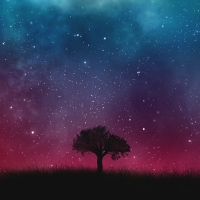
The tops of trees lift my spirit; brushlike they paint the sky the baby pinks and blues of mornings, and the majestic magentas and violets of day’s end. Each tree has its signature shape against the sky, like a fingerprint or a snowflake, similar yet each unique. Some treetops in their bare state are shaped like a fancy coiffure; others look like wrought iron filigree. On distant mountains, against the snowy ground, some look like stubble on an old man’s unshaven face.
The colorful winter sky shows through, showing off bare branches. The curvaceous branches are stark, dark lines against the bright of day and the inky sky of night. These resplendent creatures are living lines that explode. Branches tangle like the lines in a Jackson Pollock painting. Others curve in the sensuous lines of a Brancusi sculpture. Buxom tree trunks stand strong surrounded by their dead blossoms and their burgeoning offspring like a Renaissance Madonna. In truth these trees are not like art at all. Rather art imitates them– their beauty provides the timeless inspiration for artists, writers and poets of all ages and styles.
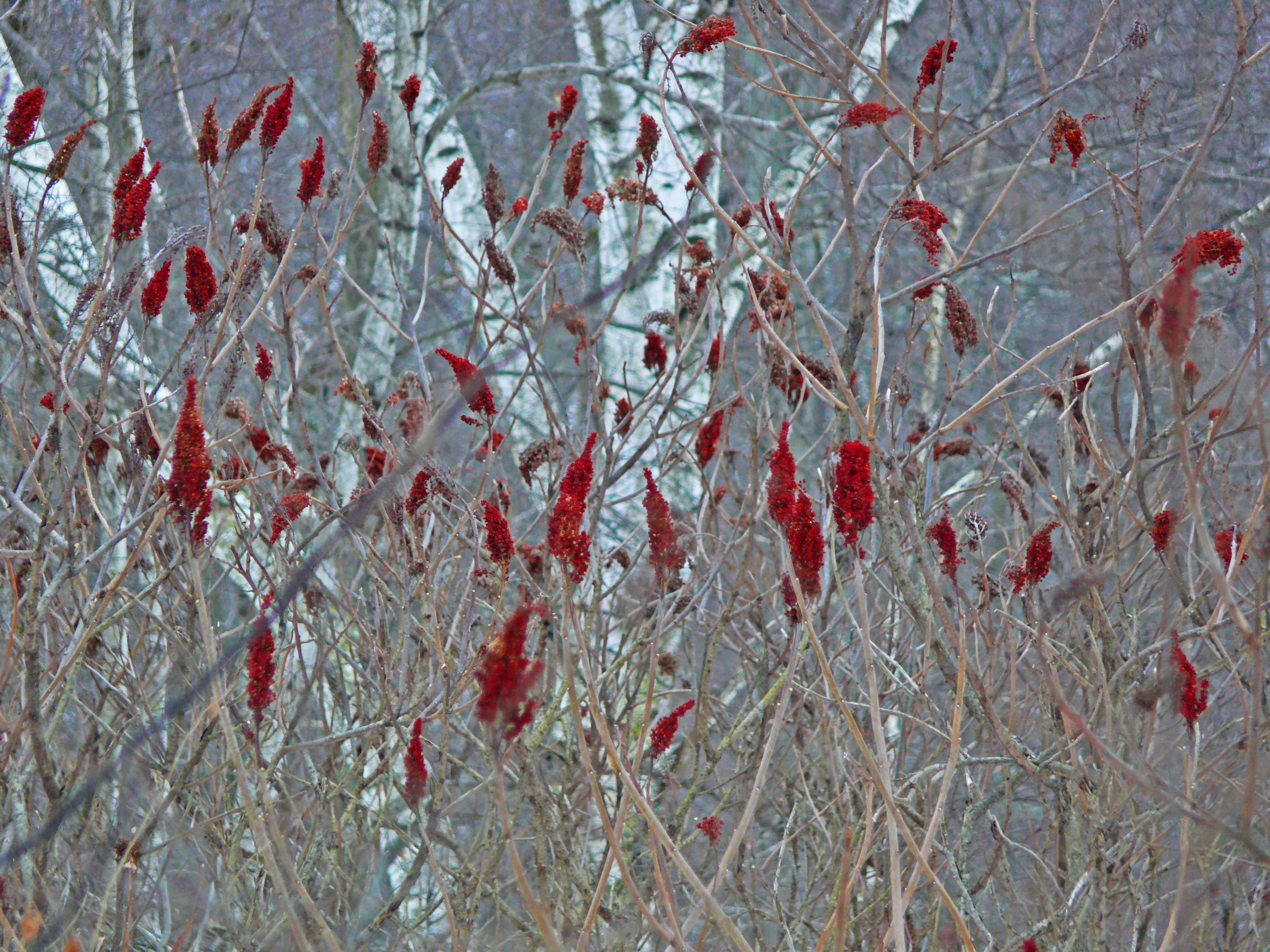
Trees not only inspire, they themselves are paragons of diversity. One look out of a car window while driving on the Taconic and one can see squat pines alongside towering majestic firs, birches interspersed with maple and oak. And together the different brown and tan barks interspersed with evergreens create not only a mosaic of contrasting colors, but display an example to inspire humans to live together in peaceful unity.
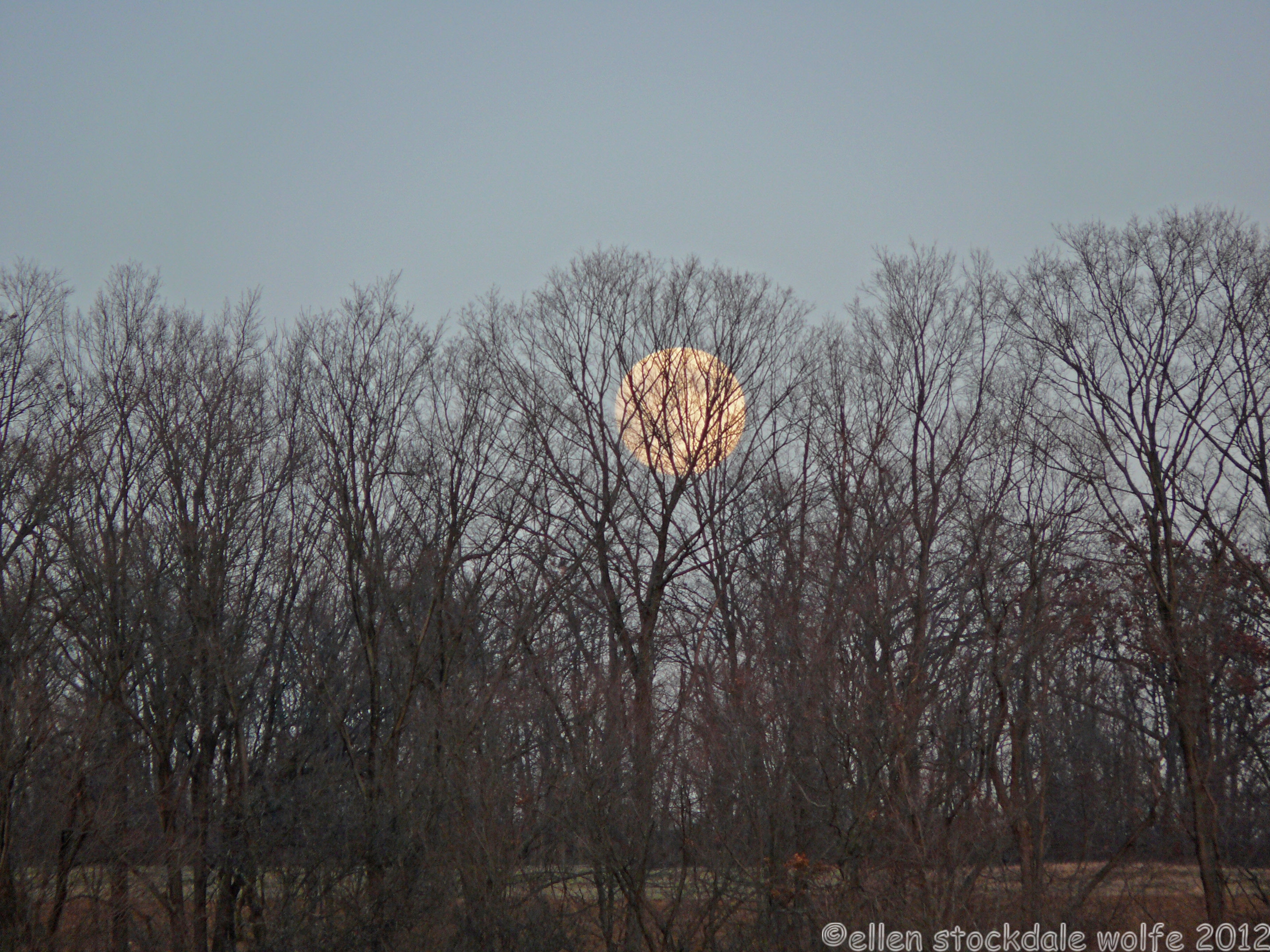
These beneficent beings carry the heavy, dark grey clouds of winter. When it snows the tree trunks become canvases for the abstract patterns of windblown-snow, while the serpentine branches are outlined in white. In ice storms their branches become chandeliers, each enveloped in glassine ice, tinkling in the wind. While in the cold melancholy of a winter rain, the branches become oiled skins of snakes weeping to the ground below. And finally, in the night sky, the branches hold the stars in their arms, those with leaves holding them in their hands, as they nurse the moon.

All trees, no matter what their species, age or height, stand tall in proud humility, their arms reaching up to the heavens to the source in prayer– soft-spoken beings of peace and tranquility towering over us, as we the wee creatures race around distractedly below in our little lives.
A Foretaste of Fall
(revised version)
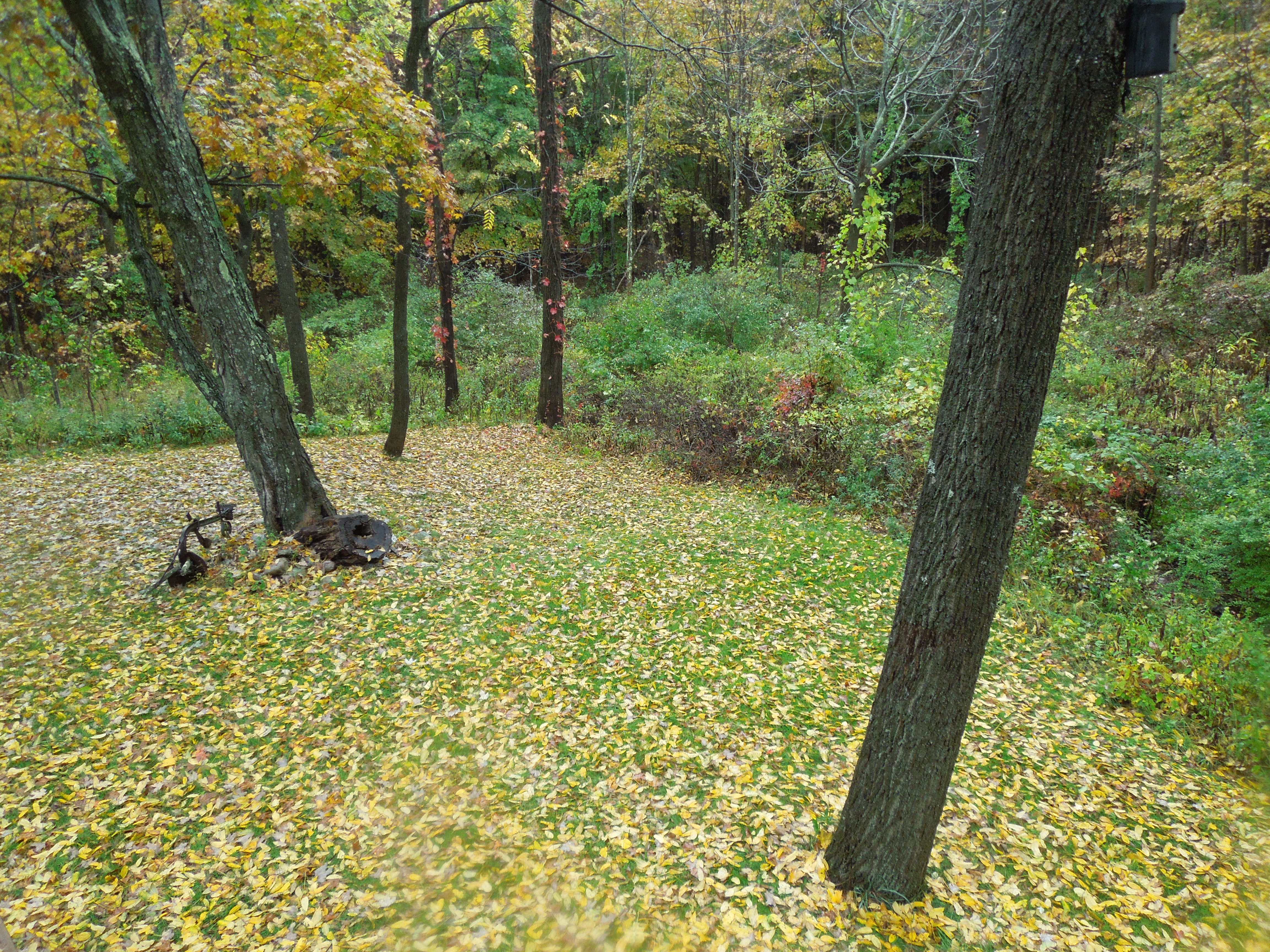
It is the school-imposed end of summer, Labor Day weekend, a weekend I look forward to all summer long for the love of Fall. It is not good to be this way. Religious leaders preach living in the present for that is all we have. I have yet to overcome this and many other bad ways of thinking. I look forward to the crisp days of September when a breeze shimmers through, what I call in my ignorance of the real name, the penny tree. It is so named because when the wind blows the leaves look like so many pennies shimmering down from Heaven. I live for the days when the sun is so hot it tingles on the skin– yet it is not the strong sun of July that burns quickly. The angle of the sun in its diurnal slant is different. Summer is definitely slipping away.
The bees, wasps and yellow jackets are having a heyday in the goldenrod, Joe Pye Weed and Purple Loosestrife. The marsh is thick with flying insects going this way and that. My eyes capture swallowtails. Happily the monarchs are still here. A turkey vulture circles overhead. Some carrion must be nearby. Earlier we saw two golden hawks fly sunlit into the back field. A wisp of a cloud floats by in an otherwise perfectly blue sky. This summer has flown by in the blink of an eye like a fritillary flits by the flowers in the marsh.
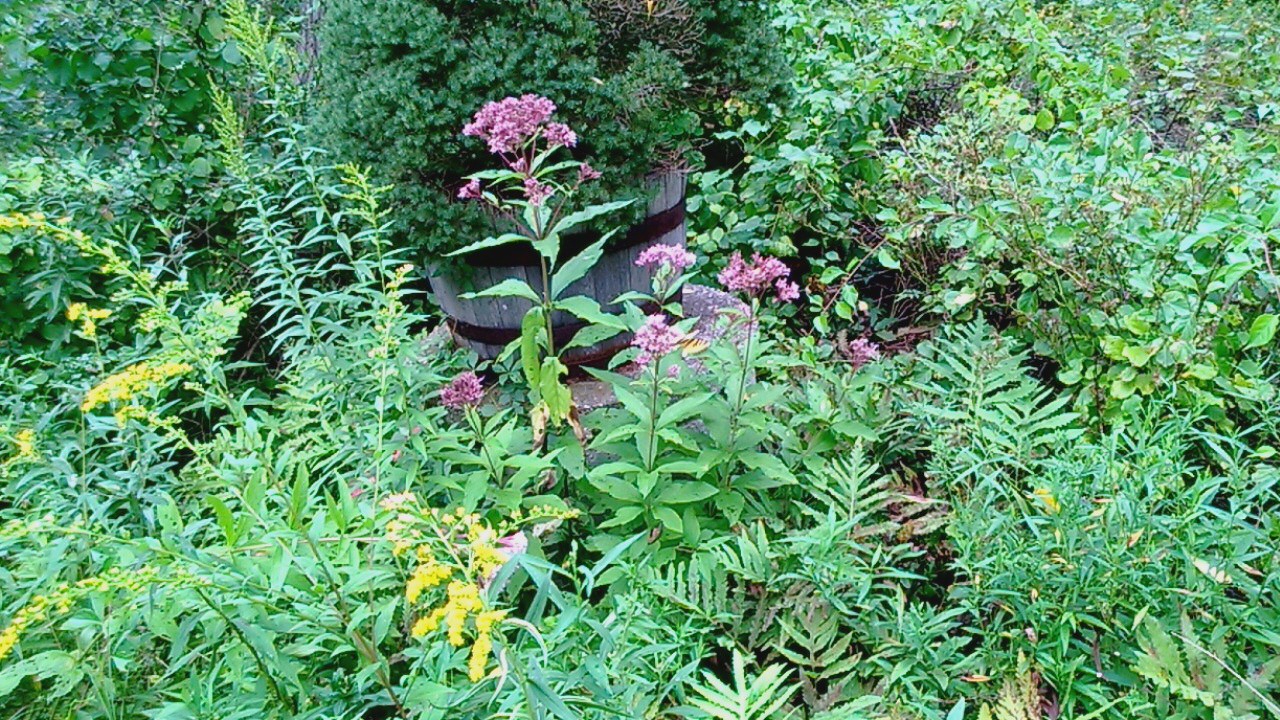
The smell of fresh cut lawn is intoxicating to my raw senses. Soon the grass will cease to grow and the lush green will look washed out. All of its inhabitants in the metropolis beneath our feet will dig deep underground or turn off their bodily systems to overwinter– an amazing concept to a mammal. Some fill their bodies with a type of antifreeze. Nature never ceases to astound. This summer I have made my peace with the insects. Terrified of them as a child I have come to love and respect them, indeed hold them in awe for the feats they accomplish. Our accomplishments pale as humans, supposedly so superior.
No longer do I see turtles sunning on rocks or snakes coming out to bask in the heat of the road. Some species of birds have left already– unbeknownst to me. I just know that some I used to see are gone and the bird song of the spring mating season is a fleeting memory. One lone humming bird flies around the marsh intermittently, causing excitement upon spotting him.
It is the time to dead head the flowers of summer. It is the time of Black-Eyed Susans and Peonies and Sebum. And soon it will be the time of the Mums.
With each gust of wind yellow finger-like walnut leaves shower down on our heads– like large yellow snowflakes– a foretaste of snowfalls to come. The sun’s shadows grow long as twilight is near. Soon the white cloud “lions and tigers and bears” will retire into the black cave of night. And the summer will die and in dying, give birth to fall. The comfortable rhythm of the changing season beats in our sometimes unhearing hearts.
(Aknowledgements to “likes” and comments may be delayed. Recuperating from surgery.)
Sentient Trees in Almost-Winter
“The Feather Trees”
(Click to enlarge)

“The Heart of Darkness“
(Click to enlarge)
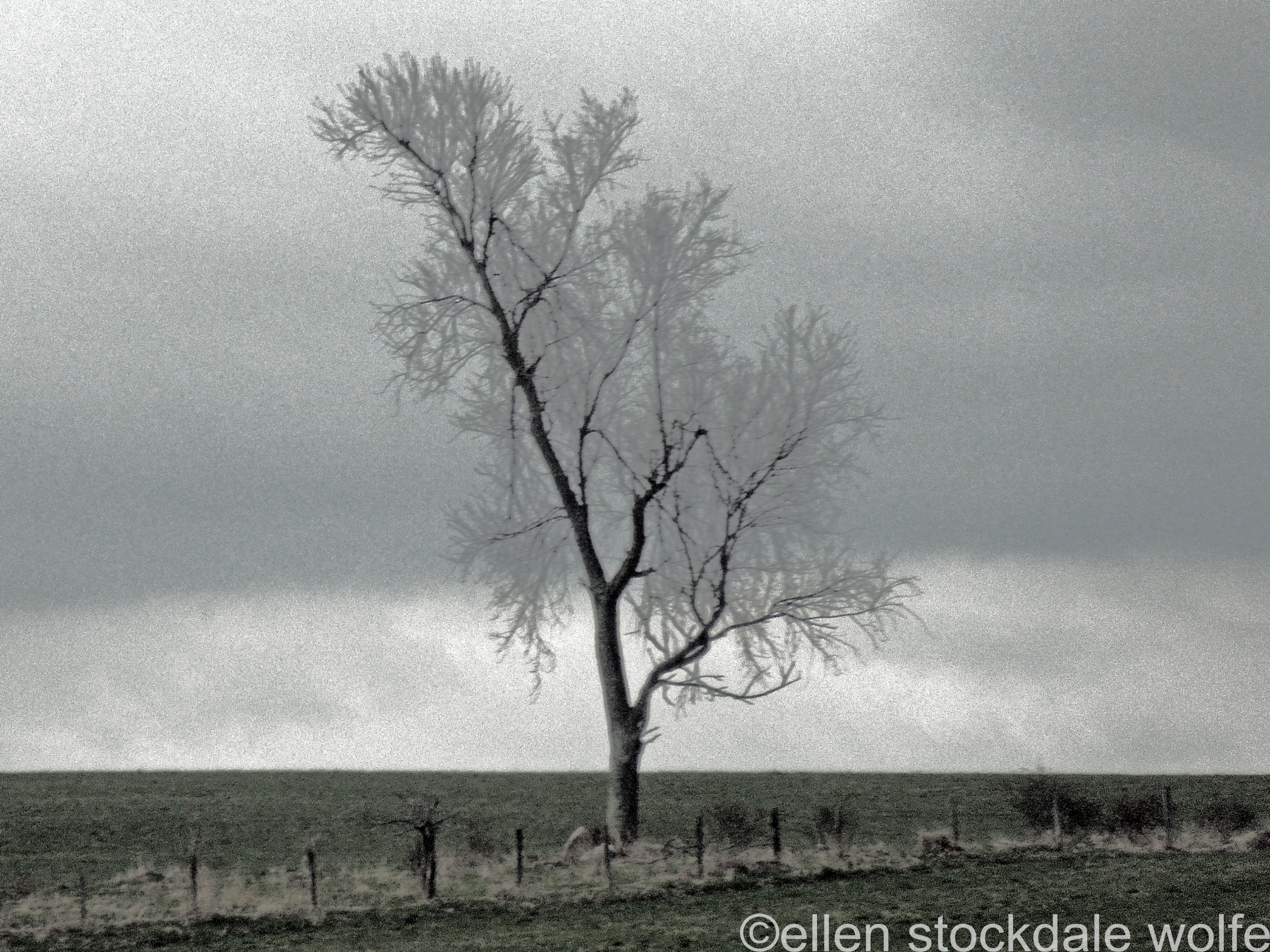
“The Cold and Lonely Tree“
(Click to enlarge)
Thanksgiving From Within
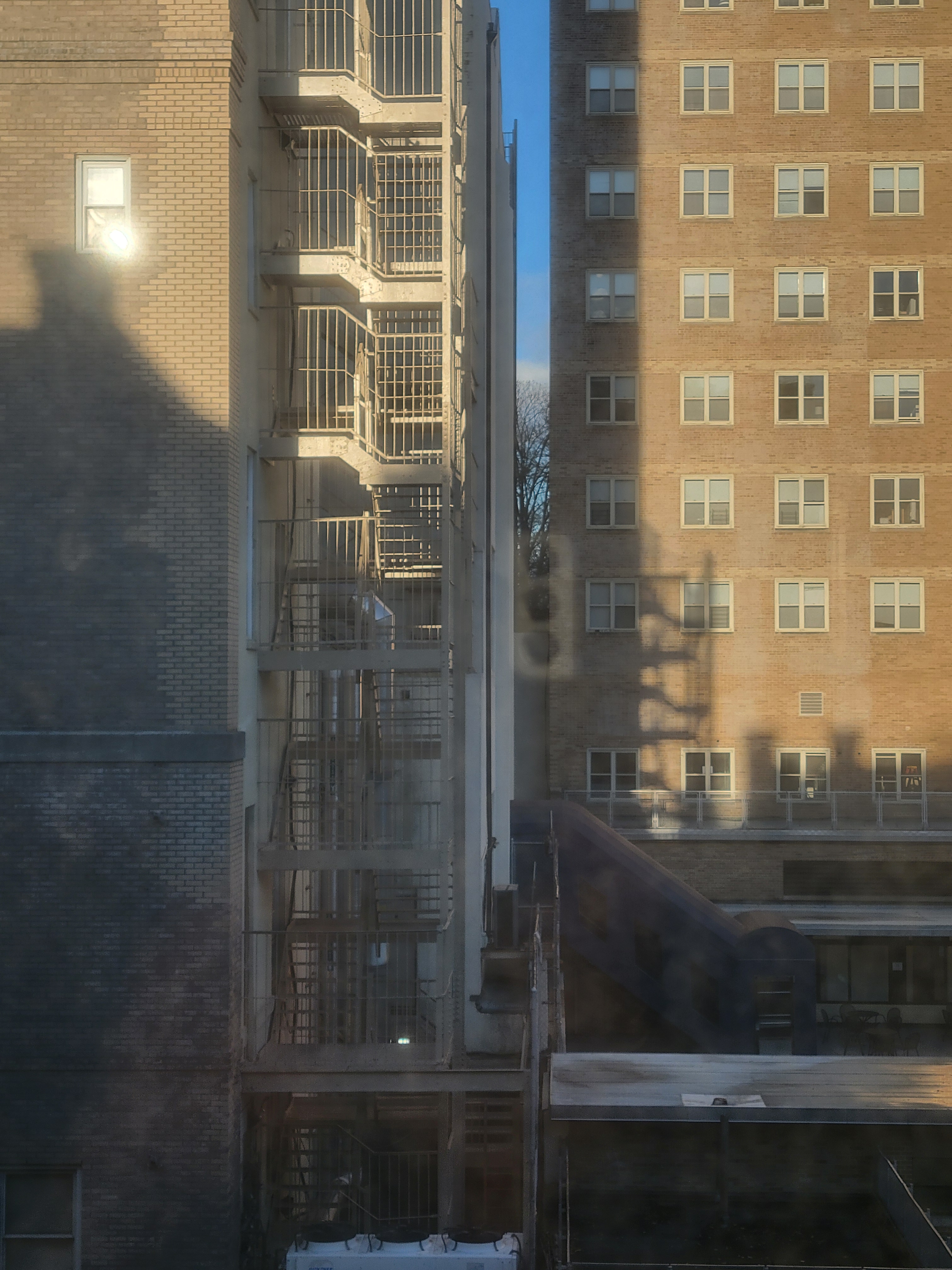
If you look between the buildings you can see the sky and the trees I watch as the seasons change. There are bare branches in between the buildings there now.
But this afternoon my husband called me in to the other room see the leaves still on the tree outside the den window.
The leaves were ecstatically yellow today as I drank in their beauty from my window seat on a stationery bike.
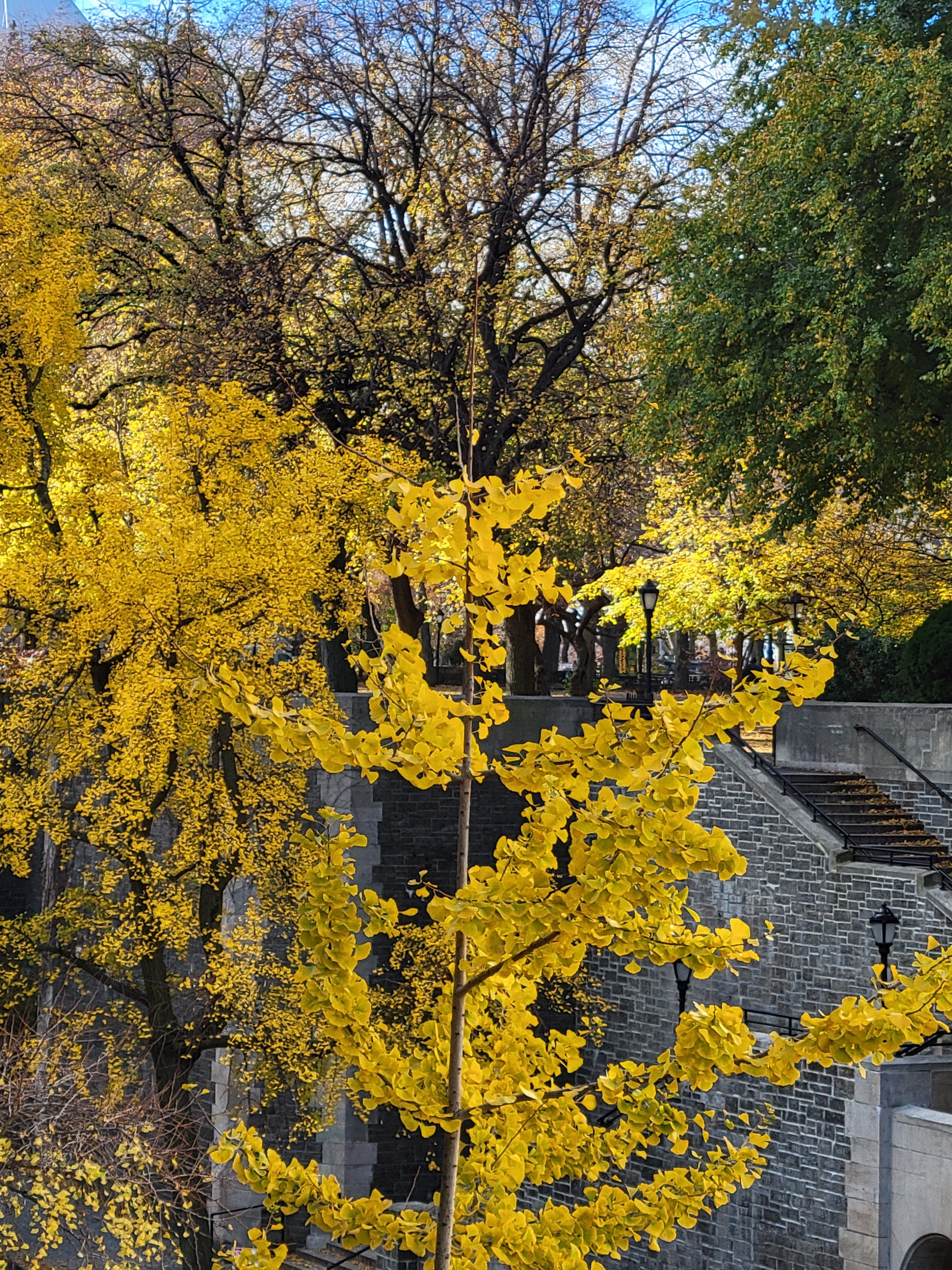
The yellow leaves filled the room with a wondrous yellow light. Migraines and severe arthritis keep me in. But MUCH can be seen from the inside.
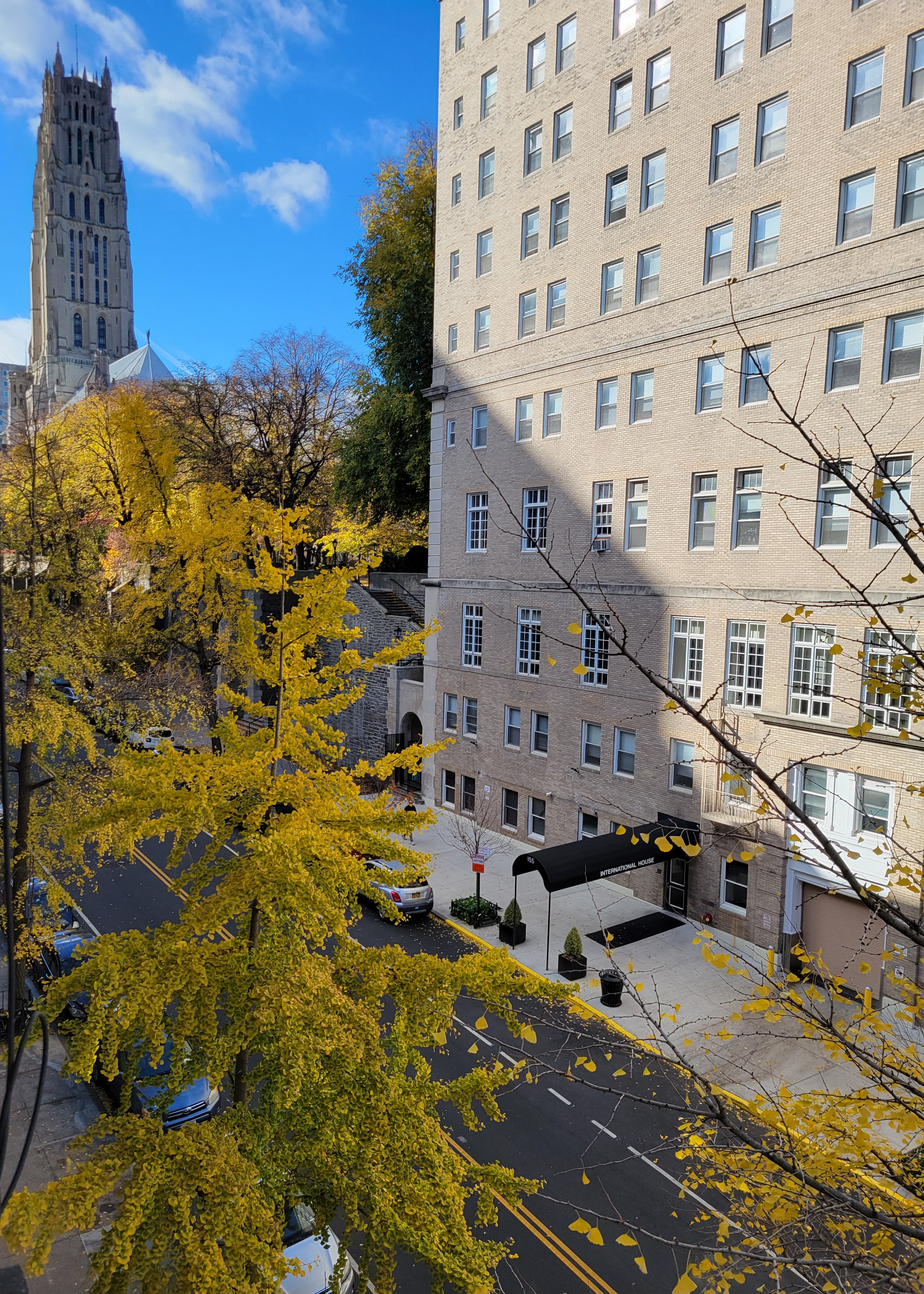
Time flew by as fast as the low lying clouds. I felt a form of ecstasy with Spirit and the world outside. A peace that nature gives and one that has been rare for me in these days of deep strife in the world.
The clouds zipping by and the fresh air from the window and the bright yellow brought me great joy that others racing by in their busy lives below do not see. I am blessed though mostly homebound… blessed with a loving husband and breathtaking beauty in the great beyond. I have much to be grateful for and I wish you all many such blessings and the urge to give thanks.
Mostly I give thanks for a sensitive and sensible husband who has stuck by me through thick and thin and my many moods and suicidal depressions– as a person with a major mental illness. Bipolar Disorder. It has not been easy for him. And he has helped many others in his career as a psychiatric social worker. I was able to help him understand some of his clients, yes, but he gave them the greatest gift of all by sharing with them his sense of humor and treating them as normal human beings.
On our first date, almost 40 years ago, a walk in the park, his sense of humor was what I first noticed about him. He scored the first home run. And then moments later, another, with his compassion. And that was the start of the love story of my life.
Today I send my deepest blessings to him, and, too, I want to wish each of you many blessings of love and nature on this fine, yellow day of Thanksgiving week!
A Few of the Last Leaves Upstate
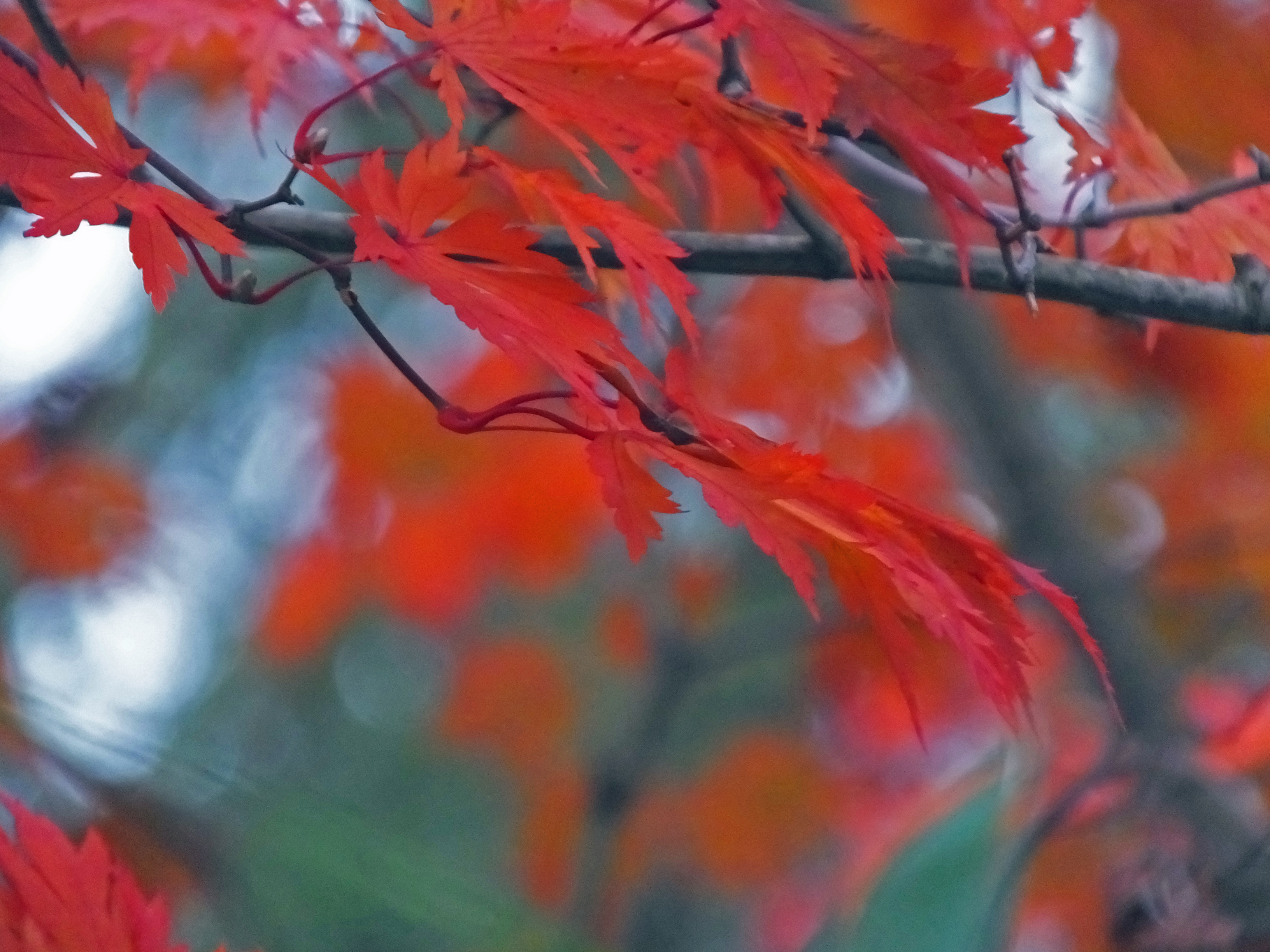
(Click to enlarge)
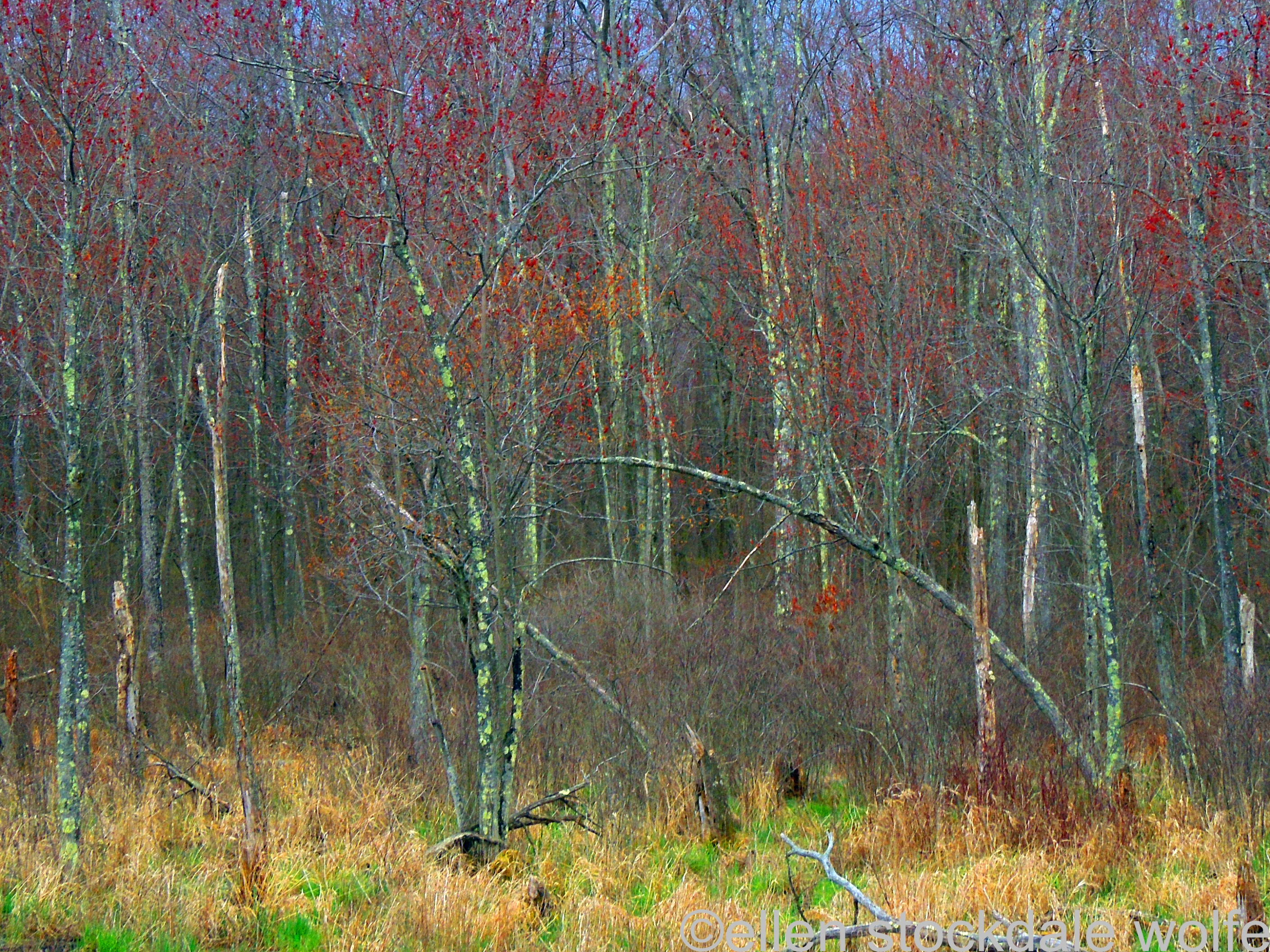
(Click to enlarge)

(Click to enlarge)
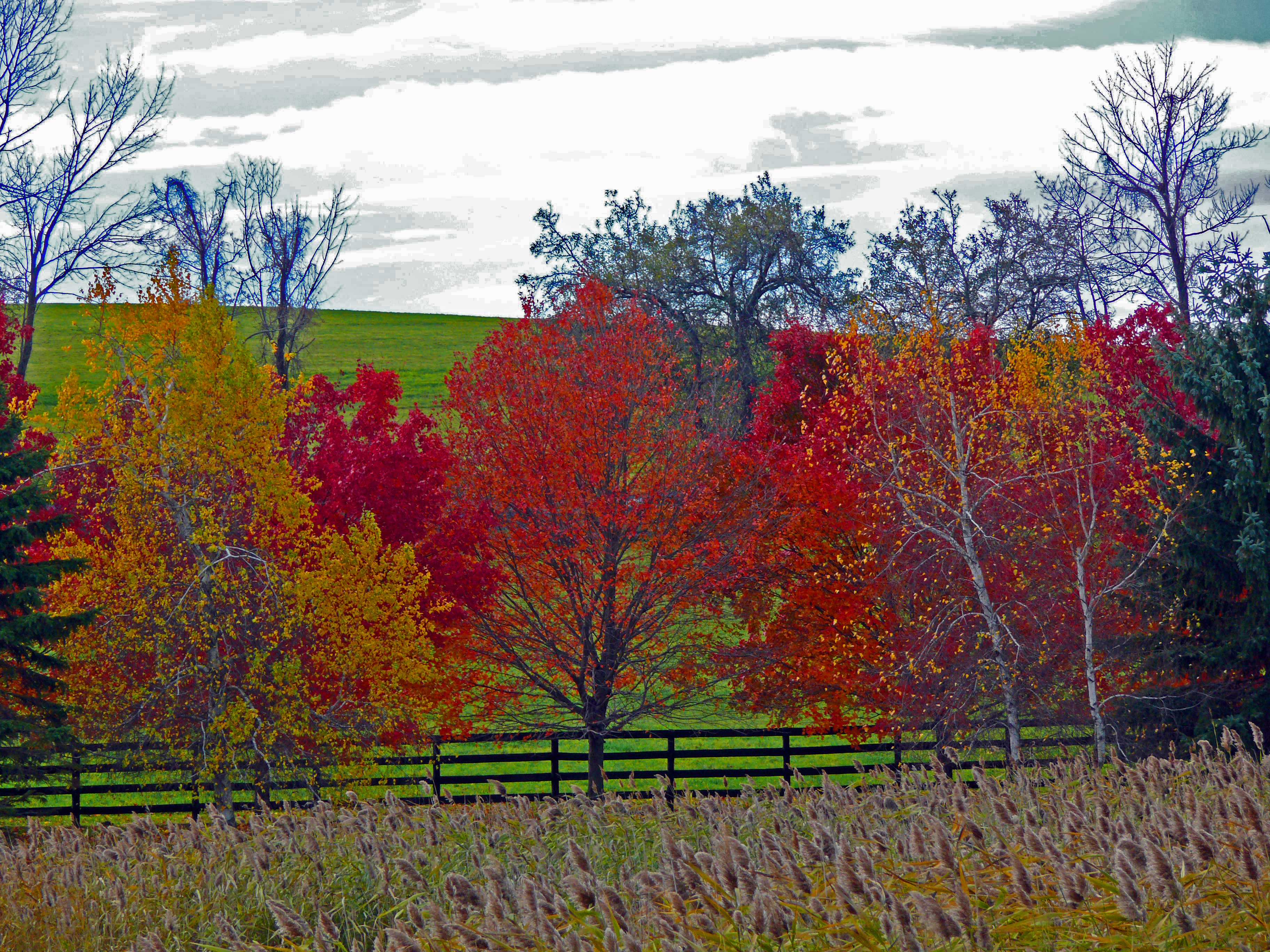
(Click to enlarge)
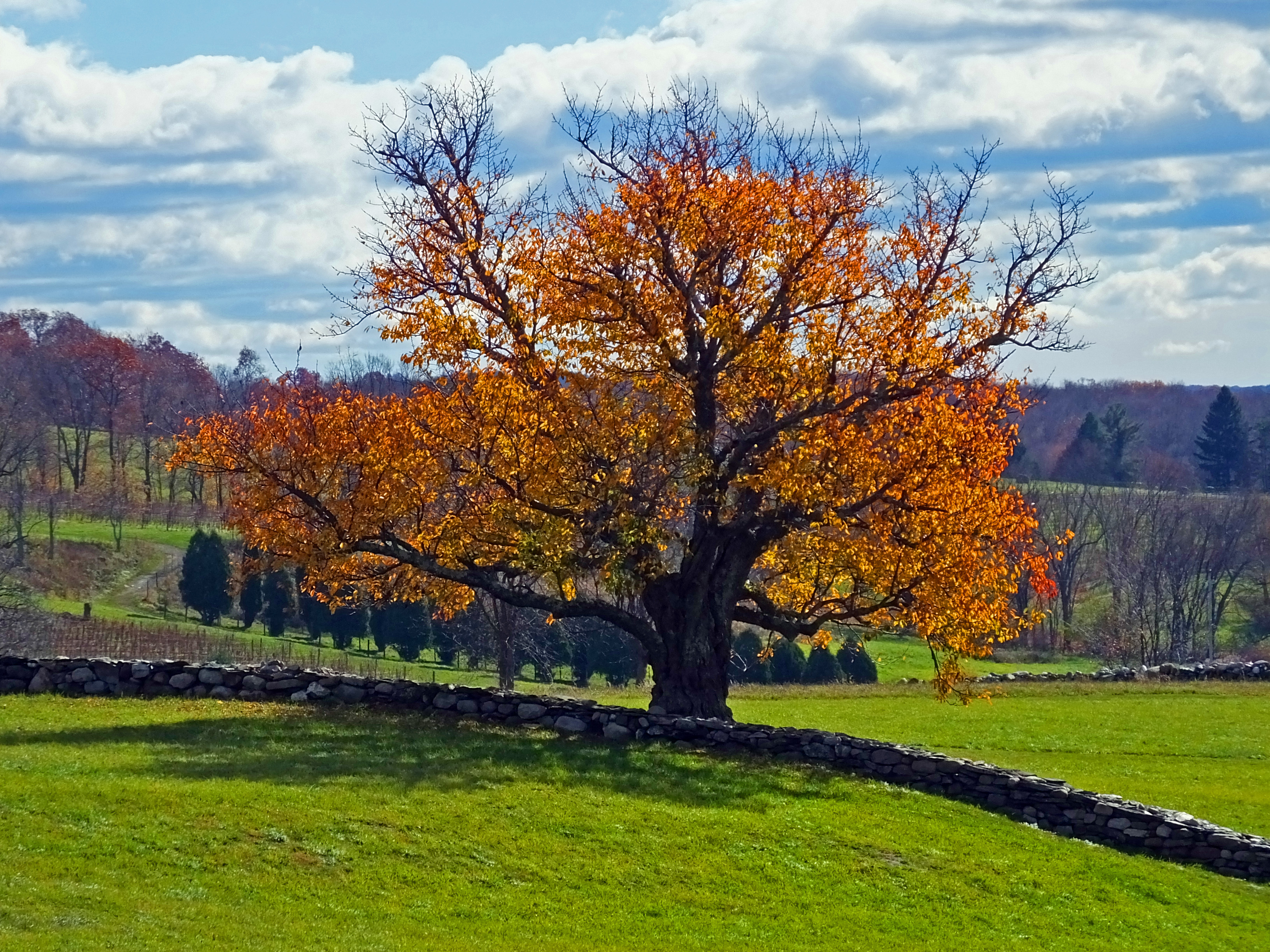
FALL IN NEW YORK CITY… Dedicated to the two most compassionate bloggers I know of… Gigi in Chicago at/ https://gigisrantsandraves.wordpress.com/ and Tiramit in Thailand at /https://dhammafootsteps.com/ for their total kindness and because they wanted to see Fall in New York City
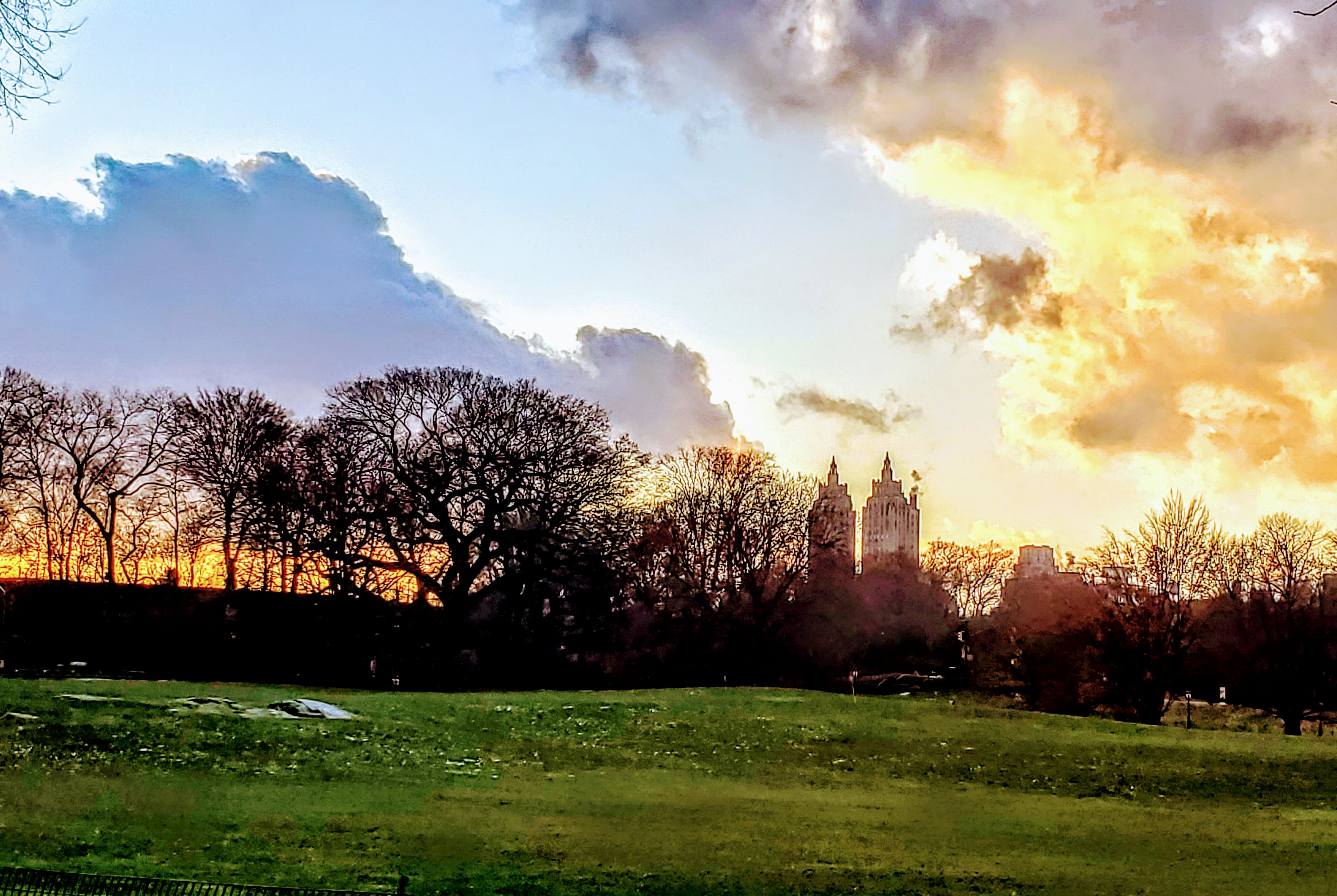
Central Park

Central Park
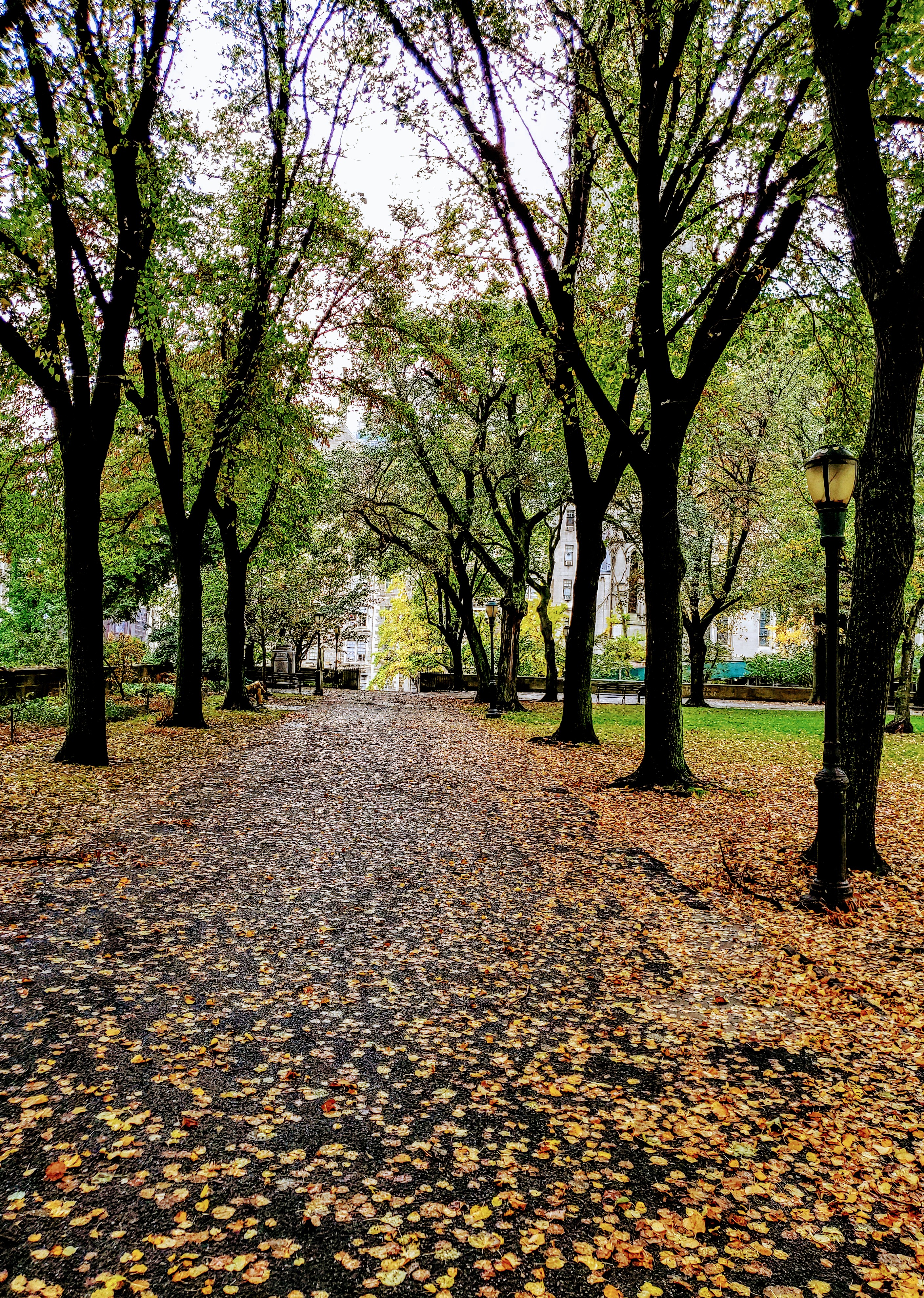
Sakura Park in Morningside Heights, Harlem

Sakura Park
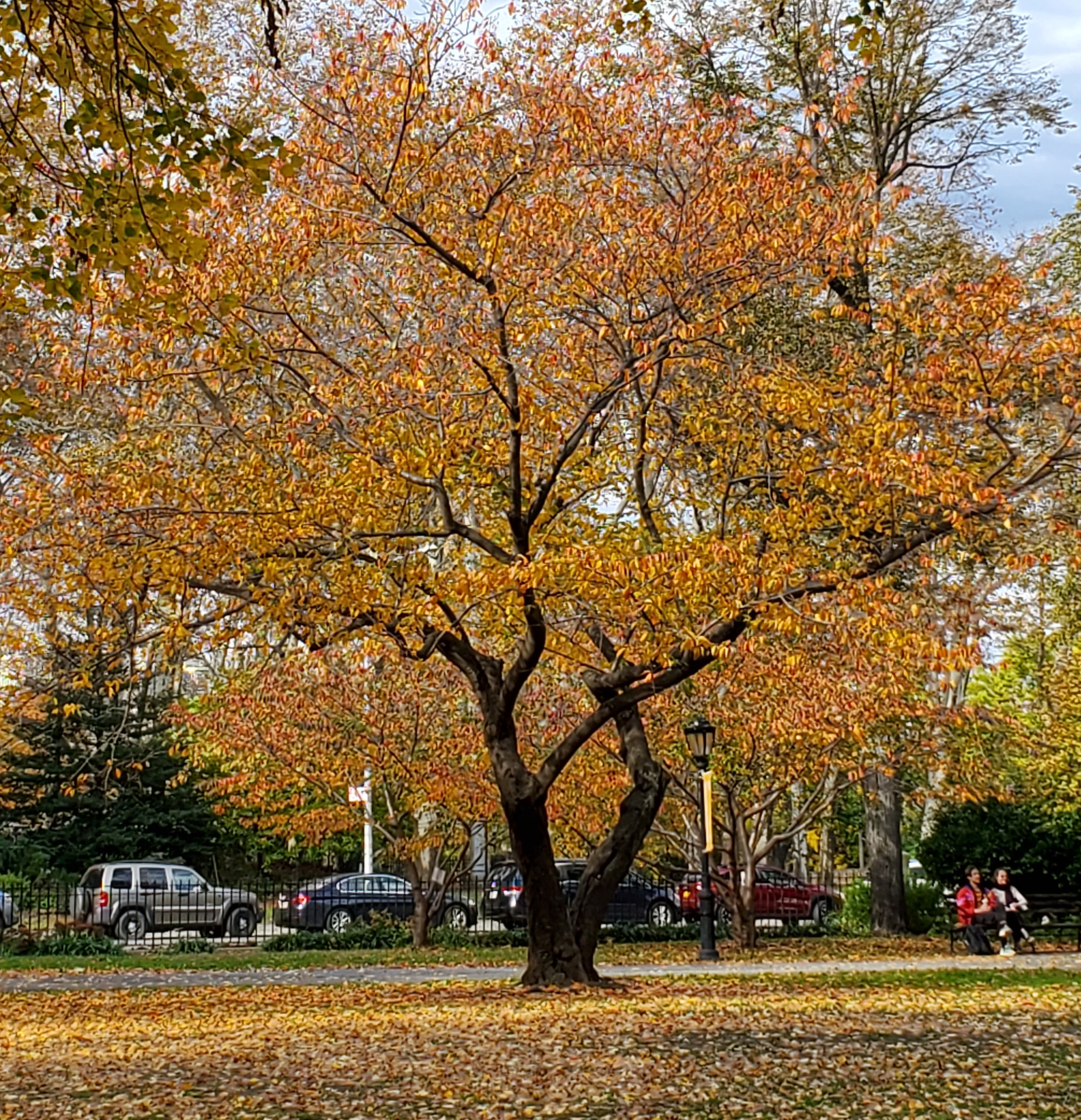
Sakura Park
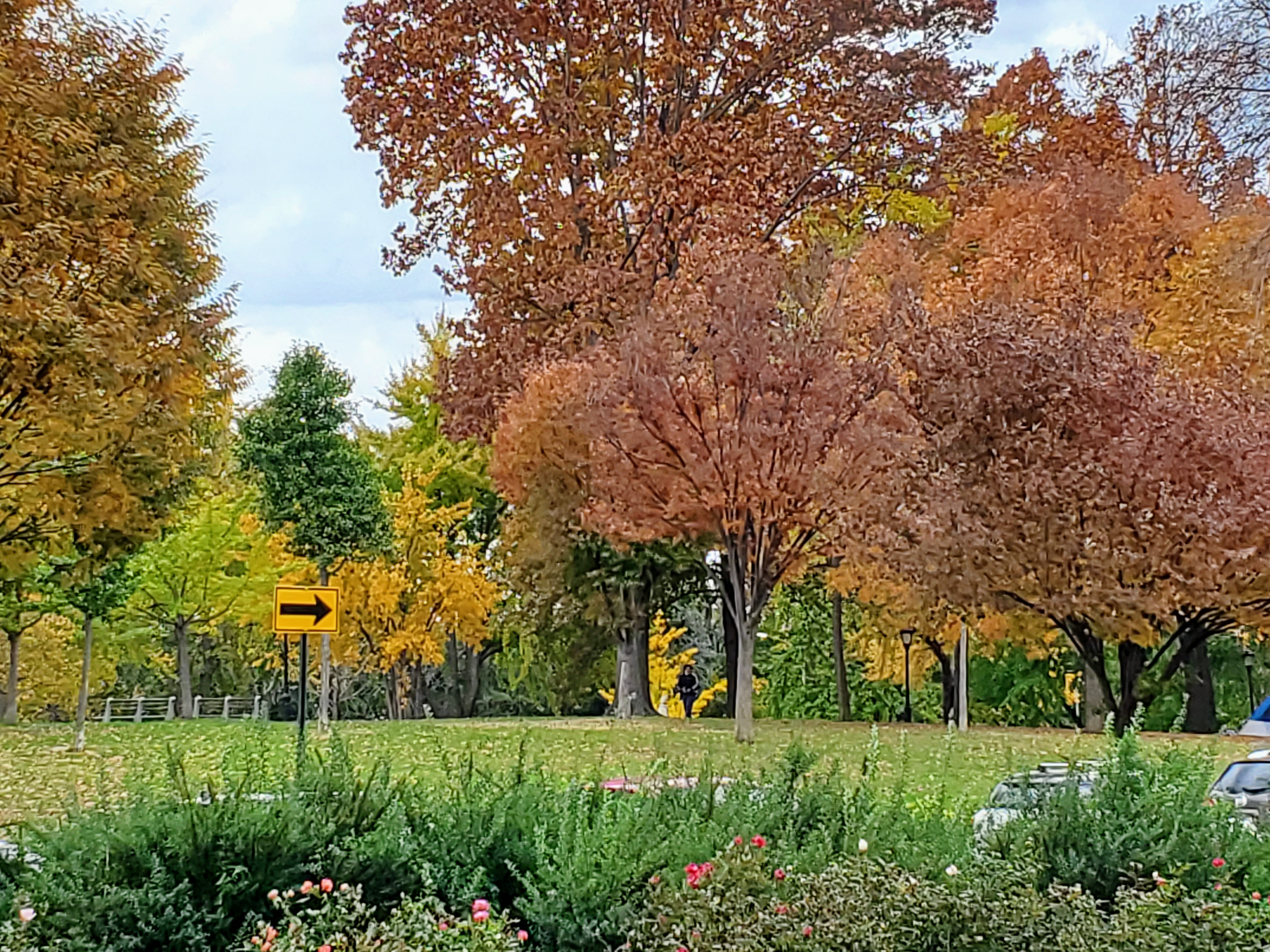
Riverside Park in Morningside Heights in Harlem
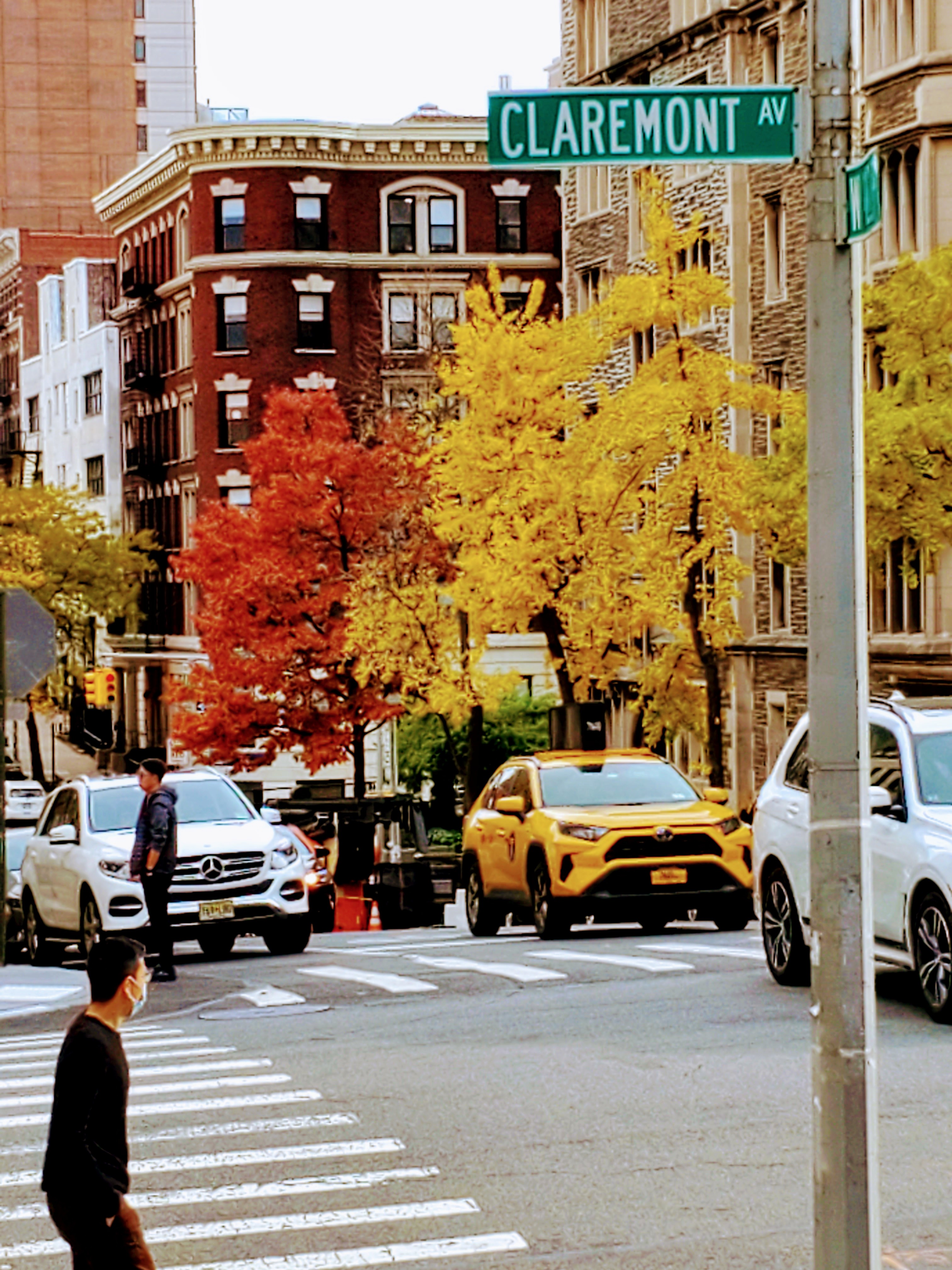
Our block in Morningside Heights, Harlem

Columbia University in Morningside Heights, Harlem
“Cool Change”… Fall Upstate in Millbrook, New York
This was one of my brother’s (R.I.P.) favorite songs… “Cool Change” by Little River Band.
Beginnings & Endings
No one in my family liked summer. Probably because we lived in New York City and summer is not fun there. Moving upstate changed all that– up to a point. Although I must admit a weakness for those beautiful June days when the temperature reaches perfection, the sky is blue with fluffy clouds, and a soporific breeze wafts through the trees. And true, one has much more time with the four or five extra hours of sunlight. Still in all, when the first hints of fall come I am bordering on ecstatic.
First there is the change in light. The sun, still hot in mid-September, does not pack the punch it did in July, when one could be outdoors for an hour and come in with a change in skin color. Temperatures cool. The grass does not grow as fast. The “blood” of the trees starts to flow back into the trunk causing leaves to change color. Walnuts, acorns and apples fall. The bats leave the attic for warmer climes, giving us yet another chance to plug up holes inside to keep them outside next summer. Summer houses are closed down. The butterflies, that were so rampant outdoors in August are now inside the stomach of many a child with the start of school. Even adults are not immune. Many grown people feel the flutter of back-to-school anxiety come fall. After all September means “back to school” for many, many years. Time to “honker down” again and mean business. Fall offers a new beginning and there is a tinge of excitement added to the anxiety in facing some thing new.

And most of all, fall is a time of riotous color, when a walk in the woods finds one reveling like a drunk, besotted by the yellow, orange, crimson, russet world which our eyes imbibe like a hefty cocktail. It is a time when Italian comes to the lips in a loud “Que bella!!” The green of summer is bucolic and raises the spirit, but the many colors of fall intoxicate. People start talking of peak color, and leafing becomes the pastime of many. It is the time to plant bulbs and endlessly rake blowing leaves.
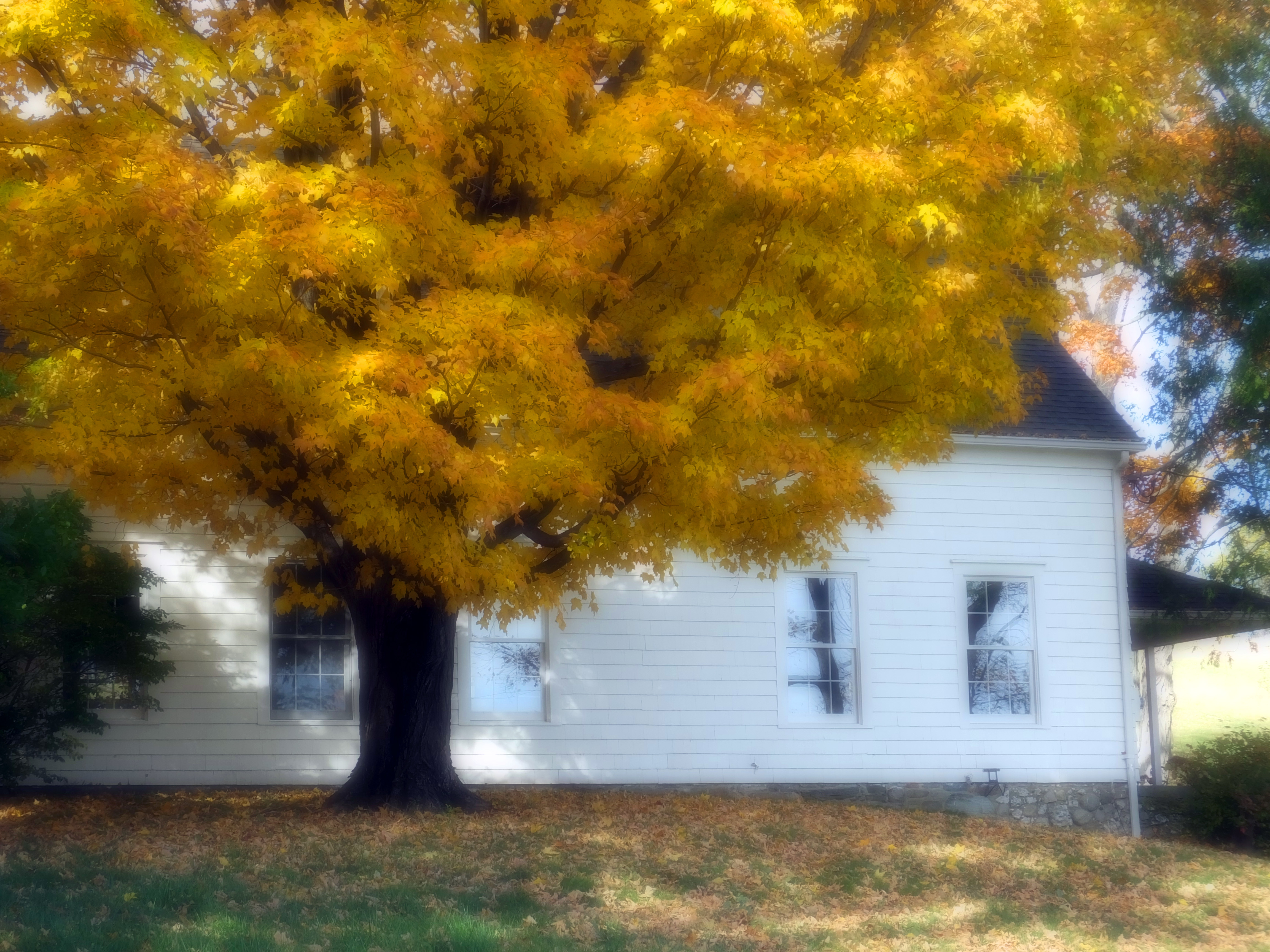
But fall is a time of melancholia, too. Flowers die. Reptiles go into hibernation. Insects die or overwinter. Songbirds migrate. Trees eventually loose their leaves. Anxiety over new beginnings can be uncomfortable. And the end of the lazy days of summer brings with it shorter days, longer nights, and possible depression for many people. Moments of sobriety seep into intoxication with the new world of color as we may remember loved ones who can no longer share the beauty. Who can no longer enjoy those cool crisp days in September, so coveted in August, when coolness brushes the cheeks.
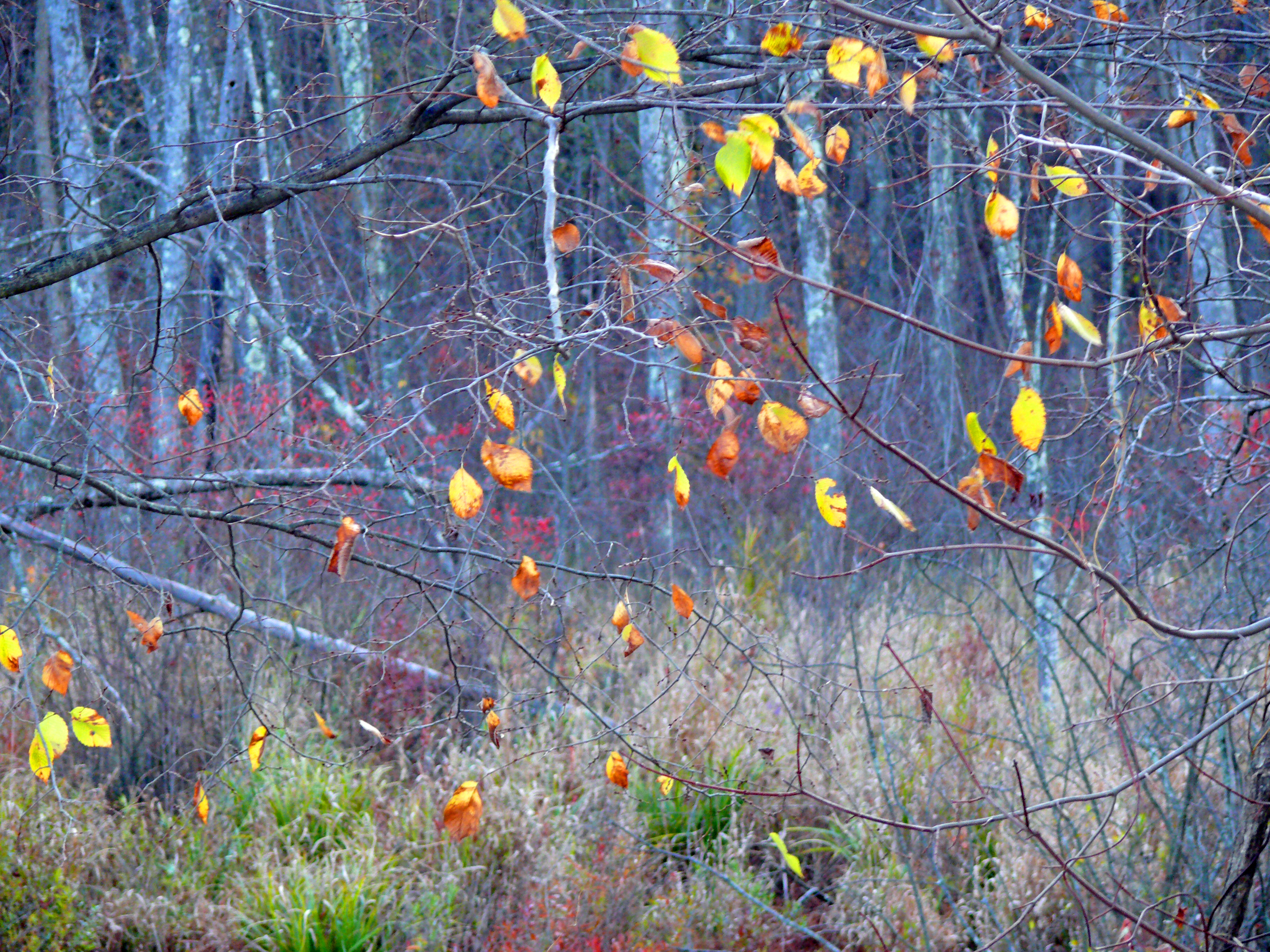
For autumn is a celebration of endings, too, perhaps best described by the French poet, Guillaume Appollinaire, in his poem Autumn:
“A bowlegged peasant and his ox receding
through the mist slowly through the mist of autumn…
Oh the autumn the autumn has been the death of summer
In the mist there are two gray shapes receding.”
When the Walnut Leaves Begin to Fall
It is the school-imposed end of summer, Labor Day weekend has come and gone and I am looking forward to Fall. It is not good to be this way. Ideally one should be living in the present… for that is all we have. I have yet to overcome this and many other bad ways of thinking. A breeze shimmers through what I call (in my ignorance of the real name) the penny tree for when the wind blows the leaves look like so many pennies shimmering down from Heaven. The sun is so hot it tingles on the skin– yet it is not the strong sun of July that burns quickly. The angle of the sun in its diurnal slant is different. Summer is definitely slipping away.

The bees, wasps and yellow jackets are having a heyday in the goldenrod, Joe Pye Weed and Purple Loosestrife. The marsh is thick with flying insects going this way and that. My eyes capture swallowtails. Happily the monarchs are still here. A turkey vulture circles overhead. Some carrion must be nearby. Earlier we saw two golden hawks fly sunlit into the back field. A wisp of a cloud floats by in an otherwise perfectly blue sky. This summer has flown by in the blink of an eye like a fritillary flits by the flowers in the marsh.
The smell of fresh cut lawn is intoxicating to my raw senses. Soon the grass will cease to grow and the lush green will look washed out. All of its inhabitants in the metropolis beneath our feet will dig deep underground or turn off their bodily systems to overwinter– an amazing concept to a mammal. Some fill their bodies with a type of antifreeze. Nature never ceases to astound. This summer I have made my peace with the insects. Terrified of them as a child I have come to love and respect them, indeed hold them in awe for the feats they accomplish. Our accomplishments pale as humans, supposedly so superior.

No longer do I see turtles sunning on rocks or snakes coming out to bask in the heat of the road. Some species of birds have left already– unbeknownst to me. I just know that some I used to see are gone and the bird song of the spring mating season is a fleeting memory. One lone humming bird flies around the marsh intermittently, causing frantic excitement upon spotting him.

It is the time to dead head the flowers of summer. It is the time of Black-Eyed Susans and Peonies and Sebum. And soon it will be the time of the Mums.
With each gust of wind yellow finger-like walnut leaves shower down on our heads– like large yellow snowflakes– a foretaste of snowfalls to come. The sun’s shadows grow long as twilight is near. Soon the white cloud “lions and tigers and bears” will retire into the black cave of night. And the summer will die and in dying, give birth to fall. The comfortable rhythm of the changing season beats in our sometimes unhearing hearts.

Last of the Informal Show
These photographs are the last to go to Michaels Makindye Foundation for street orphans and homeless children in Uganda. See reference at end for information and donations…

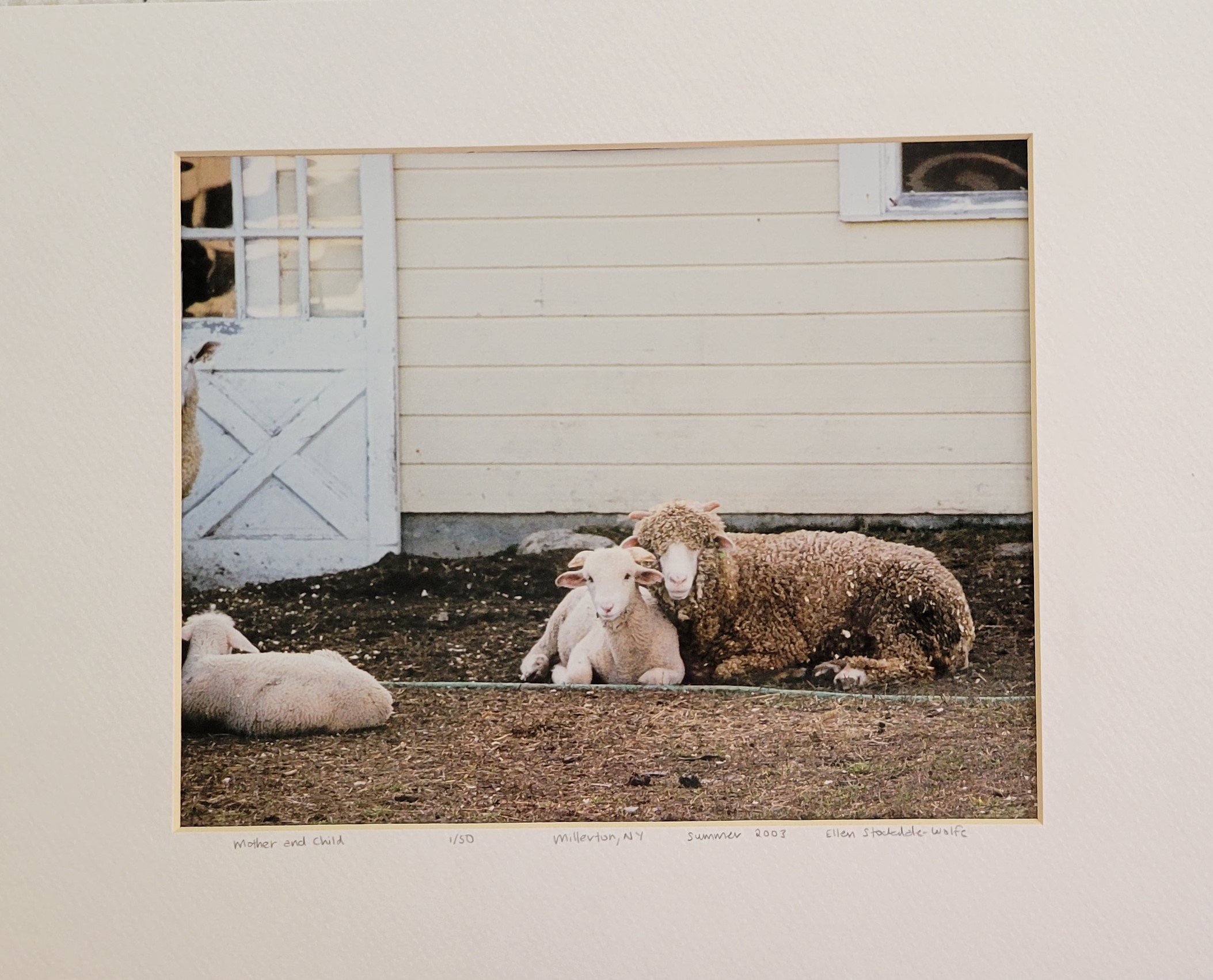

Some of my India pictures are going as well… see “India” on the blog. One appears below…
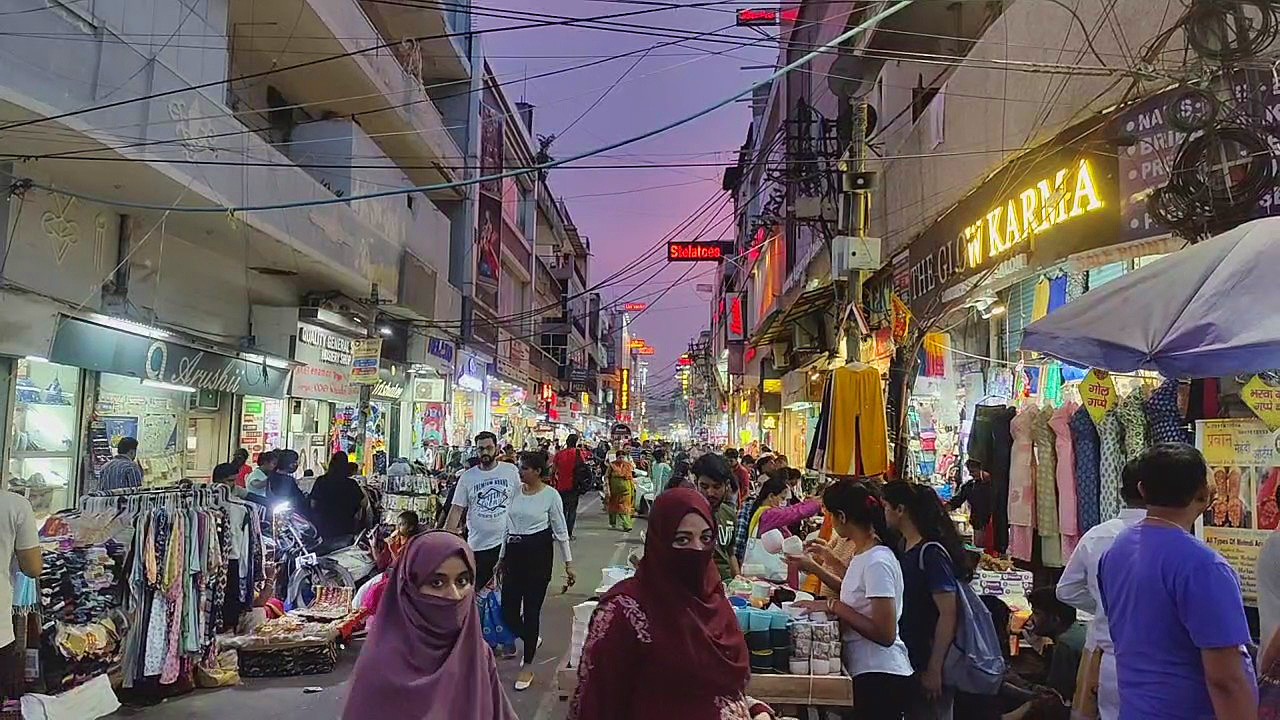
Delhi Market
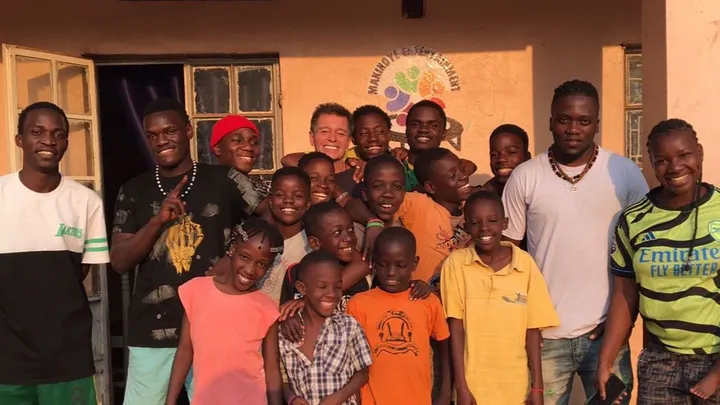
Makindye children

Michael and Angie
Click on link below to see Michael’s charity:
https://www.gofundme.com/f/sustainability-support-for-the-makindye-foundation
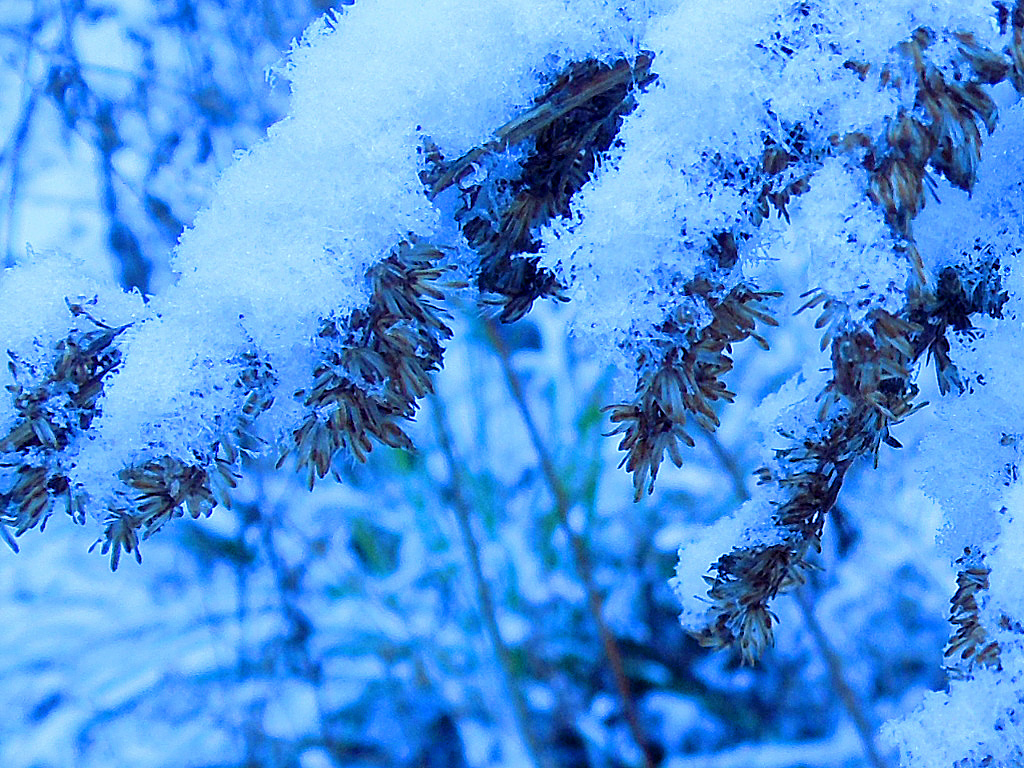


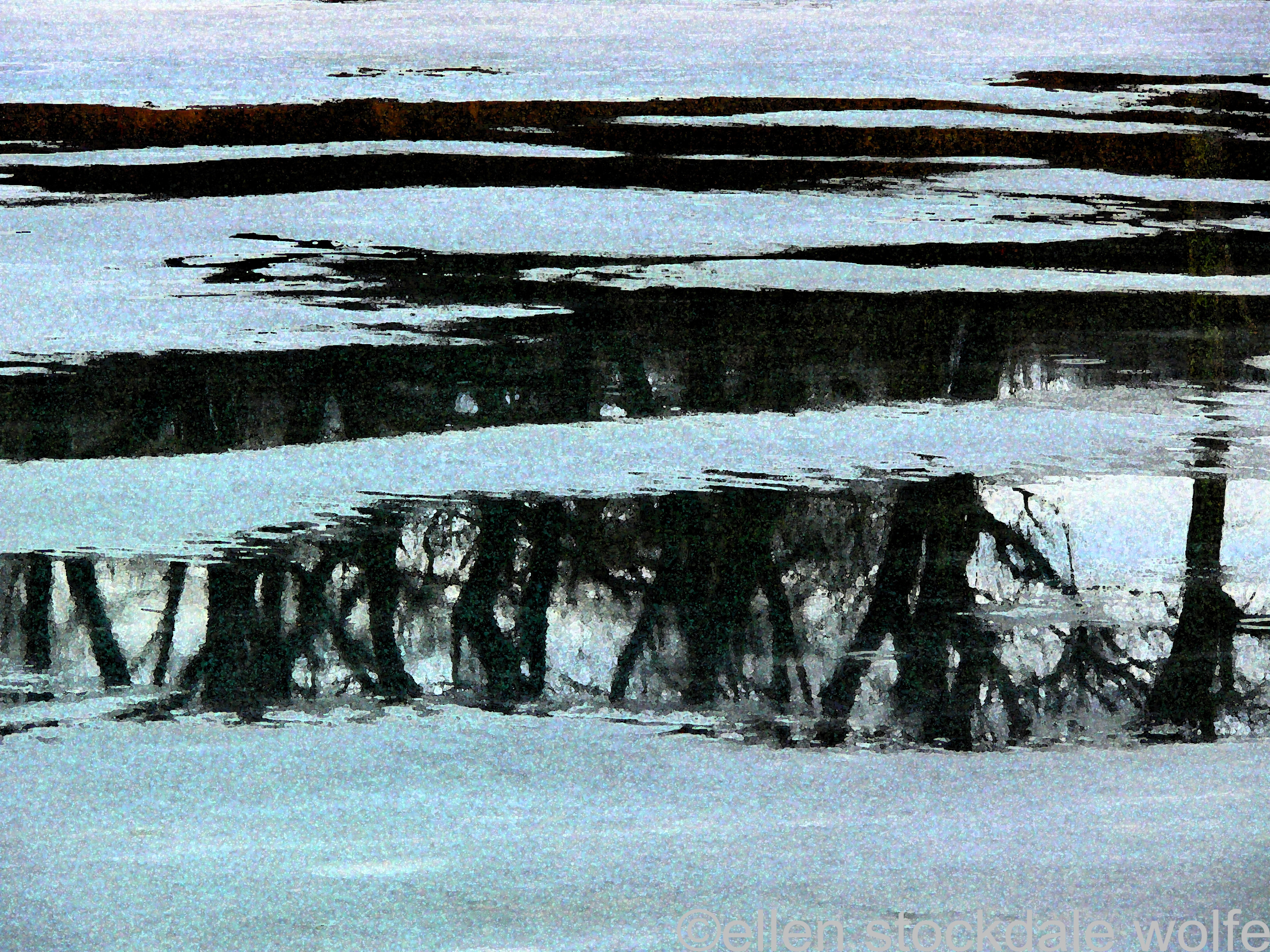

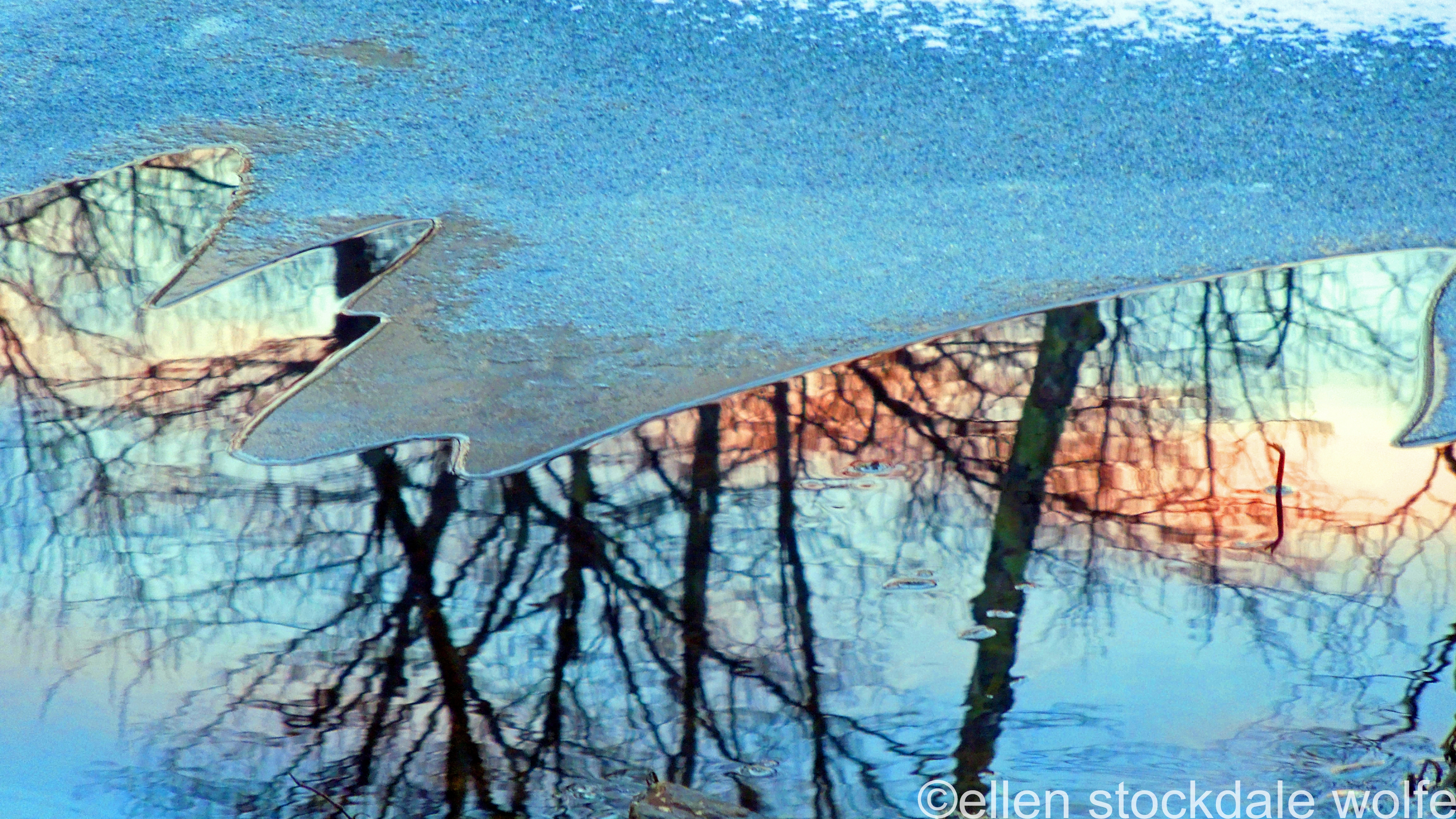
The Trees of Winter
Every year what budded in autumn, blossoms full blown in winter– my love affair with trees. Trees that were drop-dead gorgeous in their fall colors are now bare, with the exception of evergreens and a few stray deciduous trees that refuse to relinquish their leaves. Now the trees are stripped down to their souls and their souls sing a siren song to the universe.
The tops of trees lift my spirit; brushlike they paint the sky the baby pinks and blues of mornings, and the majestic magentas and violets of day’s end. Each tree has its signature shape against the sky, like a fingerprint or a snowflake, similar yet each unique. Some treetops in their bare state are shaped like a fancy coiffure; others look like wrought iron filigree. On distant mountains, against the snowy ground, some look like stubble on an old man’s unshaven face.
It is the colorful winter sky showing through, and showing off, the bare branches that woo me. The bare curvaceous branches are stark, dark lines against the bright of day and the inky sky of night. These resplendent creatures are living lines that explode. Branches tangle like the lines in a Jackson Pollock painting. Others curve in the sensuous lines of a Brancusi sculpture. Buxom tree trunks stand strong surrounded by their dead blossoms and their burgeoning offspring like a Renaissance Madonna. In truth these trees are not like art at all. Rather art imitates them– their beauty provides the timeless inspiration for artists, writers and poets of all ages and styles.
Trees not only inspire, they themselves are paragons of diversity. One look out of a car window while driving on the Taconic and one can see squat pines alongside towering majestic firs, birches interspersed with maple and oak. And together the different brown and tan barks interspersed with evergreens create not only a mosaic of contrasting colors, but display an example to inspire humans to live together in peaceful unity.
These beneficent beings carry the heavy, dark grey clouds of winter. When it snows the tree trunks become canvases for the abstract patterns of windblown-snow, while the serpentine branches are outlined in white. In ice storms their branches become chandeliers, each enveloped in glassine ice, tinkling in the wind. While in the melancholy of a winter rain, the branches become oiled skins of snakes weeping to the ground below. And finally, in the night sky, the branches hold the stars in their arms, those with leaves holding them in their hands, as they nurse the moon.
All trees, no matter what their species, age or height, stand tall in proud humility, their arms reaching up to the Heavens to our Creator in prayer– soft-spoken beings of peace and tranquility towering over us, while the little creatures race around distractedly below.
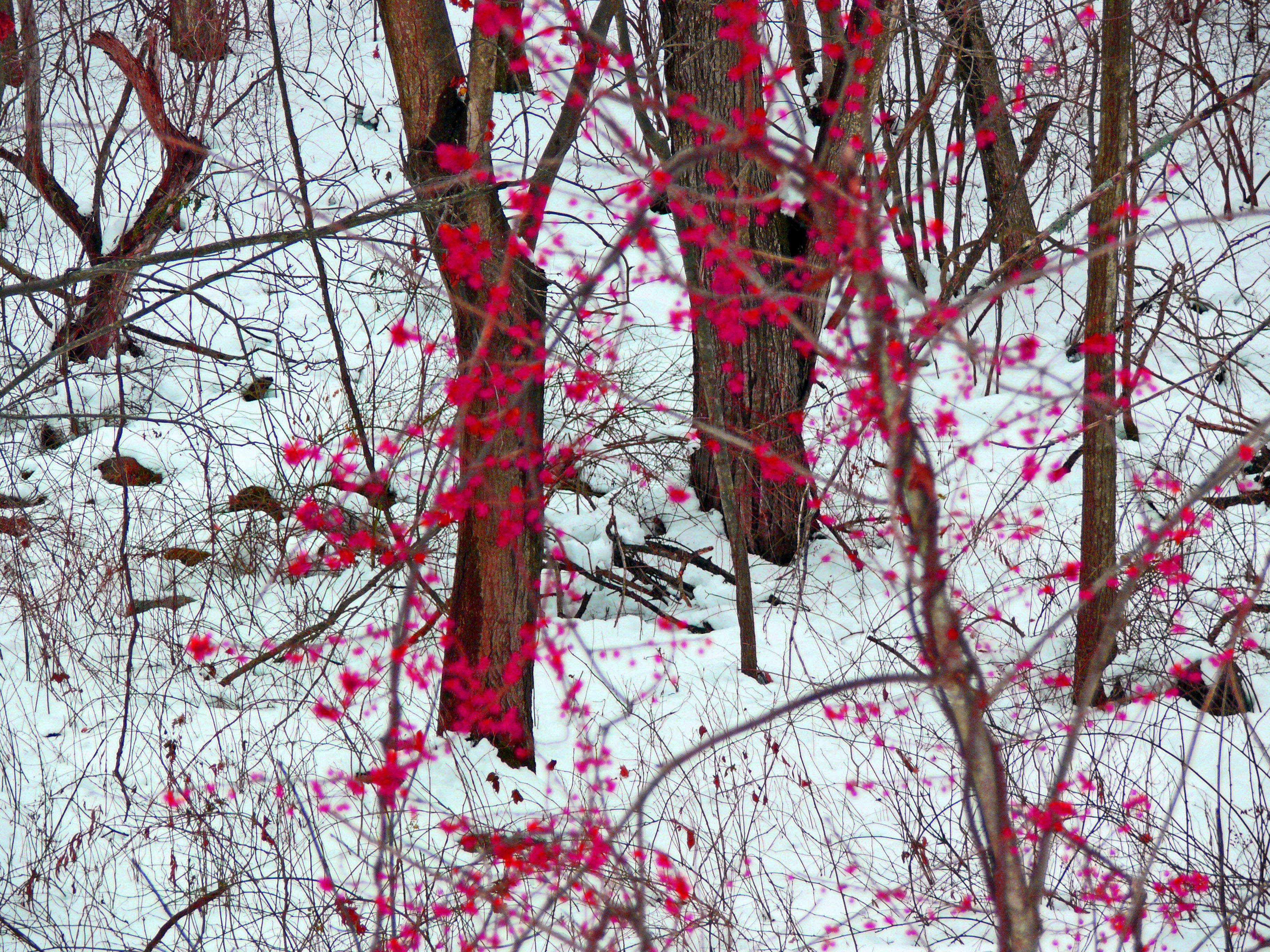


The Height Of November and Giving Thanks

(Click to enlarge)
A chill wind blows the yellowing leaves off the trees. They drift down to the ground like giant snowflakes. The air is pregnant with the feel of the coming holidays. Fall has truly come with the sudden drop in temperatures, a full 20 degrees cooler than a week ago. This is the real Fall, no mealy-mouthed disguised Fall, but a Fall that will guide us into winter appropriately. November appears as a mirror image of March. November is the vibrant color of decay while March is the decaying color of about-to-burst-forth Spring.
The birds are at the bird feeder all the time now. They are not stopped by our presence when we come to fill the feeder or blow leaves under it. Nothing stops them. They swoop around the feeder and the surrounding trees like Kamikaze pilots, darting here and there recklessly. The squirrels are in a frenzy as well, stock piling and burying acorns and walnuts which they will retrieve without fail in a month or so in a snow-covered land.
The trees are most beautiful for me at this time of year, when many of them are bare and a scattering of leaves remain on dark brown branches. The leaves that remain on the trees blow on the limbs with dainty grace in their precarious positions. Yet these are the survivors. The other leaves have fallen and gone the way all living things eventually go. Most trees have lost all their leaves and they stand in stark contrast against the blue sky, the stormy sky, even the night sky. They are perhaps most beautiful at night, like arms reaching up to the darkness trying to grab at the stars twinkling between the branches. Moonlight dances on their limbs.
November is the last glimmer of color and in some places the color seems to be predominantly yellow. A carpet of yellow lines the woods now. And now one can see inside the woods, so dark and impenetrable in summer. Some forests have carpets of oak leaves– dark brown tan in color. Or there are forest paths with variegated colors– vibrant crimsons against yellows and faded greens and tawny tans. The unmown lawns are now taken over by the spiders and, at moments, one can see a world of webs covering fields that only appear in a certain slant of sunlight. It is the silent take over of the spiders before the snows come.
The yellow, the brown, the crimson leaves are complemented by the ubiquitous yellow, brown and crimson mums that appear on the roadside near mail boxes, on porches or along driveways. These tough little flowers withstand frosty chills and stand tall throughout most of November. Hearty souls and so giving in their colorful, velvety splendor.
The Halloween pumpkins begin to sag a bit or shine with wetness as if encased in glass. They will soon be tossed, pine combs and wreathes and fir swags will take their places, and the season of lights will begin. Like a child I am filled with anticipation of what is to come although all the spiritual guides teach us to live in the moment. I try to live in the moment all Autumn for as a season it seems the fastest to come and go. I try to hold each moment in my hands as a treasure but they all sift through my fingers like grains of sand. Then Christmas comes and fades in a flash and we are into the Nor’Easter blizzards of January. Another year is gone. The years do go faster as you grow older. Every one has their favorite theory why this is so. I think it is “to-do” lists. They rob us of time as we run around like Kamikaze birds or frenzied squirrels to check things off. And our reliance on calendars. We turn to mark things in our appointment books months ahead of time effortlessly flipping through the seasons with a flick of the wrist. It is no wonder time flies. We are in August and planning Christmas. I am fighting this in November with half the Fall gone: “Stop! Stop!” I try in vain to wish time would stand still so we could be in forever Thanksgiving/Christmas. But, being human, we would soon tire of that. It is good we are defenseless against time.
We go about living our lives, trying against our natures to treasure the good moments. Now in November, at Thanksgiving, it is our time to say thank you. Inspired by the Native Americans let us thank the earth. Let us say thank you to the trees for their constantly changing beauty, to the stars for their piercing presence in the night sky, to the leaves for their inspiring colors, to the sun for its life-giving power, to the Spring for its awakening hope, to the Summer for its warm, thriving growth, to the Fall for its bounty, to the Winter for a time of renewal, to the snow flakes for their hushed, white silence that transforms our world, to the animals for their pure souls, to our families and friends for their love, and, lastly but mostly, to the Higher Power of our belief.
Happy Thanksgiving and may you each be blessed with the all embracing, pervasive Love in nature.
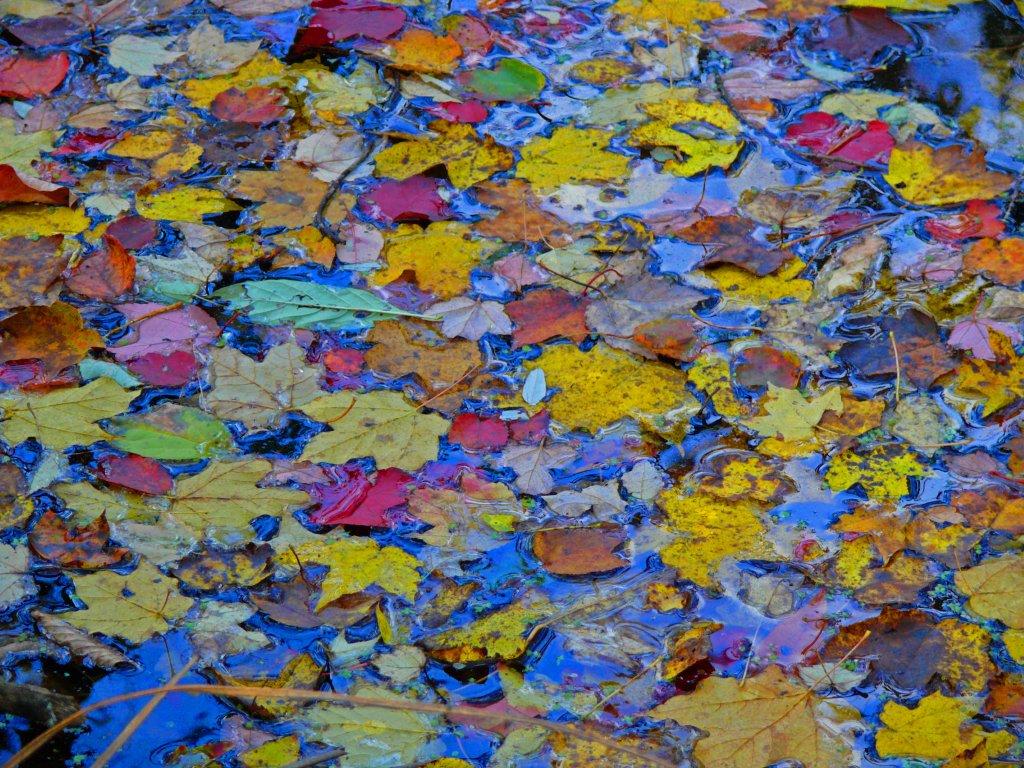
And They All Fall Down… and Become Just a Memory… Too Fast… the Scintillating Colors of Fall…
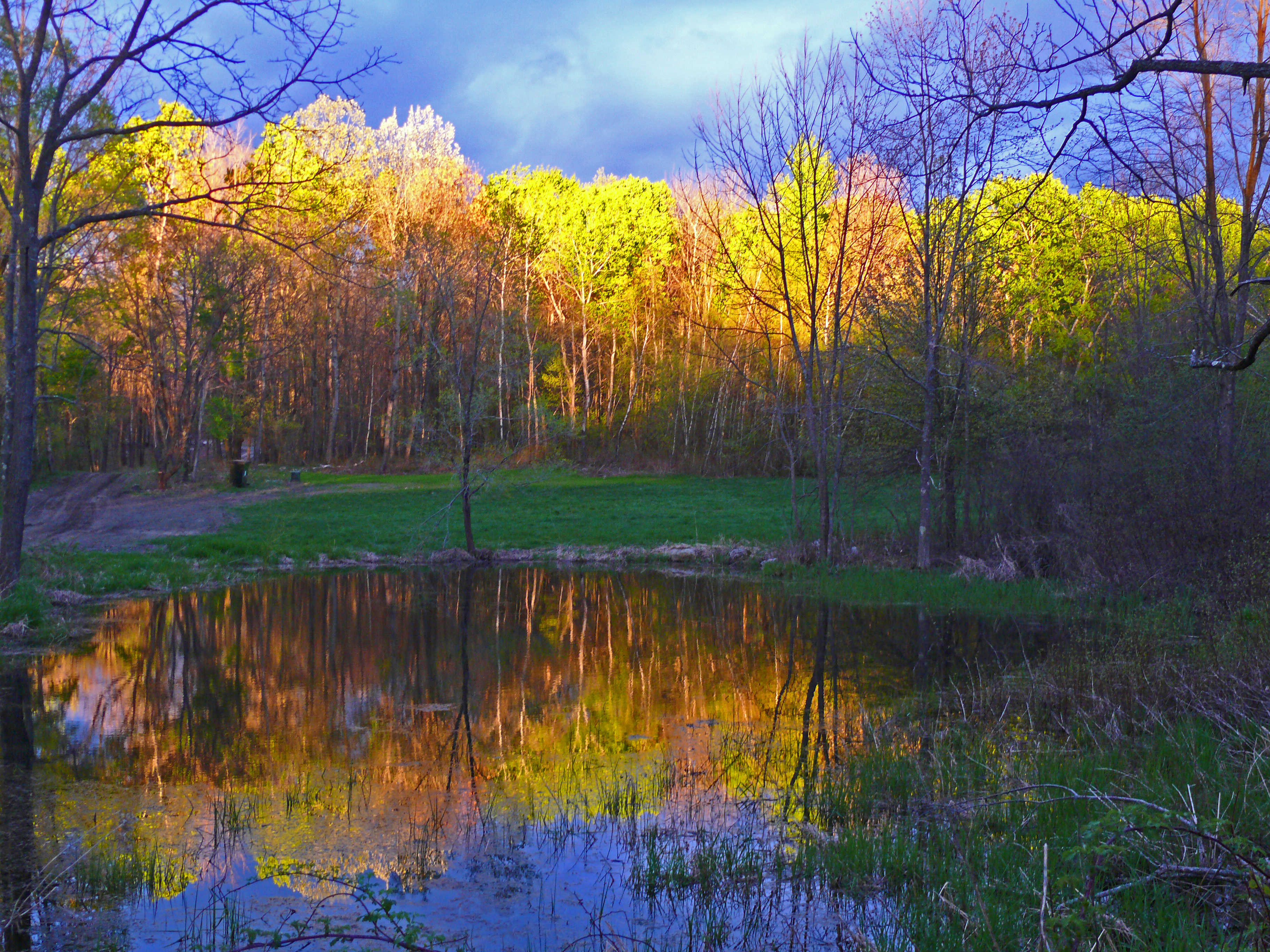
(Click to enlarge all photos)

Requiem for a Tree

It was hot and buggy and I was tired and cross, but my husband convinced me to plant the Impatiens right away because the next day was supposed to be hotter. So I did, mumbling and grumbling as I knelt down to dig up the earth. Every year we planted Impatiens around the Sugar Maple, the Queen of our trees, two trees in fact, each slanting in opposite directions in ever so pleasing ways. It was the showcase of our yard.
The bugs were buzzing around my face and it was humid as I dug deep into the rich soil around the tree and I was still irritable. But slowly the irritation started to give way as my hands enjoyed the damp, humid earth, and the magic of the tree took hold of me. I was filled with a sense of reverence. Under that tree it was hard not to feel the tranquility of the site, with birds singing and a heavy shade under her big, green leaves. In fact, we thought it such a peaceful spot we planted our dog’s ashes there. Dear Ko-ko was an indoor dog really but this place was so quiet and cool and private we thought she would be happy in the shady nook at the roots in back.
Soon all the Impatiens were planted and I was feeling exhilarated. The tree was happy with the plantings, I could feel it. She liked having her roots adorned with flowers and the pink, purple and violet Impatiens suited her. I felt, at the risk of sounding “out there,” the tree was thanking me.
It wasn’t the first time I felt communication with this tree. Often sitting out back and admiring her, I felt her kindly “vibes.” “The tree likes us,” I told my husband. No, it wasn’t the first time. Little did I suspect that it would be the last. We had been warned that a tree grown together with another is weak and experts had pronounced this tree a goner five years ago. But we hoped and prayed and my husband drove in fertilizers sticks around her with religious regularity.
I knew it would be like this. I had seen it in my mind. So when we drove in that night at twilight and my husband said, “The tree fell over,” I both knew it and felt shock. And knowing it did not stop the tears. We got out of the car and surveyed the damage. One tree, the one which had been hanging lower the past few weeks, had just keeled over, roots upright in the air. She got tired of living I guess. And already her leaves were beginning to dry out.
We both were upset. And I remembered as I lay in bed thinking of the tree, the fairy tale my Mother had read me long, long ago… The Little Fir Tree, about a fir tree that wants so badly to become a Christmas tree and go to a family’s home. He finally does get cut down and a family buys him and he is decorated royally and the center of attention. His happiness is short-lived however, for a few days after Christmas is over he is thrown out in a heap of trash and is miserable. I remember crying inconsolably over that story. A child’s tale one might say but over the years I have studied research, mostly Russian studies, that show that plants and trees are sentient beings, and can sense things like when their fellow trees or plants are being destroyed. So there was some kernel of truth in that fairy tale.
With soldiers and civilians dying daily across the world, or citizens of the world dying from the effects of climate change, and hunger, breaking the hearts of loved ones, it sounds silly crying for a tree. And yet, perhaps itis apt to mourn her, for in this world of violence, she was a thing of beauty, a magnanimous soul who gave the ordinary tree things: shade, cool in the summer, as a home for living things she was also a stage for watching birds and squirrels from our bedroom window… but most precious of all, she bestowed on all who knew her the priceless gift of PEACE!
Spring Green Intensifying
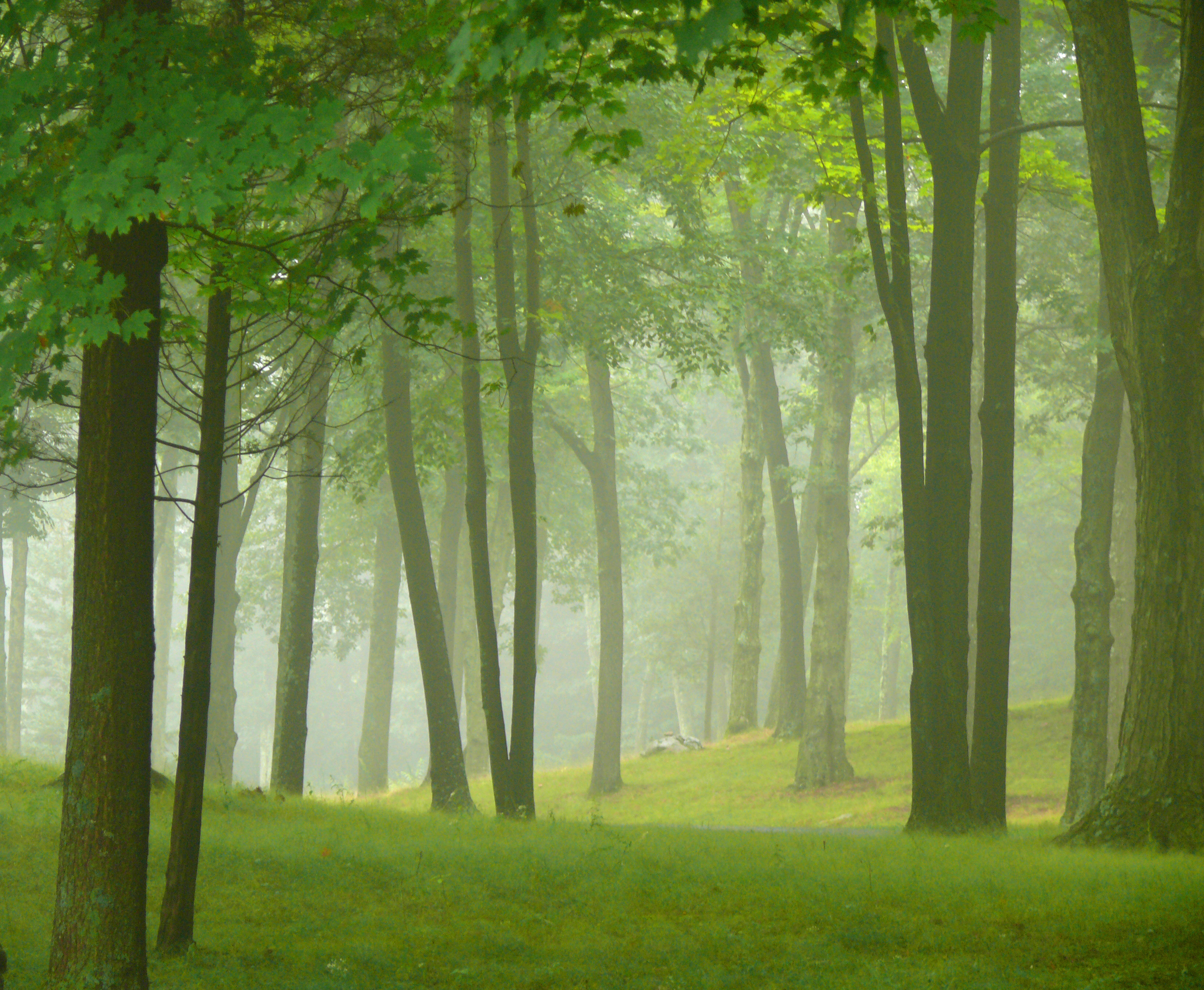
(Click to enlarge)
Welcome to samples of my work in various art forms showcasing “Eye-locks and Other Fearsome Things.” “Eye-locks” is a Bipolar/Asperger’s memoir in narrative form that describes the triumph of love over mental illness.
Dedicated with Gratitude to Didi of Didi’s Art Design
Didi, A selection of my favorite photos of upstate New York State and Delhi and other places in India to thank you for your time and effort and wishes and prayers… Love, Ellen
(Click on images to enlarge)
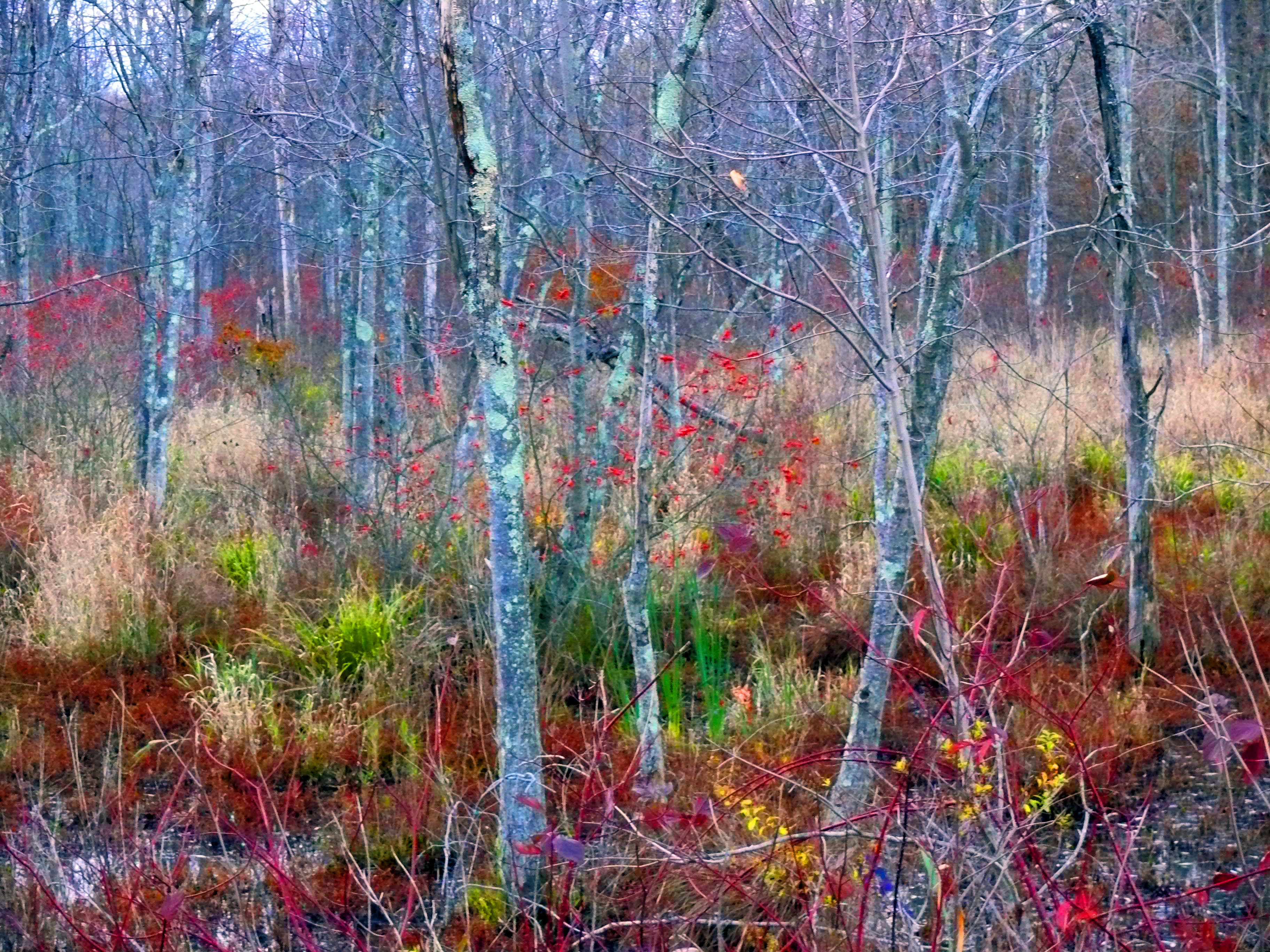




Winter Scenes, Millbrook, New York
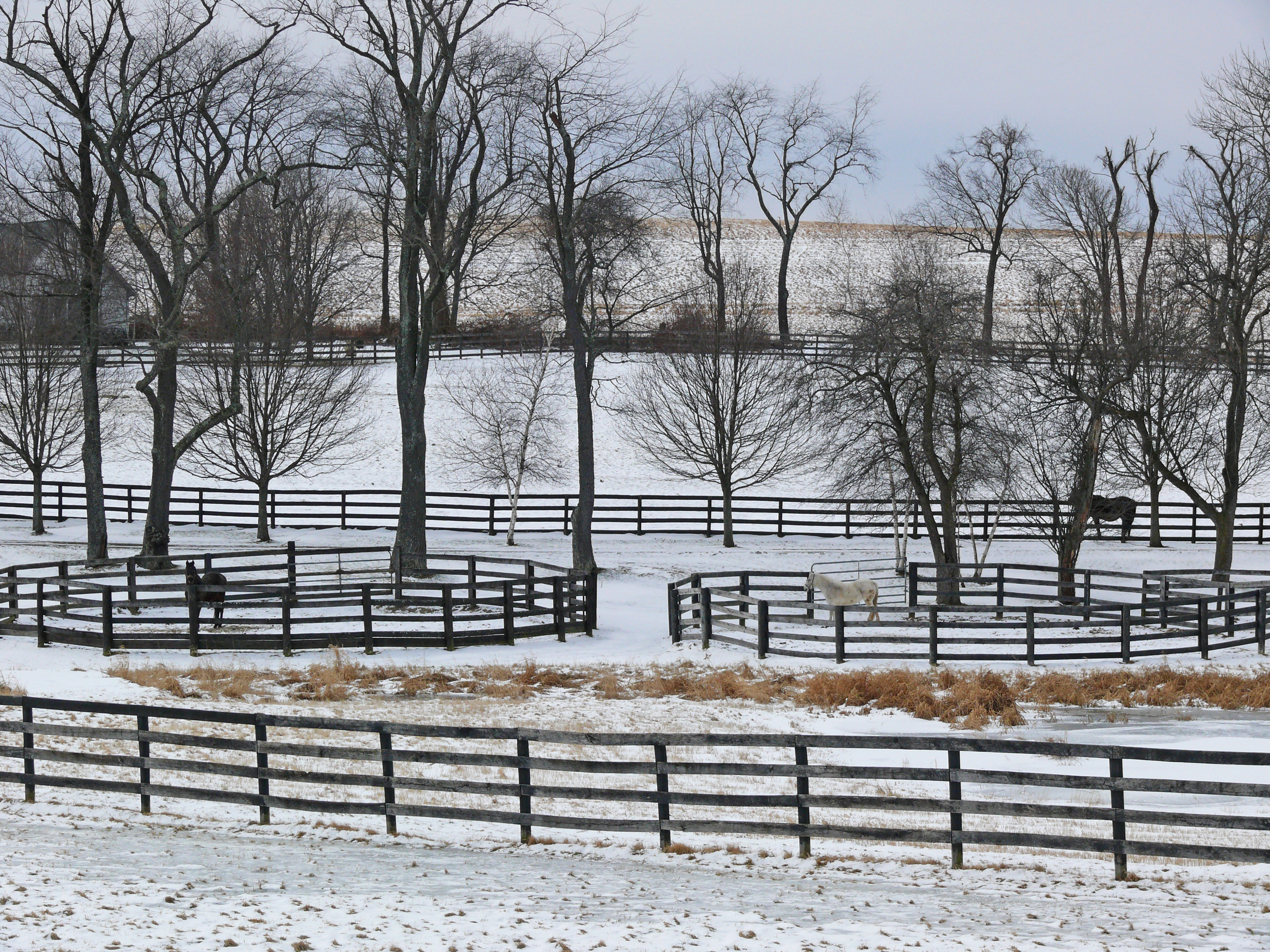
(Click to enlarge.)

Welcome to samples of my work in various art forms showcasing “Eye-locks and Other Fearsome Things.” “Eye-locks” is a Bipolar/Asperger’s memoir in narrative form that describes the triumph of love over mental illness.
(Click to enlarge.)
JOY * PEACE * LOVE

(Click to enlarge)
Welcome to samples of my writing and art work showcasing “Eye-locks and Other Fearsome Things.” “Eye-locks” is a Bipolar/Asperger’s memoir in narrative form that describes the triumph of love over mental illness.
The Edge of Winter
(Click to enlarge)
It is an overcast day. Brightly colored birds stand out like jewels in the greyness. The winter birds– jays and cardinals, juncos, black-capped chickadees, white-breasted nuthatches and downy woodpeckers flock to the bird feeder and it has to be filled up almost every day. The red berries on the bushes are nearly all gone and the feeder is becoming a matter of survival. On our walks we see empty nests held in the bare arms of winter trees. An empty robin’s nest is filled with snow– the hatchlings and the mother long gone to fairer climes. The trees are stripped down to their souls. With ice storms they become tinkling chandeliers. In the rain the few remaining dead leaves drip icy tear drops.
Occasionally a dove visits the feeder. The chipmunk, who gathered scattered seeds under the feeder all fall, is not to be seen. He must be in torpor in his den. According to Bernd Heinrich in: The Winter World: the Ingenuity of Animal Survival, the eastern chipmunk builds a twelve foot storage system with a nest chamber some three feet down and a tunnel system which includes a food storage chamber. Heinrich says chipmunks go in and out of torpor. He reasons that they would not gather food if they were to be in torpor all winter long. We will probably not see our chipmunk for the rest of the winter for, in his stuporous state, he would be easy prey. However he can be roused to eat and venture outdoors if need be, especially in March when there still may be snow on the ground but mating season begins.
The grey squirrels are busy clearing snow from branches as they run along tree limbs. On the ground they dig through the snow for the walnuts we watched them bury in the ground with their noses this fall. They do not need to hibernate for they have food stores which they built up in the autumn and leafy, well-insulated nests. The red squirrels survive winter by putting on a thick, insulating fur.
The back yard is a maze of tunnels. We think they are deer mouse tunnels as many have tunneled their way into our house. But they must get by the feral cat who sometimes waits out a snow storm under our deck. In the woods, the occasional deer waits out the same storm under a squat fir tree. The tracks in the snow tell the story of how they weathered a Nor’Easter.
Beneath the tracks in the snow, in the frozen leaf litter, the insect world is dormant. Some hibernate. Others fill their bodies with antifreeze, glycerol, to stay alive. Heinrich talks about woolly bears hibernating but they are also capable of freezing solid and surviving, coming to life again as they thaw in the spring. The pupae, however, don’t survive being frozen.
In Winter: an Ecological Handbook, authors, James C. Halfpenny, Elizabeth Besiot and Roy Douglas Ozonne, tell us that the reptiles and amphibians pick out a “microclimate for hibernation that does not freeze” for their winter, such as the “bottoms of ponds, streams, or deep in the ground.”
Our stream flows out back in the marsh under ice and snow and one can see the elongated bubbles of running water. In the pond next door the turtles lay beneath the ice in their hibernacula. At the end of the book, The Year of the Turtle, David M. Carroll, the naturalist, author and artist, has his watercolor of a spotted turtle hibernating. This picture is hypnotic and in its spell, I think of all the animals hibernating beneath our feet in lugubrious gloom. It reminds me of the penguins in the film, The March of the Penguins, in the dead of an Antarctic winter, huddled together for warmth in the harsh, strong winds and snow, taking turns being on the outside of the huddle. Winter can be magnificent in its transformations yet tragic in its harshness: hibernating animals who freeze to death and deer starving to death in the snow among the victims of its violence.
Carroll’s drawing shows the turtle all alone, withdrawn into its shell under less than two feet of water lodged firmly in the mud under ice under snow in a sunny winter’s day, a far better clime than the penguin’s– and yet it evokes a certain sadness for this little creature all alone beneath the snow, in a torpid state. The turtle is missing out on a sunny day, sleeping a deep sleep in a “half year of stillness.”
Carroll’s writing is sheer poetry as he describes the turtle’s hibernation: “Mounting layers of snow silently cover the ice. Night after night in the harshest depth of winter, as Orion and the Pleiades burn distant and brilliant in the black sky and strong winds howl off the mountain to the northwest, the turtles rest beneath the ice. With the life in them nearly suspended, reduced to its most tenuous hold, all but extinct in the vast, inhospitable regime that reaches above them to the limits of the universe, they lie within their shells, waiting for the earth to make its required turnings and return them to the sun that will awaken them to another season.”
I think of the turtles below, along with all the other beautiful creatures. I wish them a kind sleep from which they will safely stir with the life force surging through their veins as the sun brings them to the fullness of life again. The death of some, and the half life of so many, proffers the poignancy of winter.
(Click to enlarge)
Welcome to samples of my writing and art work showcasing “Eye-locks and Other Fearsome Things.” “Eye-locks” is a Bipolar/Asperger’s memoir in narrative form that describes the triumph of love over mental illness.











 MOONSIDE
You must be logged in to post a comment.